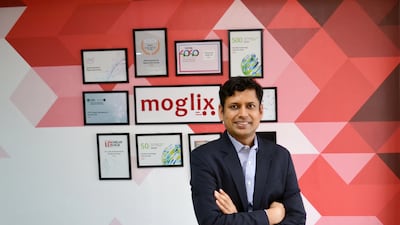
Rahul Garg, Moglix’s founder and chief executive, says the company aims to use the UAE base as a gateway to the Middle East. Courtesy Moglix

India’s Moglix enters UAE after funding round values it at $1bn


Alkesh Sharma
  • English
  • Arabic

Moglix, an industrial business-to-business marketplace in India, has entered the UAE market after raising $120 million in its latest funding round that valued the company at $1 billion.

The company is operating out the Khalifa Port Free Trade Zone in Abu Dhabi and plans to expand operations across the Middle East, it said in a statement.

Moglix is rolling out its B2B e-commerce platform, moglix.ae, that provides a digital catalogue of 500,000 industrial products across more than 50 categories. The platform will be fully operational in a few months, the company said.

“We are excited to enter the UAE ... [which] is a gateway to the GCC and a major hub of global commerce and innovation with a vision to transform into a digital economy,” Moglix’s founder and chief executive Rahul Garg said.

“The UAE government’s mission and investment in digital upskilling is unmatched and we are looking to collaborate with local talent to jointly drive digital transformation.”

Moglix provides solutions to more than 500,000 small and medium enterprises and 3,000 manufacturing plants. The start-up has raised $220m in financing to date giving it a $1bn valuation following a a Series E funding round, which was led by Falcon Edge Capital through their Abu Dhabi based Alpha Wave Ventures.

The company, which runs a network of more than 16,000 suppliers over 35 warehouses and logistics infrastructure, helps companies across the manufacturing and oil and gas sectors with end-to-end supply chain solutions from procurement to distribution.

Moglix connects suppliers with a fragmented buyer base through its data science-driven technology. The company said it aims to build a digital operating system in the UAE that is closely aligned with the digital initiative of the Emirates.

“Moglix demonstrates immense value addition to the manufacturing sector and has proven tangible ROI [return on investment] in India, which can be scaled globally, and is building a business with robust and sustainable unit economics,” Navroz D Udwadia, co-founder of Falcon Edge Capital, an investor in Moglix, said.

There are “significant procurement and efficiency benefits to buyers as well as scale and reach benefits to suppliers," he said.


The burning issue

The internal combustion engine is facing a watershed moment – major manufacturer Volvo is to stop producing petroleum-powered vehicles by 2021 and countries in Europe, including the UK, have vowed to ban their sale before 2040. The National takes a look at the story of one of the most successful technologies of the last 100 years and how it has impacted life in the UAE. 

Read part four: an affection for classic cars lives on

Read part three: the age of the electric vehicle begins

Read part two: how climate change drove the race for an alternative 

Who's who in Yemen conflict

Houthis: Iran-backed rebels who occupy Sanaa and run unrecognised government

Yemeni government: Exiled government in Aden led by eight-member Presidential Leadership Council

Southern Transitional Council: Faction in Yemeni government that seeks autonomy for the south

Habrish 'rebels': Tribal-backed forces feuding with STC over control of oil in government territory

Mercer, the investment consulting arm of US services company Marsh & McLennan, expects its wealth division to at least double its assets under management (AUM) in the Middle East as wealth in the region continues to grow despite economic headwinds, a company official said.

Mercer Wealth, which globally has $160 billion in AUM, plans to boost its AUM in the region to $2-$3bn in the next 2-3 years from the present $1bn, said Yasir AbuShaban, a Dubai-based principal with Mercer Wealth.

Within the next two to three years, we are looking at reaching $2 to $3 billion as a conservative estimate and we do see an opportunity to do so,” said Mr AbuShaban.

Mercer does not directly make investments, but allocates clients’ money they have discretion to, to professional asset managers. They also provide advice to clients.

“We have buying power. We can negotiate on their (client’s) behalf with asset managers to provide them lower fees than they otherwise would have to get on their own,” he added.

Mercer Wealth’s clients include sovereign wealth funds, family offices, and insurance companies among others.

From its office in Dubai, Mercer also looks after Africa, India and Turkey, where they also see opportunity for growth.

Wealth creation in Middle East and Africa (MEA) grew 8.5 per cent to $8.1 trillion last year from $7.5tn in 2015, higher than last year’s global average of 6 per cent and the second-highest growth in a region after Asia-Pacific which grew 9.9 per cent, according to consultancy Boston Consulting Group (BCG). In the region, where wealth grew just 1.9 per cent in 2015 compared with 2014, a pickup in oil prices has helped in wealth generation.

BCG is forecasting MEA wealth will rise to $12tn by 2021, growing at an annual average of 8 per cent.

Drivers of wealth generation in the region will be split evenly between new wealth creation and growth of performance of existing assets, according to BCG.

Another general trend in the region is clients’ looking for a comprehensive approach to investing, according to Mr AbuShaban.

“Institutional investors or some of the families are seeing a slowdown in the available capital they have to invest and in that sense they are looking at optimizing the way they manage their portfolios and making sure they are not investing haphazardly and different parts of their investment are working together,” said Mr AbuShaban.

Some clients also have a higher appetite for risk, given the low interest-rate environment that does not provide enough yield for some institutional investors. These clients are keen to invest in illiquid assets, such as private equity and infrastructure.

“What we have seen is a desire for higher returns in what has been a low-return environment specifically in various fixed income or bonds,” he said.

“In this environment, we have seen a de facto increase in the risk that clients are taking in things like illiquid investments, private equity investments, infrastructure and private debt, those kind of investments were higher illiquidity results in incrementally higher returns.”

The Abu Dhabi Investment Authority, one of the largest sovereign wealth funds, said in its 2016 report that has gradually increased its exposure in direct private equity and private credit transactions, mainly in Asian markets and especially in China and India. The authority’s private equity department focused on structured equities owing to “their defensive characteristics.”

Frankenstein in Baghdad
Ahmed Saadawi
​​​​​​​Penguin Press

Movie: Saheb, Biwi aur Gangster 3

Producer: JAR Films

Director: Tigmanshu Dhulia

Cast: Sanjay Dutt, Jimmy Sheirgill, Mahie Gill, Chitrangda Singh, Kabir Bedi

Rating: 3 star

Updated: August 18, 2021, 4:49 AM