10 tips for entry-level job seekers
- Have an up-to-date, professional LinkedIn profile. If you don’t have a LinkedIn account, set one up today. Avoid poor-quality profile pictures with distracting backgrounds. Include a professional summary and begin to grow your network.
- Keep track of the job trends in your sector through the news. Apply for job alerts at your dream organisations and the types of jobs you want – LinkedIn uses AI to share similar relevant jobs based on your selections.
- Double check that you’ve highlighted relevant skills on your resume and LinkedIn profile.
- For most entry-level jobs, your resume will first be filtered by an applicant tracking system for keywords. Look closely at the description of the job you are applying for and mirror the language as much as possible (while being honest and accurate about your skills and experience).
- Keep your CV professional and in a simple format – make sure you tailor your cover letter and application to the company and role.
- Go online and look for details on job specifications for your target position. Make a list of skills required and set yourself some learning goals to tick off all the necessary skills one by one.
- Don’t be afraid to reach outside your immediate friends and family to other acquaintances and let them know you are looking for new opportunities.
- Make sure you’ve set your LinkedIn profile to signal that you are “open to opportunities”. Also be sure to use LinkedIn to search for people who are still actively hiring by searching for those that have the headline “I’m hiring” or “We’re hiring” in their profile.
- Prepare for online interviews using mock interview tools. Even before landing interviews, it can be useful to start practising.
- Be professional and patient. Always be professional with whoever you are interacting with throughout your search process, this will be remembered. You need to be patient, dedicated and not give up on your search. Candidates need to make sure they are following up appropriately for roles they have applied.
Arda Atalay, head of Mena private sector at LinkedIn Talent Solutions, Rudy Bier, managing partner of Kinetic Business Solutions and Ben Kinerman Daltrey, co-founder of KinFitz
The Covid-19 pandemic disrupted the jobs market globally in 2020, with many companies laying off or furloughing employees to reduce operating costs. This also had an impact on fresh graduates trying to land entry-level jobs in the middle of the pandemic, according to experts.
Aside from having to compete with experienced workers who had lost their jobs, new graduates also had to contend with limited job openings as many industries directly hit by the pandemic imposed a hiring freeze until business conditions improved. However, with economies gradually opening up around the world, the job prospects for graduates are brighter in 2021.
This also rings true for the UAE, where the top industries currently hiring fresh graduates are advertising, marketing and public relations, health care and medical services, and the military, defence and police sectors, according to the 2021 Fresh Graduates in the Middle East and North Africa survey conducted by jobs site Bayt.com and market research company YouGov.
“2020 has been a challenging year for professionals across all industries and career levels. Yet, the job market is gradually reviving,” says Ola Haddad, director of human resources at Bayt.com.
“We expect the prospects for employment to increase for all professionals in the next few months, especially for fresh graduates, as our recent survey shows that more and more companies are opening their doors to entry-level professionals.”
Computer skills (58 per cent), communication skills (49 per cent) and interpersonal/team skills (35 per cent) emerged as the most important skills required to excel in the UAE workplace, according to the survey.
Employment opportunities are also increasing in general business and finance, LinkedIn's Economic Graph data revealed.
"As the government lifts restrictions to ease economic recovery, we are witnessing increasing footfall in entertainment venues and retail organisations, leading to them once again rehiring staff to keep up with the influx of customers and visitors," Arda Atalay, head of Mena private sector at LinkedIn Talent Solutions, tells The National.
Other UAE industries currently hiring professionals at all levels include e-commerce and technology sectors such as software engineering, cyber security, web development and design, Mr Atalay adds.
Companies are interested in bringing on employees who can demonstrate strength in softer skills such as analytical skills, project management, marketing, time management and customer service
“The modern workplace is now wholly dependent on digitising business operations as many employees do remote work. Businesses have realised particular competencies are essential to continue operations. So specific digital, adaptive, social and cognitive skills have gained importance,” Ms Haddad says.
Although each job may have minimum requirements, such as coursework or certifications and internship experience – companies are also interested in hiring employees who can demonstrate strength in softer skills such as analytics, project management, marketing, time management and customer service, LinkedIn’s Mr Atalay says.
We spoke to recruitment experts in top industries hiring fresh graduates in the UAE about what skills are most in-demand, the type of entry-level jobs available and compensation packages offered.
Medical/healthcare jobs
The Covid-19 pandemic put the spotlight on the global healthcare and pharmaceuticals industry, leading to increasing demand for such professionals.
The GCC pharmaceuticals and medical device sectors are enjoying strong growth, which means there are job opportunities available for fresh graduates, according to Rudy Bier, managing partner of Kinetic Business Solutions, which sources professionals for this sector.
“The Covid-19 pandemic has hit the sector in different ways: some of the sub-sectors, such as medical devices for elective surgeries, have been negatively affected as all of these were put on hold. However, in-vitro diagnostic, lab and ICU areas of the business have seen a positive growth due to the pandemic and its increased demands,” Mr Bier says.
Typically, graduates are hired for roles as product/sales specialists (marketing/sales), biomedical engineers, regulatory affairs, business support (HR/accounting), clinical research and pharmacovigilance associates in these industries, Mr Bier says.
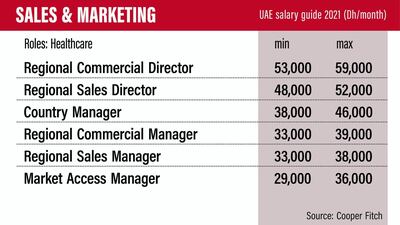
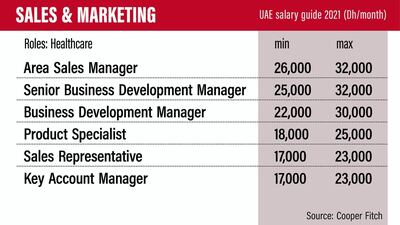
The salaries vary depending on the size of the company and type, whether it’s a multi-national player or a locally owned distributor. However, as standard, a graduate product/sales specialist can expect a starting salary from Dh8,000 ($2,178) to Dh14,000 a month, which includes basic salary, housing and transport plus a bonus or commission.
Meanwhile, regulatory affairs and pharmacovigilance associates can expect upwards of Dh8,000 a month, which includes basic salary, housing and transport, according to data from Kinetic Business Solutions.
“Besides a flexible working model, which has been adapted by the majority of our pharmaceutical and medical devices clients, candidates can expect annual flight allowances, excellent bonus packages and/or commission and, in some cases, car and housing allowances,” Mr Bier says.
Employers in these industries are seeking graduates with excellent communication skills, dedication, a great attitude and willingness to learn. They should also continue to increase their value through education – this will open up opportunities for promotions within the organisation, Mr Bier says.
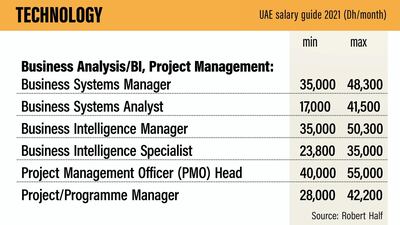
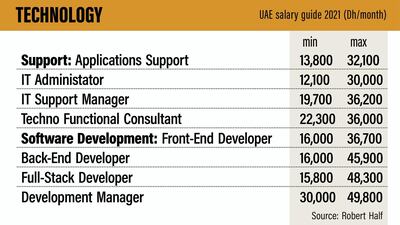
Technology jobs
The Covid-19 pandemic accelerated the need for businesses globally to digitise operations, resulting in increased demand for technology professionals.
“Software engineering and user experience design/user interface design companies are currently offering internships for fresh graduates and even individuals who have no formal qualifications,” says Bradley Maasdorp, DevOps and cloud lead (permanent recruitment) at AIQU Search, a division of TASC Outsourcing that focuses on technology recruitments.
Although salaries vary from company to company, the most commonly offered perks for interns in these industries include a visa, medical insurance, 12-month internship that pays Dh1,000 per month and then an offer of full-time employment to successful graduates, Mr Maasdorp says.
Those who have more than two years of commercial technology experience can expect to be paid a salary in the region of Dh8,000 to Dh12,000, he says.
“The most sought-after skill sets for entry-level jobs are software engineering and design. Companies are most interested in the willingness to learn and individuals who have a ‘can do’ attitude,” he says.
Fresh tech graduates are advised to be active on LinkedIn, research various technology sectors in the Middle East and North Africa and Gulf regions and find an industry that aligns with their career aspirations.
“Connect with decision makers in those companies and engage with them. We are all human and there is no hierarchy in humanity,” Mr Maasdorp adds.
SME jobs
More than 400,000 small and medium-sized enterprises currently operate in the UAE. They represent more than 60 per cent of the UAE’s non-oil economy and provide employment opportunities for 86 per cent of the workforce in the private sector, according to the Khalifa Fund.
“There are a lot of entry-level opportunities for those interested in sales,” says Ben Kinerman Daltrey, co-founder of KinFitz, a sales recruitment, training and coaching business that works with start-ups and SMEs. “Many start-ups in the region seek to recruit talented entry-level sales professionals with an open mind, positive attitude and a hunger to learn and grow.”
They also look for initiative, enthusiasm, motivation and humility, he adds.
Software engineering and user experience design/user interface design companies are currently offering internships for fresh graduates
There are also many opportunities for technology professionals in all technology areas, and there is a shortage of qualified people to fill these roles, Mr Kinerman says.
Anyone interested in entering the tech industry can sign up for affordable bootcamps and platforms to learn coding languages.
Although salaries at SMEs and start-ups can vary depending on the opportunity, he advises fresh graduates or entry-level employees to look at the growth opportunities and learning they can get from the business rather than focusing too closely on salary from day one.
“Have a look at other graduates who joined the company. Where are they now? How long did it take them to progress? What skills have they learned? Use that as a gauge for an opportunity. I would consider your first job as an extension to university. It is important to find an environment you can continue to grow,” he says.
Fresh graduates will often take on multiple roles and responsibilities, offering them plenty of learning and growth opportunities. “The skills you learn from wearing numerous hats will allow you to progress quickly in your career,” Mr Kinerman says.
Working for a start-up usually means that fresh graduates are part of a small team, allowing them to work alongside leaders, which also boosts their career development, according to Mr Kinerman.
“Start-ups with small teams usually offer great flexibility. They focus on the overall impact of the employee as opposed to their sign-on and off times,” he adds.
2025 Fifa Club World Cup groups
Group A: Palmeiras, Porto, Al Ahly, Inter Miami.
Group B: Paris Saint-Germain, Atletico Madrid, Botafogo, Seattle.
Group C: Bayern Munich, Auckland City, Boca Juniors, Benfica.
Group D: Flamengo, ES Tunis, Chelsea, Leon.
Group E: River Plate, Urawa, Monterrey, Inter Milan.
Group F: Fluminense, Borussia Dortmund, Ulsan, Mamelodi Sundowns.
Group G: Manchester City, Wydad, Al Ain, Juventus.
Group H: Real Madrid, Al Hilal, Pachuca, Salzburg.
The biog
Marital status: Separated with two young daughters
Education: Master's degree from American Univeristy of Cairo
Favourite book: That Is How They Defeat Despair by Salwa Aladian
Favourite Motto: Their happiness is your happiness
Goal: For Nefsy to become his legacy long after he is gon
Profile of Foodics
Founders: Ahmad AlZaini and Mosab AlOthmani
Based: Riyadh
Sector: Software
Employees: 150
Amount raised: $8m through seed and Series A - Series B raise ongoing
Funders: Raed Advanced Investment Co, Al-Riyadh Al Walid Investment Co, 500 Falcons, SWM Investment, AlShoaibah SPV, Faith Capital, Technology Investments Co, Savour Holding, Future Resources, Derayah Custody Co.
BULKWHIZ PROFILE
Date started: February 2017
Founders: Amira Rashad (CEO), Yusuf Saber (CTO), Mahmoud Sayedahmed (adviser), Reda Bouraoui (adviser)
Based: Dubai, UAE
Sector: E-commerce
Size: 50 employees
Funding: approximately $6m
Investors: Beco Capital, Enabling Future and Wain in the UAE; China's MSA Capital; 500 Startups; Faith Capital and Savour Ventures in Kuwait
The more serious side of specialty coffee
While the taste of beans and freshness of roast is paramount to the specialty coffee scene, so is sustainability and workers’ rights.
The bulk of genuine specialty coffee companies aim to improve on these elements in every stage of production via direct relationships with farmers. For instance, Mokha 1450 on Al Wasl Road strives to work predominantly with women-owned and -operated coffee organisations, including female farmers in the Sabree mountains of Yemen.
Because, as the boutique’s owner, Garfield Kerr, points out: “women represent over 90 per cent of the coffee value chain, but are woefully underrepresented in less than 10 per cent of ownership and management throughout the global coffee industry.”
One of the UAE’s largest suppliers of green (meaning not-yet-roasted) beans, Raw Coffee, is a founding member of the Partnership of Gender Equity, which aims to empower female coffee farmers and harvesters.
Also, globally, many companies have found the perfect way to recycle old coffee grounds: they create the perfect fertile soil in which to grow mushrooms.
Tips for job-seekers
- Do not submit your application through the Easy Apply button on LinkedIn. Employers receive between 600 and 800 replies for each job advert on the platform. If you are the right fit for a job, connect to a relevant person in the company on LinkedIn and send them a direct message.
- Make sure you are an exact fit for the job advertised. If you are an HR manager with five years’ experience in retail and the job requires a similar candidate with five years’ experience in consumer, you should apply. But if you have no experience in HR, do not apply for the job.
David Mackenzie, founder of recruitment agency Mackenzie Jones Middle East
BIO
Favourite holiday destination: Turkey - because the government look after animals so well there.
Favourite film: I love scary movies. I have so many favourites but The Ring stands out.
Favourite book: The Lord of the Rings. I didn’t like the movies but I loved the books.
Favourite colour: Black.
Favourite music: Hard rock. I actually also perform as a rock DJ in Dubai.
MATCH INFO
Uefa Champions League semi-finals, first leg
Liverpool v Roma
When: April 24, 10.45pm kick-off (UAE)
Where: Anfield, Liverpool
Live: BeIN Sports HD
Second leg: May 2, Stadio Olimpico, Rome
APPLE IPAD MINI (A17 PRO)
Display: 21cm Liquid Retina Display, 2266 x 1488, 326ppi, 500 nits
Chip: Apple A17 Pro, 6-core CPU, 5-core GPU, 16-core Neural Engine
Storage: 128/256/512GB
Main camera: 12MP wide, f/1.8, digital zoom up to 5x, Smart HDR 4
Front camera: 12MP ultra-wide, f/2.4, Smart HDR 4, full-HD @ 25/30/60fps
Biometrics: Touch ID, Face ID
Colours: Blue, purple, space grey, starlight
In the box: iPad mini, USB-C cable, 20W USB-C power adapter
Price: From Dh2,099
Avatar: Fire and Ash
Director: James Cameron
Starring: Sam Worthington, Sigourney Weaver, Zoe Saldana
Rating: 4.5/5
Results
6.30pm: Maiden Dh165,000 (Dirt) 1,200m
Winner: Barack Beach, Richard Mullen (jockey), Satish Seemar (trainer).
7.05pm: Handicap Dh170,000 (D) 1,200m
Winner: Way Of Wisdom, Connor Beasley, Satish Seemar.
7.40pm: Maiden Dh165,000 (D) 1,900m
Winner: Woodditton, Connor Beasley, Ahmad bin Harmash.
8.15pm: Handicap Dh185,000 (D) 2,000m
Winner: Secret Trade, Sandro Paiva, Ali Rashid Al Raihe.
8.50pm: Handicap Dh185,000 (D) 1,600m
Winner: Mark Of Approval, Antonio Fresu, Mahmood Hussain.
9.25pm: Handicap Dh165,000 (D) 2,000m
Winner: Tradesman, Pat Dobbs, Doug Watson.
MATCH INFO
FA Cup final
Chelsea 1
Hazard (22' pen)
Manchester United 0
Man of the match: Eden Hazard (Chelsea)
Mercer, the investment consulting arm of US services company Marsh & McLennan, expects its wealth division to at least double its assets under management (AUM) in the Middle East as wealth in the region continues to grow despite economic headwinds, a company official said.
Mercer Wealth, which globally has $160 billion in AUM, plans to boost its AUM in the region to $2-$3bn in the next 2-3 years from the present $1bn, said Yasir AbuShaban, a Dubai-based principal with Mercer Wealth.
“Within the next two to three years, we are looking at reaching $2 to $3 billion as a conservative estimate and we do see an opportunity to do so,” said Mr AbuShaban.
Mercer does not directly make investments, but allocates clients’ money they have discretion to, to professional asset managers. They also provide advice to clients.
“We have buying power. We can negotiate on their (client’s) behalf with asset managers to provide them lower fees than they otherwise would have to get on their own,” he added.
Mercer Wealth’s clients include sovereign wealth funds, family offices, and insurance companies among others.
From its office in Dubai, Mercer also looks after Africa, India and Turkey, where they also see opportunity for growth.
Wealth creation in Middle East and Africa (MEA) grew 8.5 per cent to $8.1 trillion last year from $7.5tn in 2015, higher than last year’s global average of 6 per cent and the second-highest growth in a region after Asia-Pacific which grew 9.9 per cent, according to consultancy Boston Consulting Group (BCG). In the region, where wealth grew just 1.9 per cent in 2015 compared with 2014, a pickup in oil prices has helped in wealth generation.
BCG is forecasting MEA wealth will rise to $12tn by 2021, growing at an annual average of 8 per cent.
Drivers of wealth generation in the region will be split evenly between new wealth creation and growth of performance of existing assets, according to BCG.
Another general trend in the region is clients’ looking for a comprehensive approach to investing, according to Mr AbuShaban.
“Institutional investors or some of the families are seeing a slowdown in the available capital they have to invest and in that sense they are looking at optimizing the way they manage their portfolios and making sure they are not investing haphazardly and different parts of their investment are working together,” said Mr AbuShaban.
Some clients also have a higher appetite for risk, given the low interest-rate environment that does not provide enough yield for some institutional investors. These clients are keen to invest in illiquid assets, such as private equity and infrastructure.
“What we have seen is a desire for higher returns in what has been a low-return environment specifically in various fixed income or bonds,” he said.
“In this environment, we have seen a de facto increase in the risk that clients are taking in things like illiquid investments, private equity investments, infrastructure and private debt, those kind of investments were higher illiquidity results in incrementally higher returns.”
The Abu Dhabi Investment Authority, one of the largest sovereign wealth funds, said in its 2016 report that has gradually increased its exposure in direct private equity and private credit transactions, mainly in Asian markets and especially in China and India. The authority’s private equity department focused on structured equities owing to “their defensive characteristics.”
Wonka
%3Cp%3E%3Cstrong%3EDirector%3A%3C%2Fstrong%3E%C2%A0Paul%20King%3C%2Fp%3E%0A%3Cp%3E%3Cstrong%3EStarring%3A%C2%A0%3C%2Fstrong%3ETimothee%20Chalamet%2C%20Olivia%20Colman%2C%20Hugh%20Grant%3C%2Fp%3E%0A%3Cp%3E%3Cstrong%3ERating%3A%3C%2Fstrong%3E%202%2F5%3C%2Fp%3E%0A
10 tips for entry-level job seekers
- Have an up-to-date, professional LinkedIn profile. If you don’t have a LinkedIn account, set one up today. Avoid poor-quality profile pictures with distracting backgrounds. Include a professional summary and begin to grow your network.
- Keep track of the job trends in your sector through the news. Apply for job alerts at your dream organisations and the types of jobs you want – LinkedIn uses AI to share similar relevant jobs based on your selections.
- Double check that you’ve highlighted relevant skills on your resume and LinkedIn profile.
- For most entry-level jobs, your resume will first be filtered by an applicant tracking system for keywords. Look closely at the description of the job you are applying for and mirror the language as much as possible (while being honest and accurate about your skills and experience).
- Keep your CV professional and in a simple format – make sure you tailor your cover letter and application to the company and role.
- Go online and look for details on job specifications for your target position. Make a list of skills required and set yourself some learning goals to tick off all the necessary skills one by one.
- Don’t be afraid to reach outside your immediate friends and family to other acquaintances and let them know you are looking for new opportunities.
- Make sure you’ve set your LinkedIn profile to signal that you are “open to opportunities”. Also be sure to use LinkedIn to search for people who are still actively hiring by searching for those that have the headline “I’m hiring” or “We’re hiring” in their profile.
- Prepare for online interviews using mock interview tools. Even before landing interviews, it can be useful to start practising.
- Be professional and patient. Always be professional with whoever you are interacting with throughout your search process, this will be remembered. You need to be patient, dedicated and not give up on your search. Candidates need to make sure they are following up appropriately for roles they have applied.
Arda Atalay, head of Mena private sector at LinkedIn Talent Solutions, Rudy Bier, managing partner of Kinetic Business Solutions and Ben Kinerman Daltrey, co-founder of KinFitz