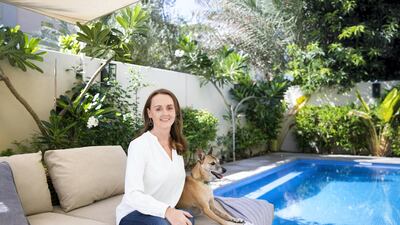
Following a successful career as an accountant, Carol Glynn pursued an ambition to launch her own business.
Conscious Finance Coaching went live in July, primarily with a vision to empower women to take better control of and enjoy their money.
Ms Glynn, 39, was born in Ireland and moved to the UAE 11 years ago with a job in Abu Dhabi and then Dubai.
She lives in The Meadows with her husband, who works in golf tournaments management, their daughter, aged eight, and seven-year-old twin boys.
How did your upbringing shape your attitude towards money?
I have four brothers and we grew up in a small Irish town. My dad has a courier business, has always worked for himself, and my mother was a dressmaker. All my relations were entrepreneurs, so I was surrounded by that growing up. Mum managed the money mostly. We weren’t poor, but we never had a lot. There would be no luxuries, we didn’t go on fancy holidays. We always had what we needed, especially when it came to activities and sports. She prioritised how she spent … on what she felt was important in life.
Were you influenced by others creating their own wealth?
It was just what people did. I wanted to work for myself, but my mother would say things like, ‘Work for somebody else because you know you’re going to get paid’. I was very much encouraged to follow the traditional route, which is what I did; got a degree in accounting, went to work for PricewaterhouseCoopers. Looking back, she wanted me to be strong, independent and have my own money. But, I’ve always wanted to work for myself and recently have given into it.
Did you work as a teenager?
My first proper paid job was in the local chip shop, weekends mostly and summer. It was a small town, so there were limited options where you could get a part-time job. I’d have been maybe 16, paid the equivalent of €19 a day (Dh81) for a seven-hour shift.
I had other jobs while at university. I joined PwC at 20, the training contract to get qualified, starting on €12,500 per year.
What prompted your career choices?
I always enjoyed numbers, maths was my favourite subject. Accounting was always the winner for me. In the latter years of my finance career, I’ve had huge opportunities, surrounded by great people.
But I found I wasn’t fulfilled. I finished with a company in the Dubai International Financial Centre in December and said, ‘This is the time for me to make a change’. I love working with people, problem solving and am passionate about female empowerment. There was a really good training course in financial coaching, even though I had all the skills needed to get myself qualified.
I took a huge risk, but my safety net was my experience and my credentials. I believe my skillset will be of huge benefit to women. And men as well.
My number one thing is an emergency fund that I have in cash in an accessible bank account
Is there demand for finance coaching amid the pandemic?
Absolutely. People are becoming more conscious of the uncertainty, of their money, what they're spending, where they're spending and often have more time now to think about it. So many people have had pay cuts.
What is your approach to spending and saving?
I tend to be risk-averse and security is a massive thing; saving enough that I have security. That gave me the ability to do this (coaching), that I could be able to not have an income for a period of time.
I save to the point that I have security and then my next step is investing, but also spending on experiences, travel or a nice dress I want and know it’s a reasonable amount and I can afford. It’s a conscious balance.
How do you save?
My number one thing is an emergency fund that I have in cash in an accessible bank account. I’ve got property in Ireland and we own our house in Dubai. I have exchange-traded funds, bonds and some individual stocks. The plan is to diversify as much as possible.
What has been your best investment?
It’s not going to make me millions, but the first home I bought at 24 in my hometown. It’s holding its value and is constantly rented at a good rate. I never did anything too risky that gave me a great return. Slow and steady is what I do.
What is your most cherished purchase?
Our home that we live in. It’s probably not going to be the best financial decision, but we realised we love it here, the kids are happy, so we set down roots and bought the house. It’s grounding for them and us, and gives that security that you don’t have to move.
Do you have a philosophy about personal finance?
I do and this evolves as you get older and circumstances and priorities change. Having kids really changes how you look at this kind of thing. For years, I thought I needed to make lots of money because I’ll be able to ‘do all these things’. What it really meant was I worked a lot harder, longer, travelled too much and was miserable. So for me, money brings security.
I have my emergency fund, enough that I can pay the mortgage, school fees and am able to give the kids the life and activities they enjoy. After that, it’s about freedom to do things you want to do.
So, do you have a healthier relationship with money?
Money would have been a stress point in my life. For a long time, I had that scarcity mindset of, ‘I always need to be making money’, and not because I want to be spending it on major things. That’s how I operated and kept going in my job and career. I was successful, which was great, but it didn’t bring me happiness.
I never did anything too risky that gave me a great return
Now, I have a much healthier relationship with money in that I see it like an enabler. It’s not the most significant thing, it doesn’t overshadow my life, whereas before it would have been a driver.
Do you pass such wisdom to your children?
I try to subtly do it, just have them thinking about it, the right approach to it. They’re a good age to be introduced to money. We’ve had a ‘have fun with sensible spending October’. There’s so much you can do here that doesn’t have to cost a lot. I like getting the kids thinking of ideas.
How well prepared are you for the future?
Setting up my own business is a risk. Going from a stable income is a change in our plans to what they would have been three years ago. But I’m confident and comfortable in what we have done. We’ve got a diversified portfolio. Where next and what does that look like … that’s the biggest unknown.
If you won Dh1 million, what would you spend it on?
I always had a dream, the five of us taking a year out to travel. I would put money towards that, invest the rest.

Timeline
2012-2015
The company offers payments/bribes to win key contracts in the Middle East
May 2017
The UK SFO officially opens investigation into Petrofac’s use of agents, corruption, and potential bribery to secure contracts
September 2021
Petrofac pleads guilty to seven counts of failing to prevent bribery under the UK Bribery Act
October 2021
Court fines Petrofac £77 million for bribery. Former executive receives a two-year suspended sentence
December 2024
Petrofac enters into comprehensive restructuring to strengthen the financial position of the group
May 2025
The High Court of England and Wales approves the company’s restructuring plan
July 2025
The Court of Appeal issues a judgment challenging parts of the restructuring plan
August 2025
Petrofac issues a business update to execute the restructuring and confirms it will appeal the Court of Appeal decision
October 2025
Petrofac loses a major TenneT offshore wind contract worth €13 billion. Holding company files for administration in the UK. Petrofac delisted from the London Stock Exchange
November 2025
180 Petrofac employees laid off in the UAE
Who's who in Yemen conflict
Houthis: Iran-backed rebels who occupy Sanaa and run unrecognised government
Yemeni government: Exiled government in Aden led by eight-member Presidential Leadership Council
Southern Transitional Council: Faction in Yemeni government that seeks autonomy for the south
Habrish 'rebels': Tribal-backed forces feuding with STC over control of oil in government territory
Mercer, the investment consulting arm of US services company Marsh & McLennan, expects its wealth division to at least double its assets under management (AUM) in the Middle East as wealth in the region continues to grow despite economic headwinds, a company official said.
Mercer Wealth, which globally has $160 billion in AUM, plans to boost its AUM in the region to $2-$3bn in the next 2-3 years from the present $1bn, said Yasir AbuShaban, a Dubai-based principal with Mercer Wealth.
“Within the next two to three years, we are looking at reaching $2 to $3 billion as a conservative estimate and we do see an opportunity to do so,” said Mr AbuShaban.
Mercer does not directly make investments, but allocates clients’ money they have discretion to, to professional asset managers. They also provide advice to clients.
“We have buying power. We can negotiate on their (client’s) behalf with asset managers to provide them lower fees than they otherwise would have to get on their own,” he added.
Mercer Wealth’s clients include sovereign wealth funds, family offices, and insurance companies among others.
From its office in Dubai, Mercer also looks after Africa, India and Turkey, where they also see opportunity for growth.
Wealth creation in Middle East and Africa (MEA) grew 8.5 per cent to $8.1 trillion last year from $7.5tn in 2015, higher than last year’s global average of 6 per cent and the second-highest growth in a region after Asia-Pacific which grew 9.9 per cent, according to consultancy Boston Consulting Group (BCG). In the region, where wealth grew just 1.9 per cent in 2015 compared with 2014, a pickup in oil prices has helped in wealth generation.
BCG is forecasting MEA wealth will rise to $12tn by 2021, growing at an annual average of 8 per cent.
Drivers of wealth generation in the region will be split evenly between new wealth creation and growth of performance of existing assets, according to BCG.
Another general trend in the region is clients’ looking for a comprehensive approach to investing, according to Mr AbuShaban.
“Institutional investors or some of the families are seeing a slowdown in the available capital they have to invest and in that sense they are looking at optimizing the way they manage their portfolios and making sure they are not investing haphazardly and different parts of their investment are working together,” said Mr AbuShaban.
Some clients also have a higher appetite for risk, given the low interest-rate environment that does not provide enough yield for some institutional investors. These clients are keen to invest in illiquid assets, such as private equity and infrastructure.
“What we have seen is a desire for higher returns in what has been a low-return environment specifically in various fixed income or bonds,” he said.
“In this environment, we have seen a de facto increase in the risk that clients are taking in things like illiquid investments, private equity investments, infrastructure and private debt, those kind of investments were higher illiquidity results in incrementally higher returns.”
The Abu Dhabi Investment Authority, one of the largest sovereign wealth funds, said in its 2016 report that has gradually increased its exposure in direct private equity and private credit transactions, mainly in Asian markets and especially in China and India. The authority’s private equity department focused on structured equities owing to “their defensive characteristics.”
Pharaoh's curse
British aristocrat Lord Carnarvon, who funded the expedition to find the Tutankhamun tomb, died in a Cairo hotel four months after the crypt was opened.
He had been in poor health for many years after a car crash, and a mosquito bite made worse by a shaving cut led to blood poisoning and pneumonia.
Reports at the time said Lord Carnarvon suffered from “pain as the inflammation affected the nasal passages and eyes”.
Decades later, scientists contended he had died of aspergillosis after inhaling spores of the fungus aspergillus in the tomb, which can lie dormant for months. The fact several others who entered were also found dead withiin a short time led to the myth of the curse.
'The Coddling of the American Mind: How Good Intentions and Bad Ideas are Setting up a Generation for Failure'
Greg Lukianoff and Jonathan Haidt, Penguin Randomhouse
UAE currency: the story behind the money in your pockets
SPEC%20SHEET%3A%20SAMSUNG%20GALAXY%20S23%20ULTRA
%3Cp%3E%3Cstrong%3EDisplay%3A%3C%2Fstrong%3E%206.8%22%20edge%20quad-HD%2B%20dynamic%20Amoled%202X%2C%20Infinity-O%2C%203088%20x%201440%2C%20500ppi%2C%20HDR10%2B%2C%20120Hz%3C%2Fp%3E%0A%3Cp%3E%3Cstrong%3EProcessor%3A%3C%2Fstrong%3E%204nm%20Qualcomm%20Snapdragon%208%20Gen%202%2C%2064-bit%20octa-core%3C%2Fp%3E%0A%3Cp%3E%3Cstrong%3EMemory%3A%3C%2Fstrong%3E%208%2F12GB%20RAM%3C%2Fp%3E%0A%3Cp%3E%3Cstrong%3EStorage%3A%3C%2Fstrong%3E%20128%2F256%2F512GB%2F1TB%20(only%20128GB%20has%20an%208GB%20RAM%20option)%3C%2Fp%3E%0A%3Cp%3E%3Cstrong%3EPlatform%3A%3C%2Fstrong%3E%20Android%2013%3C%2Fp%3E%0A%3Cp%3E%3Cstrong%3EMain%20camera%3A%3C%2Fstrong%3E%20quad%2012MP%20ultra-wide%20f%2F2.2%20%2B%20200MP%20wide%20f%2F1.7%20%2B%2010MP%20telephoto%20f%2F4.9%20%2B%2010MP%20telephoto%202.4%3B%203x%2F10x%20optical%20zoom%2C%20Space%20Zoom%20up%20to%20100x%3B%20auto%20HDR%2C%20expert%20RAW%3C%2Fp%3E%0A%3Cp%3E%3Cstrong%3EVideo%3A%3C%2Fstrong%3E%208K%4024%2F30fps%2C%204K%4060fps%2C%20full-HD%4060fps%2C%20HD%4030fps%2C%20full-HD%20super%20slo-mo%40960fps%3C%2Fp%3E%0A%3Cp%3E%3Cstrong%3EFront%20camera%3A%3C%2Fstrong%3E%2012MP%20f%2F2.2%3C%2Fp%3E%0A%3Cp%3E%3Cstrong%3EBattery%3A%3C%2Fstrong%3E%205000mAh%2C%20fast%20wireless%20charging%202.0%2C%20Wireless%20PowerShare%3C%2Fp%3E%0A%3Cp%3E%3Cstrong%3EConnectivity%3A%3C%2Fstrong%3E%205G%2C%20Wi-Fi%2C%20Bluetooth%205.2%2C%20NFC%3C%2Fp%3E%0A%3Cp%3E%3Cstrong%3EI%2FO%3A%3C%2Fstrong%3E%20USB-C%3B%20built-in%20Galaxy%20S%20Pen%3C%2Fp%3E%0A%3Cp%3E%3Cstrong%3ESIM%3A%3C%2Fstrong%3E%20single%20nano%20%2F%20nano%20%2B%20eSIM%20%2F%20nano%20%2B%20nano%20%2B%20eSIM%20%2F%20nano%20%2B%20nano%3C%2Fp%3E%0A%3Cp%3E%3Cstrong%3EColours%3A%3C%2Fstrong%3E%20cream%2C%20green%2C%20lavender%2C%20phantom%20black%3B%20online%20exclusives%3A%20graphite%2C%20lime%2C%20red%2C%20sky%20blue%3C%2Fp%3E%0A%3Cp%3E%3Cstrong%3EPrice%3A%3C%2Fstrong%3E%20Dh4%2C949%20for%20256GB%2C%20Dh5%2C449%20for%20512GB%2C%20Dh6%2C449%20for%201TB%3B%20128GB%20unavailable%20in%20the%20UAE%3C%2Fp%3E%0A
Groom and Two Brides
Director: Elie Semaan
Starring: Abdullah Boushehri, Laila Abdallah, Lulwa Almulla
Rating: 3/5
COMPANY%20PROFILE%20
%3Cp%3E%3Cstrong%3ECompany%20name%3A%20%3C%2Fstrong%3ENomad%20Homes%3Cbr%3E%3Cstrong%3EStarted%3A%20%3C%2Fstrong%3E2020%3Cbr%3E%3Cstrong%3EFounders%3A%20%3C%2Fstrong%3EHelen%20Chen%2C%20Damien%20Drap%2C%20and%20Dan%20Piehler%3Cbr%3E%3Cstrong%3EBased%3A%3C%2Fstrong%3E%20UAE%20and%20Europe%3Cbr%3E%3Cstrong%3EIndustry%3C%2Fstrong%3E%3A%20PropTech%3Cbr%3E%3Cstrong%3EFunds%20raised%20so%20far%3A%3C%2Fstrong%3E%20%2444m%3Cbr%3E%3Cstrong%3EInvestors%3A%3C%2Fstrong%3E%20Acrew%20Capital%2C%2001%20Advisors%2C%20HighSage%20Ventures%2C%20Abstract%20Ventures%2C%20Partech%2C%20Precursor%20Ventures%2C%20Potluck%20Ventures%2C%20Knollwood%20and%20several%20undisclosed%20hedge%20funds%3C%2Fp%3E%0A
The specs
Engine: 4.0-litre V8 twin-turbocharged and three electric motors
Power: Combined output 920hp
Torque: 730Nm at 4,000-7,000rpm
Transmission: 8-speed dual-clutch automatic
Fuel consumption: 11.2L/100km
On sale: Now, deliveries expected later in 2025
Price: expected to start at Dh1,432,000
How to avoid crypto fraud
- Use unique usernames and passwords while enabling multi-factor authentication.
- Use an offline private key, a physical device that requires manual activation, whenever you access your wallet.
- Avoid suspicious social media ads promoting fraudulent schemes.
- Only invest in crypto projects that you fully understand.
- Critically assess whether a project’s promises or returns seem too good to be true.
- Only use reputable platforms that have a track record of strong regulatory compliance.
- Store funds in hardware wallets as opposed to online exchanges.
ETFs explained
Exhchange traded funds are bought and sold like shares, but operate as index-tracking funds, passively following their chosen indices, such as the S&P 500, FTSE 100 and the FTSE All World, plus a vast range of smaller exchanges and commodities, such as gold, silver, copper sugar, coffee and oil.
ETFs have zero upfront fees and annual charges as low as 0.07 per cent a year, which means you get to keep more of your returns, as actively managed funds can charge as much as 1.5 per cent a year.
There are thousands to choose from, with the five biggest providers BlackRock’s iShares range, Vanguard, State Street Global Advisors SPDR ETFs, Deutsche Bank AWM X-trackers and Invesco PowerShares.
