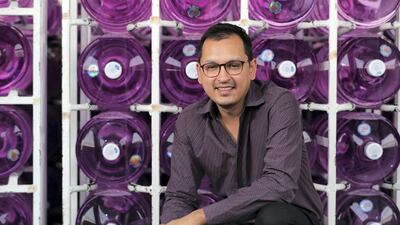
Ashish Bhandari, owner of Aquaplus, says he likes to create an asset and then spend what he earns from that asset. He buys property and spends the rental income earned from the unit. Photo: Chris Whiteoak / The National
Ashish Bhandari, owner of Aquaplus, says he likes to create an asset and then spend what he earns from that asset. He buys property and spends the rental income earned from the unit. Photo: Chris Whit

Money & Me: ‘I regret not investing in Bitcoin 10 years ago’


  • English
  • Arabic

Ashish Bhandari owns Aquaplus, a company that plays healing frequency music to alkaline water, a positive energy technique from Japan before bottling it in BPA-free gallon containers.

Born in India and raised in Dubai, he is also involved in his family's staffing solutions and property investment businesses. He became an entrepreneur at the age of 25 with a luxury car rental business. Now 32, Mr Bhandari lives in Jumeirah with his wife and their two young daughters.

How did your upbringing shape your attitude towards money?

I came here when I was three months old, the youngest of three siblings. A middle-class family, money wasn’t the most important aspect growing up. We led a simple life, played outdoors for entertainment. The importance of sharing and good values was instilled in us.

My father came as a factory worker in the late 1970s. He worked at Daewoo and moved onto his own businesses. Dubai’s economy picked up, he had a great mind and, as an entrepreneur, did the right things at the right time. He was into different ventures and jumped into real estate in the early 2000s. That’s when our family really took off.

Did your lifestyle change?

To an extent. There was a fine line between luxuries and things that were not required. We always had that balance in place, never went overboard. Our family believes in building assets for the future, so whatever he made went more into real estate than a lavish lifestyle. Looking at my father and his instincts as an entrepreneur … from being a kid, I always knew I wanted to have my own business.

When did you earn your first wage?

In college, I did part-time jobs and promotional work at Gitex – Dh4,000 for a week for a 16 or 17 year old, that’s pretty good money. I used to enjoy life, but would try to invest it.

I don't think there'll be an asset [like Bitcoin] on the planet that will give a return like it will over the next decade or so

At about 18, I used to buy number plates, hold them for a while as an asset and then flip them. In Dubai, especially the local community, they take pride in their plates. My father helped me financially. He never stopped us doing something if we were confident about it. That has made me and my older brother confident entrepreneurs … if we believe in what we’re doing, “Go for it, even if you go wrong”.

What was your best deal?

I bought a three-digit plate for Dh420,000, flipped it for half a million and made Dh80,000. It took two or three months. It was my father’s money so I gave it back to him. I ended up losing a lot on plates as well, but my father said “that’s how you learn”. I probably ended up even.

He would never stop us trying something so long as it made sense.

Because I saw him grow from a humble background, I learned there are times when you won’t make money, times when you’ll lose. These kind of things help you in tough times.

What led you to Aquaplus?

We got the opportunity to take over in 2017. The product was very promising, the problem was the backend. I knew if we could spend money and time correcting the basics, this could be something else. Late 2019, we were 90 per cent there and started marketing. We’ve seen 60 per cent to 70 per cent growth since.

Mr Bhandari says he loves spending on cars, holidays and collectible watches that appreciate in value. Photo: Chris Whiteoak / The National

It’s about logistics and customer service. I love the industry and thought about doing something out of the box. If you look inside the five gallon bottle, we’ve written the affirmation “love and gratitude” in English and Arabic on the sticker. We believe in positive energy.

What is your spending and savings outlook?

Save first, then spend. I like creating an asset and what I earn from that asset is what I spend. So, I would buy property and spend the rent from that. I understand there are times that are going to be amazing and times that are going to be tough, so you’ve got to build for the future. That’s kind of the reason I stepped into Aquaplus; it’s an essential sector – play it right, you will grow.

Where do you save?

Number one is property, to keep building that portfolio. For the time being, it’s under the family umbrella; we put into a family pool. I also invest in stocks, more in the India and US markets. The only regret I have is not getting into Bitcoin 10 years ago; I used to read a lot about it in the early 2010s. Of late, pretty much all my savings are going into that. I don’t think there’ll be an asset on the planet that will give a return like it will over the next decade or so.

Do you have a philosophy towards money?

It’s not the only thing that can make you happy. It gives you a better life, you can give more to your children. It’s very important, but not the most important thing over other values such as time with family. Money’s why you work, but it’s not the only thing you look towards in life. There always needs to be a balance.

Did parenthood alter your outlook?

I had a high-risk appetite since I finished college but that mellowed once I had children. You realise it is not just about you. The idea of securing an asset and earning from that really came [after becoming a parent]. I understood the importance of trying to be financially independent.

Do you have spending regrets?

There are a few things I shouldn’t have bought, made mistakes, but I don’t regret because it’s given me something to learn from. I could have been smarter with my money, but I’m not going to kill myself over investing in or buying something I didn’t need. I could have done away with a couple of cars early on and invested that money instead.

What are you happiest spending on?

Cars, holidays and collectible watches that appreciate in value. Going to the India vs Pakistan World Cup match in Manchester in 2019 with my older brother (was special). Apart from material (items), I love playing cricket and golf, collecting cricket bats. When I get the chance, I’ll probably be looking at a Rolls-Royce or Bentley.

I could have done away with a couple of cars early on and invested that money instead

Has the pandemic influenced your business?

Initially, we were worried. Luckily, we did unbelievably well because probably 70 per cent to 80 per cent of Aquaplus’ portfolio is households. When everyone was locked down, water consumption was really high. A lot of people started spending time at home and we made a lot of new customers.

What has been your key financial milestone?

Turning Aquaplus into a profitable venture with the help of a solid team. I learned you need to be patient, do things right, focus on the process … the results will follow.

Are you planning for your future?

Definitely, for another 20 years, keep pushing that goal forward as you move on and try to enjoy life with what you have at that point, making sure you have enough for your children. I don’t think I’ll be able to retire completely at any point, I’ll always be involved in some venture.

What would you raid your savings for?

A family holiday. A month or two in a place like England.

Switching%20sides
%3Cp%3EMahika%20Gaur%20is%20the%20latest%20Dubai-raised%20athlete%20to%20attain%20top%20honours%20with%20another%20country.%0D%3C%2Fp%3E%0A%3Cp%3E%3Cstrong%3EVelimir%20Stjepanovic%20(Serbia%2C%20swimming)%20%3C%2Fstrong%3E%0D%3Cbr%3EBorn%20in%20Abu%20Dhabi%20and%20raised%20in%20Dubai%2C%20he%20finished%20sixth%20in%20the%20final%20of%20the%202012%20Olympic%20Games%20in%20London%20in%20the%20200m%20butterfly%20final.%20%0D%3C%2Fp%3E%0A%3Cp%3E%3Cstrong%3EJonny%20Macdonald%20(Scotland%2C%20rugby%20union)%20%3C%2Fstrong%3E%0D%3Cbr%3EBrought%20up%20in%20Abu%20Dhabi%20and%20represented%20the%20region%20in%20international%20rugby.%20When%20the%20Arabian%20Gulf%20team%20was%20broken%20up%20into%20its%20constituent%20nations%2C%20he%20opted%20to%20play%20for%20Scotland%20instead%2C%20and%20went%20to%20the%20Hong%20Kong%20Sevens.%20%0D%3C%2Fp%3E%0A%3Cp%3E%3Cstrong%3ESophie%20Shams%20(England%2C%20rugby%20union)%20%3C%2Fstrong%3E%0D%3Cbr%3EThe%20daughter%20of%20an%20English%20mother%20and%20Emirati%20father%2C%20Shams%20excelled%20at%20rugby%20in%20Dubai%2C%20then%20after%20attending%20university%20in%20the%20UK%20played%20for%20England%20at%20sevens.%20%0D%3C%2Fp%3E%0A
Result

UAE (S. Tagliabue 90 1') 1-2 Uzbekistan (Shokhruz Norkhonov 48', 86')

COMPANY%20PROFILE
%3Cp%3E%3Cstrong%3ECompany%20name%3A%3C%2Fstrong%3E%20Dresos%3C%2Fp%3E%0A%3Cp%3E%3Cstrong%3EStarted%3A%3C%2Fstrong%3E%20September%202020%3C%2Fp%3E%0A%3Cp%3E%3Cstrong%3EFounders%3A%3C%2Fstrong%3E%20Vladimir%20Radojevic%20and%20Aleksandar%20Jankovic%3C%2Fp%3E%0A%3Cp%3E%3Cstrong%3EBased%3A%3C%2Fstrong%3E%20Dubai%2C%20UAE%3C%2Fp%3E%0A%3Cp%3E%3Cstrong%3EIndustry%3A%3C%2Fstrong%3E%20Fashion%3C%2Fp%3E%0A%3Cp%3E%3Cstrong%3EFunding%3A%3C%2Fstrong%3E%20%24285%2C000%3B%20%24500%2C000%20currently%20being%20raised%3C%2Fp%3E%0A%3Cp%3E%3Cstrong%3EInvestors%3A%3C%2Fstrong%3E%20Crowdfunding%2C%20family%2C%20friends%20and%20self-funding%3C%2Fp%3E%0A
The specs

Engine: 3.8-litre, twin-turbo V8

Transmission: eight-speed automatic

Power: 582bhp

Torque: 730Nm

Price: Dh649,000

On sale: now  

How to watch Ireland v Pakistan in UAE

When: The one-off Test starts on Friday, May 11
What time: Each day’s play is scheduled to start at 2pm UAE time.
TV: The match will be broadcast on OSN Sports Cricket HD. Subscribers to the channel can also stream the action live on OSN Play.

Quick facts on cancer
  • Cancer is the second-leading cause of death worldwide, after cardiovascular diseases 
  •  About one in five men and one in six women will develop cancer in their lifetime 
  • By 2040, global cancer cases are on track to reach 30 million 
  • 70 per cent of cancer deaths occur in low and middle-income countries 
  • This rate is expected to increase to 75 per cent by 2030 
  • At least one third of common cancers are preventable 
  • Genetic mutations play a role in 5 per cent to 10 per cent of cancers 
  • Up to 3.7 million lives could be saved annually by implementing the right health
    strategies 
  • The total annual economic cost of cancer is $1.16 trillion


Profile

Name: Carzaty

Founders: Marwan Chaar and Hassan Jaffar

Launched: 2017

Employees: 22

Based: Dubai and Muscat

Sector: Automobile retail

Funding to date: $5.5 million

Islamophobia definition

A widely accepted definition was made by the All Party Parliamentary Group on British Muslims in 2019: “Islamophobia is rooted in racism and is a type of racism that targets expressions of Muslimness or perceived Muslimness.” It further defines it as “inciting hatred or violence against Muslims”.

Ten tax points to be aware of in 2026

1. Domestic VAT refund amendments: request your refund within five years

If a business does not apply for the refund on time, they lose their credit.

2. E-invoicing in the UAE

Businesses should continue preparing for the implementation of e-invoicing in the UAE, with 2026 a preparation and transition period ahead of phased mandatory adoption. 

3. More tax audits

Tax authorities are increasingly using data already available across multiple filings to identify audit risks. 

4. More beneficial VAT and excise tax penalty regime

Tax disputes are expected to become more frequent and more structured, with clearer administrative objection and appeal processes. The UAE has adopted a new penalty regime for VAT and excise disputes, which now mirrors the penalty regime for corporate tax.

5. Greater emphasis on statutory audit

There is a greater need for the accuracy of financial statements. The International Financial Reporting Standards standards need to be strictly adhered to and, as a result, the quality of the audits will need to increase.

6. Further transfer pricing enforcement

Transfer pricing enforcement, which refers to the practice of establishing prices for internal transactions between related entities, is expected to broaden in scope. The UAE will shortly open the possibility to negotiate advance pricing agreements, or essentially rulings for transfer pricing purposes. 

7. Limited time periods for audits

Recent amendments also introduce a default five-year limitation period for tax audits and assessments, subject to specific statutory exceptions. While the standard audit and assessment period is five years, this may be extended to up to 15 years in cases involving fraud or tax evasion. 

8. Pillar 2 implementation 

Many multinational groups will begin to feel the practical effect of the Domestic Minimum Top-Up Tax (DMTT), the UAE's implementation of the OECD’s global minimum tax under Pillar 2. While the rules apply for financial years starting on or after January 1, 2025, it is 2026 that marks the transition to an operational phase.

9. Reduced compliance obligations for imported goods and services

Businesses that apply the reverse-charge mechanism for VAT purposes in the UAE may benefit from reduced compliance obligations. 

10. Substance and CbC reporting focus

Tax authorities are expected to continue strengthening the enforcement of economic substance and Country-by-Country (CbC) reporting frameworks. In the UAE, these regimes are increasingly being used as risk-assessment tools, providing tax authorities with a comprehensive view of multinational groups’ global footprints and enabling them to assess whether profits are aligned with real economic activity. 

Contributed by Thomas Vanhee and Hend Rashwan, Aurifer

WWE TLC results

Asuka won the SmackDown Women's title in a TLC triple threat with Becky Lynch and Charlotte Flair

Dean Ambrose won the Intercontinental title against Seth Rollins

Daniel Bryan retained the WWE World Heavyweight Championship against AJ Styles

Ronda Rousey retained the Raw Women's Championship against Nia Jax

Rey Mysterio beat Randy Orton in a chairs match

Finn Balor defeated Drew McIntyre

Natalya beat Ruby Riott in a tables match

Braun Strowman beat Baron Corbin in a TLC match

Sheamus and Cesaro retained the SmackDown Tag Titles against The Usos and New Day

R-Truth and Carmella won the Mixed Match Challenge by beating Jinder Mahal and Alicia Fox

How Apple's credit card works

The Apple Card looks different from a traditional credit card — there's no number on the front and the users' name is etched in metal. The card expands the company's digital Apple Pay services, marrying the physical card to a virtual one and integrating both with the iPhone. Its attributes include quick sign-up, elimination of most fees, strong security protections and cash back.

What does it cost?

Apple says there are no fees associated with the card. That means no late fee, no annual fee, no international fee and no over-the-limit fees. It also said it aims to have among the lowest interest rates in the industry. Users must have an iPhone to use the card, which comes at a cost. But they will earn cash back on their purchases — 3 per cent on Apple purchases, 2 per cent on those with the virtual card and 1 per cent with the physical card. Apple says it is the only card to provide those rewards in real time, so that cash earned can be used immediately.

What will the interest rate be?

The card doesn't come out until summer but Apple has said that as of March, the variable annual percentage rate on the card could be anywhere from 13.24 per cent to 24.24 per cent based on creditworthiness. That's in line with the rest of the market, according to analysts

What about security? 

The physical card has no numbers so purchases are made with the embedded chip and the digital version lives in your Apple Wallet on your phone, where it's protected by fingerprints or facial recognition. That means that even if someone steals your phone, they won't be able to use the card to buy things.

Is it easy to use?

Apple says users will be able to sign up for the card in the Wallet app on their iPhone and begin using it almost immediately. It also tracks spending on the phone in a more user-friendly format, eliminating some of the gibberish that fills a traditional credit card statement. Plus it includes some budgeting tools, such as tracking spending and providing estimates of how much interest could be charged on a purchase to help people make an informed decision. 

* Associated Press
