
The digitalisation of the UAE's remittance industry picked up in 2020 as a result of Covid-19-related movement restrictions, with many providers reporting exponential growth in money transfers through mobile apps.
“The major trend in the UAE remittance industry this year is the adoption of digital channels faster than what we have seen in the previous years,” says Rashed Al Ansari, chief executive of Al Ansari Exchange. “The pandemic has warped the speed of adoption for existing digital channels, shortening the uptake that would normally take years into months, especially in the second quarter of this year.”
The UAE is the second-biggest global market for outbound migrant remittances after the US before the Covid-19 outbreak, according to preliminary 2020 data in a study by Oxford Business Group and Al Fardan Exchange.
Outward personal remittances rose 7.8 per cent to Dh41.4 billion during the first quarter of 2020, up from Dh38.4bn in the same period last year, according to the Central Bank of the UAE. However, the volume declined 10.3 per cent to Dh38.2bn in the second quarter because of Covid-19 movement restrictions.
Money transfers sent through exchange houses fell Dh4.6bn in the second quarter of 2020, while outward remittances through banks rose Dh300 million, according to the central bank.
Despite the increased pivot to digital services, the overwhelming majority of money flows remitted from the UAE are still sent via exchange houses, which served 77 per cent of the market in the first quarter, according to the Oxford Business Group study.
Market analysts say the full impact on remittances can be fully measured once the third and fourth quarter reports become available.
The World Bank expects global remittances to drop 7 per cent this year to $508bn. However, it also expects remittances to fall a further 7.5 per cent in 2021 to $470bn. By comparison, remittances decreased about 5 per cent in 2009 following the global financial crisis.
There was a 40 per cent drop in UAE business volumes at Orient Exchange during the first six months of the pandemic, says Rajiv Raipancholia, chief executive of Orient Exchange and treasurer of the Foreign Exchange and Remittance Group.
“From July, we are seeing a steady growth and since the last two months, the curve has been flat," Mr Raipancholia adds. "Home remittances to India and Philippines had the highest drop in volumes.”
The top five destination countries for outward personal remittances during the second quarter were India (34.3 per cent), Pakistan (13 per cent), Egypt (6.4 per cent), the Philippines (6.1 per cent) and Bangladesh (4.8 per cent), according to the Central Bank of the UAE.
Remittances to various corridors have been affected by factors such as salary cuts, retrenchments and the cancellation of flights.

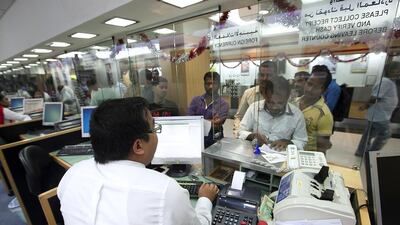
“Due to the spread of Covid-19 and corresponding restrictions on outdoor movement, we noticed a drop in the blue-collar expat remittances made via walk-ins to branches. There were also repatriations of both blue-collar and white-collar expats, which affected the volumes,” a Lulu Financial Holdings spokesperson said.
But Bangladesh and Pakistan bucked the trend, with outward personal remittances to these corridors rising on an annual basis, the spokesperson added.
While the pandemic hit remittance flows in the first half, many white-collar employees shifted to remitting money via digital platforms, Mr Raipancholia says.

The global average cost of sending $200 was 6.75 per cent of the amount in the third quarter of 2020, up from 6.67 in the second quarter of the year, but down from 6.94 per cent in the first quarter of 2019, according to the World Bank's Remittance Prices Worldwide Database. By 2030, the United Nations has committed to reduce remittance transaction costs to less than 3 per cent.
Banks are the costliest channel for sending remittances, averaging 10.89 per cent, followed by post offices at 8.59 per cent, money transfer operators at 5.81 per cent, and mobile operators at 2.83 per cent. At just under 5 per cent, South Asia was the least costly region to send $200 in the third quarter of 2020.
The UN cites technological innovations – including mobile technologies, blockchain and digitalisation that accelerated during the pandemic – as one tool that could help lower remittance costs and improve efficiencies. The organisation estimates the global digital remittance market to grow by 12.2 per cent to $36.2bn by 2027, up from $16.2bn in 2020.

Increased adoption of technology to remit funds also led to a boom in FinTech companies including TransferWise, Now Money, Denarii Cash and Rise tapping into the sector. These firms offer lower fees, reductions in transfer times and make finance accessible to all.
Now Money provides app-based accounts with physical debit cards and remittance options for low-income workers, while Rise offers migrant workers affordable insurance options, retirement planning and the ability to pay for products in instalments.
TransferWise, a global low-cost digital money transfer service, now operates in the UAE. It enables people to send money online at the mid-market exchange rate – the mid-point between demand and supply for a currency – and charges an upfront, transparent fee.
“In the UAE, we are seeing a continuous increase in the adoption of technology, specifically the pace of mobile wallet adoption, and this is driven by users searching for fast, reliable and cheap digital solutions to send money to loved ones back home,” says Jon Santillan, founder of Denarii Cash, a remittance app focused on Filipino expats sending money home from the Gulf.
Rise rolled out a new platform that allows expatriate workers to eliminate the cost of remittance fees by sharing real-time access to their bank accounts with family and friends. The multi-use Xare (pronounced share) app enables users to set daily or monthly limits for recipients, provide short-term loans through credit cards, set up expense accounts for colleagues or send pocket money to their children without them seeing the details of the account.
“Remittance has only evolved on two dimensions – how much does it cost to move money and how long does it take to move money,” says Padmini Gupta, co-founder and chief executive at Rise.
"All other elements of remittances – the needs of both the sender [control and visibility on where the money is being spent] and receiver [ability to spend online/get access to credit] have not yet been targeted," she tells The National.
Ms Gupta says remittance volumes to the Philippines dropped by about 3 per cent this year because of the Covid-19 impact on the UAE's service sector. However, she adds that corridors such as Pakistan saw a spike in money transfers because of depressed currency rates and efforts by citizens to support families affected by economic disruption at home.
“There is an irrational fear of FinTechs disrupting incumbents. Partnerships with regulatory authorities and incumbent players is essential to make the UAE competitive and we are seeing this pick up,” Mr Santillan says.
“If we look to the US, Europe or Chinese FinTech landscape, innovation has made the financial sectors competitive. FinTech can play the same role in the UAE and GCC,” he adds.
Outlook for 2021
Once the Covid-19 vaccine is distributed widely in the UAE, remittance industry stakeholders expect the sector to rebound in the first or second quarter of 2021.
“With the government easing restrictions and implementing measures to stimulate tourism and other economic activities, we are already witnessing a steady recovery in the foreign exchange and remittance sector,” Mr Al Ansari says.
“We expect this upward trajectory to gain momentum in 2021, with the availability of an effective vaccine. We expect to see increased digital transformation activities within the industry in 2021 and beyond.”
However, the Lulu Financial Holdings spokesperson forecasts challenging conditions ahead for the sector in the first half of next year as the “pandemic domino effect continues and travel remains restricted on a need-to basis”.
The spokesperson also hints at consolidation in the UAE’s remittance industry as “declining volumes and a switch to digital transfers with high cost of compliance endanger smaller exchange houses”.
The gradual recovery in global aviation traffic is also expected to create demand for remittances and money exchange services as more people begin to travel for work and leisure, the Oxford Business Group report said. Another factor expected to boost remittance volumes in 2021 is the rapid adoption of mobile money transfers, the report adds.
“A gradual recovery in global travel and consumer sentiment is likely to lead to a strong rebound in 2021, with the UAE expected to play a key role in this,” the OBG report says.

