Bitcoin, the world's largest cryptocurrency, continued its slide on Tuesday, falling to below $30,000 for the first time since January, as Chinese authorities, worried about the environmental impact of cryptocurrency, closed down mining operations in Sichuan.
Bitcoin was down more than 11 per cent on Tuesday to $29,273 at 6.12pm UAE time. Ethereum, the second largest cryptocurrency, was down 13.8 per cent to $1,725.
"Bitcoin has violated an important support level and it is likely that we may see more panic in the market as investors will think that it may be the end of Bitcoin," said Naeem Aslam, chief market analyst at London-based AVA Trade. "The current sell off could be the opportunity for many investors to load their portfolio with Bitcoin, which is selling at a huge discount."
China's central bank has encouraged payment service provider Alipay and other large institutions to crack down on cryptocurrency trading, he added, citing reports of Bitcoin mines in Sichuan being shut down after regulators in China stopped crypto mining.
"The majority of Bitcoin mines consume coal power, which has raised concerns about the digital currency's potential environmental impact," Mr Aslam said.
The slide in prices also comes a day after China’s biggest banks said they will refuse to help customers trade Bitcoin and other cryptocurrencies after the country's central bank said executives were told to step up enforcement of a government ban, according to the AP.
In May, public criticism of the digital currency’s energy needs by Tesla’s billionaire chief executive and founder Elon Musk and a Chinese regulatory crackdown caused the Bitcoin’s price to plummet more than 53 per cent to $30,000 after reaching an all-time high of $64,899 in April.
Electricity is a primary input of Bitcoin and other cryptocurrencies. The coins are mined by computers that process complex algorithms in halls that span the area of several football pitches. In April, researchers at Cambridge University estimated that the electricity consumption of the Bitcoin network is almost 120 terawatt-hours per year, more than the energy consumption of the UAE at 119.45 terawatt-hours, and on course to overtake Pakistan.
Despite Bitcoin's volatility, investor confidence in cryptocurrencies is growing, Mr Aslam said.
"This is backed up by institutional investors, who are working to diversify their product portfolios in order to provide their clients with access to Bitcoin," he said.
Mr Aslam cited findings of several surveys that show a growing number of hedge fund managers are willing to allocate about 10 per cent of their portfolio to cryptocurrencies.
"Technically, there are two make-or-break levels on the Bitcoin chart: the $30K support on the downside and the $43K resistance on the upside, which is the 200-day moving average. Which will break first is hard to tell, but the state of technical indicators hints that the $30K support could fall first," said Ipek Ozkardeskaya, a senior analyst at Swissquote.
"There is a death cross formation on the daily chart, warning that the technicals are in favour of a further Bitcoin sell-off. However ... the fact that the 200-day moving average is still on a rising path could prevent Bitcoin from a bloodbath in the short run, and that things would get more serious once the 200-day moving average turns its nose to the downside."
Central banks have been reluctant to endorse cryptocurrencies and critics have said they are speculative, lack any value and are a medium for money laundering and criminal activity.
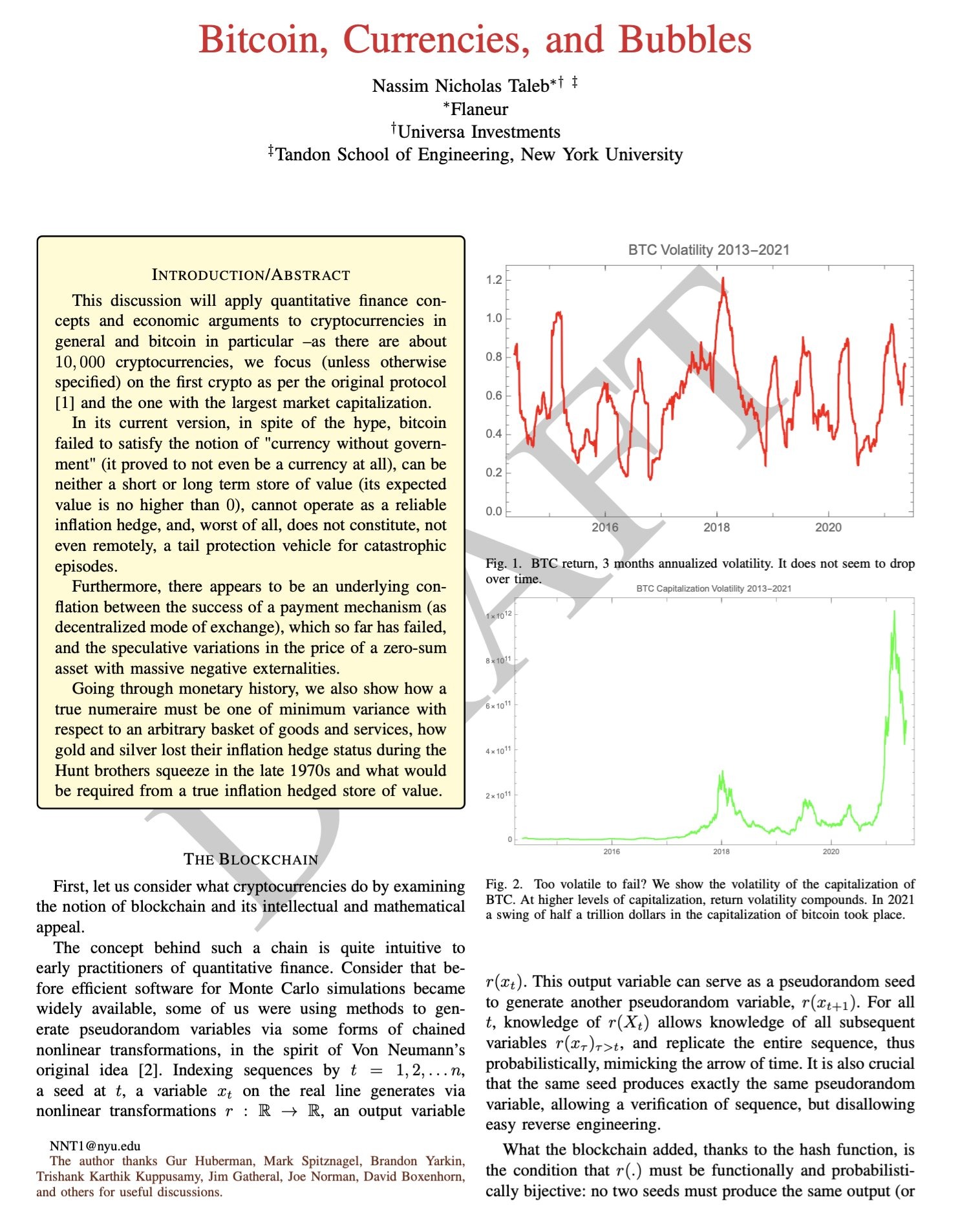
"In its current version, in spite of the hype, Bitcoin failed to satisfy the notion of 'currency without government' (it proved to not even be a currency at all), can be neither a short or long term store of value (its expected value is no higher than 0), cannot operate as a reliable inflation hedge, and, worst of all, does not constitute, not even remotely, safe haven for one's investments, shield against government tyranny, or tail protection vehicle for catastrophic episodes," Nassim Taleb, New York University professor and author of the Black Swan wrote on his blog.
Mr Taleb said there is a fundamental flaw and contradiction at the base of most cryptocurrencies and how miners extract value.
"The originators, miners, and maintainers of the system currently make their money from the inflation of their currencies rather than just from the volume of underlying transactions in them," he said. "Hence, the total failure of Bitcoin in becoming a currency has been masked by the inflation of the currency value, generating (paper) profits for large enough a number of people to enter the discourse well ahead of its utility."
Mr Taleb went on to explain that unlike the 1995-2000 dot-com rush that was characterised by highly speculative investments in Internet-related companies, the Bitcoin bubble has no foundation.
The companies "were at least promising some type of future revenue stream", he said.