UAE President Sheikh Khalifa, who also heads Abu Dhabi's Supreme Council for Financial and Economic Affairs, appointed a new board of directors to govern the state-owned Abu Dhabi National Oil Company.
The new board will be chaired by Sheikh Mohamed bin Zayed, Crown Prince of Abu Dhabi and Deputy Supreme Commander of the Armed Forces, and will include the company's group chief executive Dr Sultan Al Jaber, who has additionally been appointed managing director of Adnoc.
Dr Al Jaber, who is also the Minister for Industry and Advanced Technology, is also part of an executive committee of Adnoc's board which includes energy minister Suhail Al Mazrouei, Mubadala Investment Company chief executive Khaldoon Al Mubarak, chairman of Abu Dhabi's Department of Finance Jassem Al Zaabi and Minister of State, Ahmed Al Sayegh. The executive committee will be chaired by Sheikh Khaled bin Mohamed bin Zayed, who is a member of the Abu Dhabi Executive Council and the chairman of the Abu Dhabi Executive Office.
Adnoc's new board of directors includes Sheikh Hazza bin Zayed, Sheikh Mansour bin Zayed, Sheikh Khaled bin Mohamed bin Zayed, Dr Al Jaber, Khaldoon Al Mubarak, Ahmed Mubarak Al Mazrouei, Jassem Mohammed Al Zaabi, Suhail Al Mazrouei, Ahmed Ali Al Sayegh and Awaidha Murshed Al Marar.
-
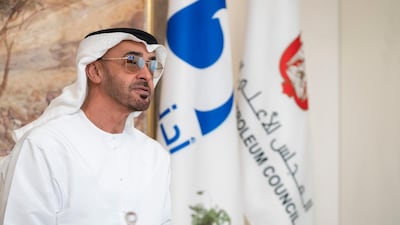
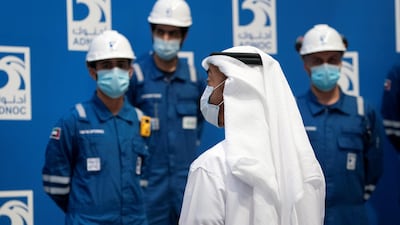
Sheikh Mohamed bin Zayed, Crown Prince of Abu Dhabi and Deputy Supreme Commander of the Armed Forces, will chair Adnoc's new board of directors. Wam -
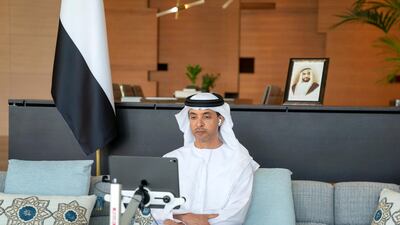
The Adnoc board includes Sheikh Hazza bin Zayed, also Vice Chairman of the Abu Dhabi Executive Council. Eissa Al Hammadi for the Ministry of Presidential Affairs -
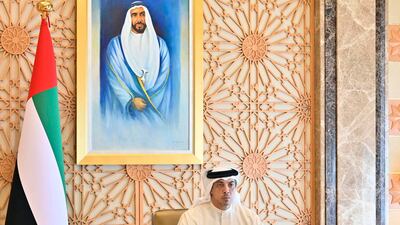
Adnoc's new board of directors includes Sheikh Mansour bin Zayed, Deputy Prime Minister and Minister of Presidential Affairs. Sheikh Mohamed bin Zayed Twitter -
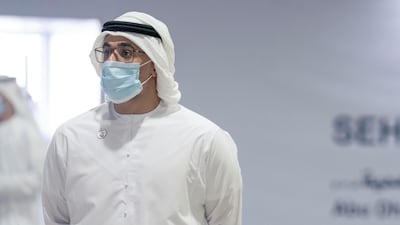
The executive committee of Adnoc's board will be chaired by Sheikh Khaled bin Mohamed bin Zayed, Deputy National Security Adviser, member of the Abu Dhabi Executive Council and Chairman of Abu Dhabi Executive Office. Hamad Al Mansoori for the Ministry of Presidential Affairs. -
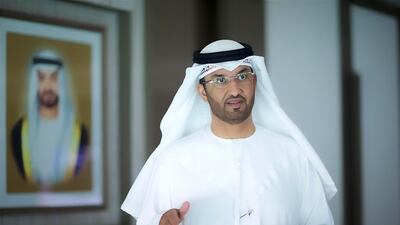
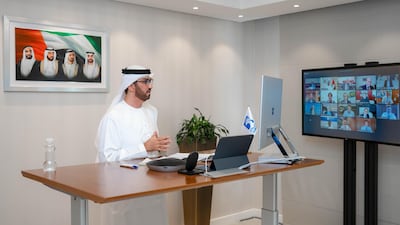
Dr Sultan Al Jaber, Minister for Industry and Advanced Technology is also Adnoc Group Chief Executive and Managing Director. Adnoc -
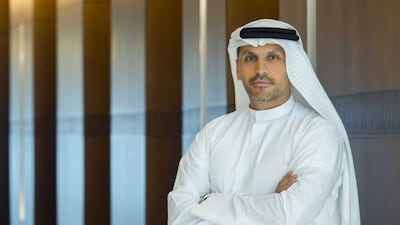
Mubadala Investment Company Chief Executive Khaldoon Al Mubarak serves on the executive committee of Adnoc's board. Executive Affairs Authority -
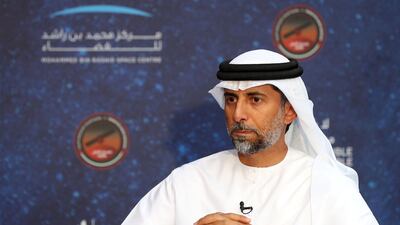
Sheikh Suhail Al Mazrouei, Minister of Energy and Infrastructure, serves on the executive committee of Adnoc's board. Chris Whiteoak / The National -
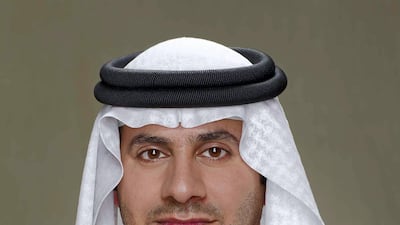
Adnoc's new board includes Dr Ahmed Mubarak Al Mazrouei, Chairman of the Abu Dhabi Water and Electricity Authority and Deputy Secretary-General of the Executive Council. Crown Prince Court - Abu Dhabi -
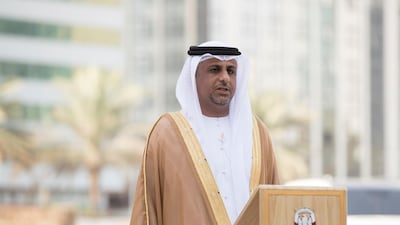
Adnoc's new board includes Jassem Mohamed Al Zaabi, Director General of the National Electronic Security Authority. Crown Prince Court - Abu Dhabi -
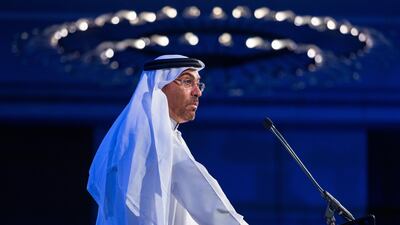
Adnoc's new board includes Ahmed Ali Al Sayegh, Chairman of Abu Dhabi Global Market. Bloomberg -

Adnoc's new board includes Awaidha Murshed Al Marar, Chairman of the Department of Energy in Abu Dhabi. Pawan Singh / The National
The new board of directors takes over from the Supreme Petroleum Council, which previously governed Adnoc.
The council ratifies Adnoc's annual five-year spending plan, discoveries of new resources and allocation of concessions to international energy companies.
The SPC was replaced in December by the Supreme Council for Financial and Economic Affairs, with Sheikh Khalifa as the chairman and Sheikh Mohamed bin Zayed as its vice-chair.
The constitution of Adnoc's first board marks a significant milestone in the group's evolution from a national oil firm to an integrated energy company with a growing international reach.
The new council was established to support Abu Dhabi's competitiveness and its economic and financial sustainability.
It will set financial and economic policy and will oversee the approval of strategies for a number of state-owned entities including Adnoc, Mubadala Investment Company, Abu Dhabi Investment Authority and holding company ADQ.
The council has oversight on the Department of Finance but it will operate with autonomy on a day-to-day basis.
The UAE, Opec's third-largest producer, accounts for nearly 4.2 per cent of global output of oil. Most of the production comes from fields owned and operated by Adnoc in Abu Dhabi. The national oil company has streamlined its operations under Dr Al Jaber, who was appointed to his existing position in 2016.
Under his leadership, Adnoc invited partnerships from international investors into its upstream concessions and also opened up opportunities across its midstream and downstream assets to foreign capital.
Last year, the company forged a number of agreements with global asset managers across its value chain, attracting $16.8 billion in foreign direct investment into the UAE.
The Abu Dhabi firm also plans to spend $122bn over the next five years, of which $43.5bn will be directed towards the local economy.
-

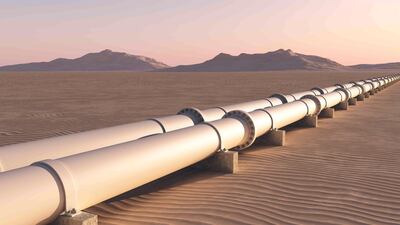
The UAE has continued to attract foreign investment during the pandemic, with Adnoc agreeing a $20.7bn deal in June for a group of global asset managers to acquire leasing rights to parts of its gas pipeline network. Wam -

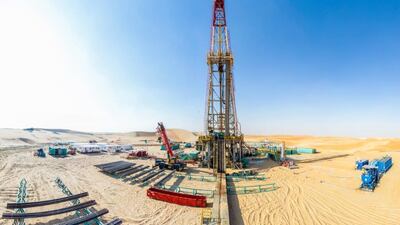
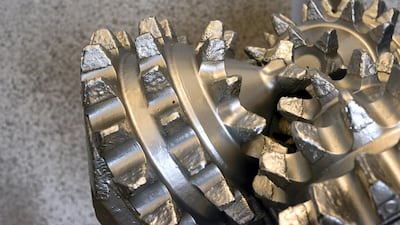
An Adnoc drilling rig in action. The company has achieved $2bn in savings over the past five years through the deployment of technology. Courtesy: Adnoc -

Sheikh Mohamed bin Zayed, Crown Prince of Abu Dhabi and Deputy Supreme Commander of the Armed Forces (R), is updated on the progress of Adnoc's downstream projects in Ruwais. Mohamed Al Hammadi / Ministry of Presidential Affairs -

Adnoc group chief executive and Minister of Industry and Advanced Technology, Dr Sultan Al Jaber has overseen a transformation of the company into a more commercially-focused organisation since he took on the role in early 2016. Image: Adnoc -

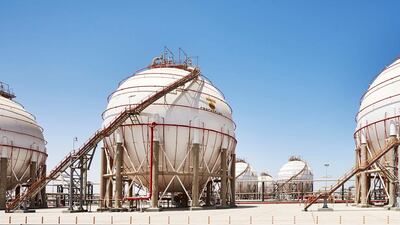
Adnoc refining operation in Ruwais. Courtesy: Adnoc -

Adnoc has been able to maximise the value of its assets including of its refining operations. Image: Adnoc -

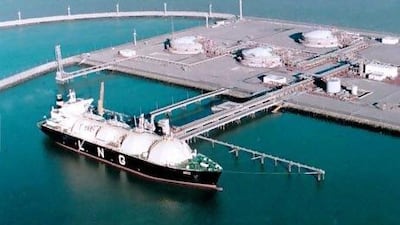
An Adnoc LNG facility. Image: Adnoc -

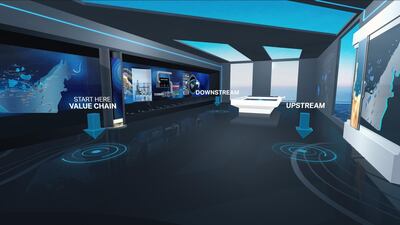
Adnoc's Virtual Energy Centre is available to students and public interested in learning about the company. Image: Adnoc -

Fuel retailer Adnoc Distribution has expanded the number of its service stations. Image: Adnoc Distribution -

Adnoc Distribution, the UAE’s largest fuel and convenience retailer, reported a 22% increase in third quarter profit as it nearly halved costs. Image: Adnoc -

Adnoc's real time data monitoring centre lowered well duration by 30 per cent leading to cost savings of around $1bn. Khushnum Bhandari / The National -

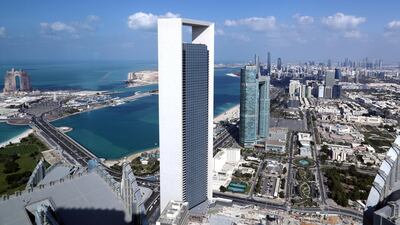
Adnoc HQ on Abu Dhabi's Corniche. On Sunday, Abu Dhabi's Supreme Petroleum Council also approved the award of new oil and gas exploration blocks under a second competitive licensing round. Image: Adnoc -

Adnoc HQ. Reuters -

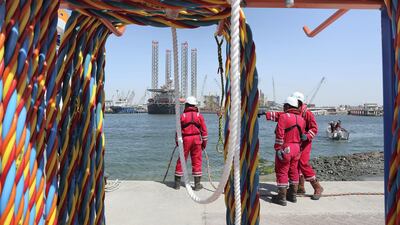
Adnoc staff during a diving at the Adnoc Logistics and Services Maritime Logistics Base in Mussafah in Abu Dhabi. Pawan Singh / The National -

Adnoc vessels. Pawan Singh / The National -

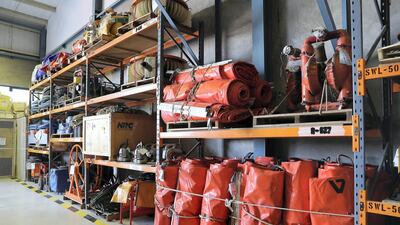
Equipment at the Oil Spill Response warehouse at the Adnoc Logistics and Services Maritime Logistics Base in Mussaffah in Abu Dhabi. Pawan Singh / The National -
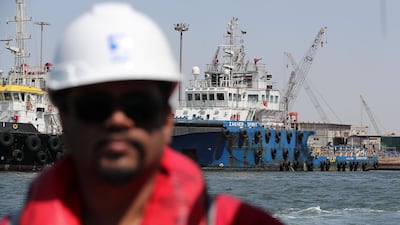
Schlumberger's operations base in the ICAD II area of Mussaffah in Abu Dhabi. Schlumberger, G42 and AIQ plan to work to identify pilot projects that have the potential to be commercialised. Christopher Pike / The National -
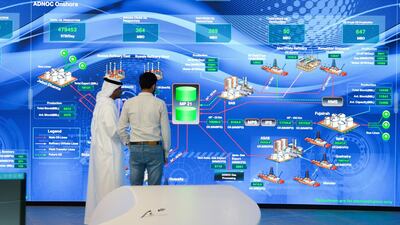
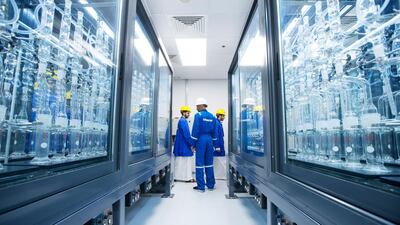
The Panorama Command Centre at Adnoc's headquarters in Abu Dhabi. Adnoc formed a joint venture with G42 in October to develop and commercialise AI products for the energy industry. Khushnum Bhandari / The National -
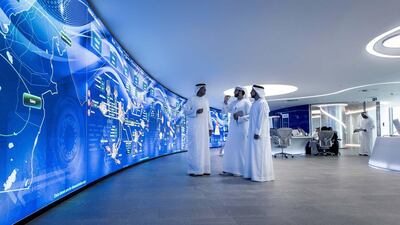
ADNOC's Panorama Digital Command Center. Courtesy Adnoc
Pakistanis%20at%20the%20ILT20%20
Inside Palestine-Israel
Saeb Erakat: Palestine can overcome coronavirus
Michael Young: The issue with Israel's 'iron wall'
Michael Young: What Israel's divisions mean for Arabs
TOUR RESULTS AND FIXTURES
June 3: NZ Provincial Barbarians 7 Lions 13
June 7: Blues 22 Lions 16
June 10: Crusaders 3 Lions 12
June 13: Highlanders 23 Lions 22
June 17: Maori All Blacks 10 Lions 32
June 20: Chiefs 6 Lions 34
June 24: New Zealand 30 Lions 15 (First Test)
June 27: Hurricanes 31 Lions 31
July 1: New Zealand 21 Lions 24 (Second Test)
July 8: New Zealand v Lions (Third Test) - kick-off 11.30am (UAE)
While you're here
Sholto Byrnes: Here's how this century can still belong to Asia
Brahma Chellaney: South China Sea is Asean's Achilles heel
The National Editorial: Territorial disputes require a mediator
What is graphene?
Graphene is a single layer of carbon atoms arranged like honeycomb.
It was discovered in 2004, when Russian-born Manchester scientists Andrei Geim and Kostya Novoselov were "playing about" with sticky tape and graphite - the material used as "lead" in pencils.
Placing the tape on the graphite and peeling it, they managed to rip off thin flakes of carbon. In the beginning they got flakes consisting of many layers of graphene. But as they repeated the process many times, the flakes got thinner.
By separating the graphite fragments repeatedly, they managed to create flakes that were just one atom thick. Their experiment had led to graphene being isolated for the very first time.
At the time, many believed it was impossible for such thin crystalline materials to be stable. But examined under a microscope, the material remained stable, and when tested was found to have incredible properties.
It is many times times stronger than steel, yet incredibly lightweight and flexible. It is electrically and thermally conductive but also transparent. The world's first 2D material, it is one million times thinner than the diameter of a single human hair.
But the 'sticky tape' method would not work on an industrial scale. Since then, scientists have been working on manufacturing graphene, to make use of its incredible properties.
In 2010, Geim and Novoselov were awarded the Nobel Prize for Physics. Their discovery meant physicists could study a new class of two-dimensional materials with unique properties.
MATCH INFO
Tottenham Hotspur 3 (Son 1', Kane 8' & 16') West Ham United 3 (Balbuena 82', Sanchez og 85', Lanzini 90' 4)
Man of the match Harry Kane
Teams
Punjabi Legends Owners: Inzamam-ul-Haq and Intizar-ul-Haq; Key player: Misbah-ul-Haq
Pakhtoons Owners: Habib Khan and Tajuddin Khan; Key player: Shahid Afridi
Maratha Arabians Owners: Sohail Khan, Ali Tumbi, Parvez Khan; Key player: Virender Sehwag
Bangla Tigers Owners: Shirajuddin Alam, Yasin Choudhary, Neelesh Bhatnager, Anis and Rizwan Sajan; Key player: TBC
Colombo Lions Owners: Sri Lanka Cricket; Key player: TBC
Kerala Kings Owners: Hussain Adam Ali and Shafi Ul Mulk; Key player: Eoin Morgan
Venue Sharjah Cricket Stadium
Format 10 overs per side, matches last for 90 minutes
Timeline October 25: Around 120 players to be entered into a draft, to be held in Dubai; December 21: Matches start; December 24: Finals
What is graphene?
Graphene is extracted from graphite and is made up of pure carbon.
It is 200 times more resistant than steel and five times lighter than aluminum.
It conducts electricity better than any other material at room temperature.
It is thought that graphene could boost the useful life of batteries by 10 per cent.
Graphene can also detect cancer cells in the early stages of the disease.
The material was first discovered when Andre Geim and Konstantin Novoselov were 'playing' with graphite at the University of Manchester in 2004.
LOVE%20AGAIN
GYAN’S ASIAN OUTPUT
2011-2015: Al Ain – 123 apps, 128 goals
2015-2017: Shanghai SIPG – 20 apps, 7 goals
2016-2017: Al Ahli (loan) – 25 apps, 11 goals
Company%20profile
The%20specs
BIOSAFETY LABS SECURITY LEVELS
Biosafety Level 1
The lowest safety level. These labs work with viruses that are minimal risk to humans.
Hand washing is required on entry and exit and potentially infectious material decontaminated with bleach before thrown away.
Must have a lock. Access limited. Lab does not need to be isolated from other buildings.
Used as teaching spaces.
Study microorganisms such as Staphylococcus which causes food poisoning.
Biosafety Level 2
These labs deal with pathogens that can be harmful to people and the environment such as Hepatitis, HIV and salmonella.
Working in Level 2 requires special training in handling pathogenic agents.
Extra safety and security precautions are taken in addition to those at Level 1
Biosafety Level 3
These labs contain material that can be lethal if inhaled. This includes SARS coronavirus, MERS, and yellow fever.
Significant extra precautions are taken with staff given specific immunisations when dealing with certain diseases.
Infectious material is examined in a biological safety cabinet.
Personnel must wear protective gowns that must be discarded or decontaminated after use.
Strict safety and handling procedures are in place. There must be double entrances to the building and they must contain self-closing doors to reduce risk of pathogen aerosols escaping.
Windows must be sealed. Air from must be filtered before it can be recirculated.
Biosafety Level 4
The highest level for biosafety precautions. Scientist work with highly dangerous diseases that have no vaccine or cure.
All material must be decontaminated.
Personnel must wear a positive pressure suit for protection. On leaving the lab this must pass through decontamination shower before they have a personal shower.
Entry is severely restricted to trained and authorised personnel. All entries are recorded.
Entrance must be via airlocks.
EA Sports FC 24
Three ways to get a gratitude glow
By committing to at least one of these daily, you can bring more gratitude into your life, says Ong.
- During your morning skincare routine, name five things you are thankful for about yourself.
- As you finish your skincare routine, look yourself in the eye and speak an affirmation, such as: “I am grateful for every part of me, including my ability to take care of my skin.”
- In the evening, take some deep breaths, notice how your skin feels, and listen for what your skin is grateful for.
How to avoid crypto fraud
- Use unique usernames and passwords while enabling multi-factor authentication.
- Use an offline private key, a physical device that requires manual activation, whenever you access your wallet.
- Avoid suspicious social media ads promoting fraudulent schemes.
- Only invest in crypto projects that you fully understand.
- Critically assess whether a project’s promises or returns seem too good to be true.
- Only use reputable platforms that have a track record of strong regulatory compliance.
- Store funds in hardware wallets as opposed to online exchanges.
The%20Caine%20Mutiny%20Court-Martial%20
While you're here
Declan McVeigh: Northern Ireland is marking its centenary, rattled and alone
Declan McVeigh: A tribute to John Hume and his lessons in peacemaking
Gavin Esler: The Good Friday Agreement teaches us some important lessons
Damien McElroy: Boris must listen to Churchill's comments on Irish divisions
GROUPS
Group Gustavo Kuerten
Novak Djokovic (x1)
Alexander Zverev (x3)
Marin Cilic (x5)
John Isner (x8)
Group Lleyton Hewitt
Roger Federer (x2)
Kevin Anderson (x4)
Dominic Thiem (x6)
Kei Nishikori (x7)
The alternatives
• Founded in 2014, Telr is a payment aggregator and gateway with an office in Silicon Oasis. It’s e-commerce entry plan costs Dh349 monthly (plus VAT). QR codes direct customers to an online payment page and merchants can generate payments through messaging apps.
• Business Bay’s Pallapay claims 40,000-plus active merchants who can invoice customers and receive payment by card. Fees range from 1.99 per cent plus Dh1 per transaction depending on payment method and location, such as online or via UAE mobile.
• Tap started in May 2013 in Kuwait, allowing Middle East businesses to bill, accept, receive and make payments online “easier, faster and smoother” via goSell and goCollect. It supports more than 10,000 merchants. Monthly fees range from US$65-100, plus card charges of 2.75-3.75 per cent and Dh1.2 per sale.
• 2checkout’s “all-in-one payment gateway and merchant account” accepts payments in 200-plus markets for 2.4-3.9 per cent, plus a Dh1.2-Dh1.8 currency conversion charge. The US provider processes online shop and mobile transactions and has 17,000-plus active digital commerce users.
• PayPal is probably the best-known online goods payment method - usually used for eBay purchases - but can be used to receive funds, providing everyone’s signed up. Costs from 2.9 per cent plus Dh1.2 per transaction.
The Bio
Favourite vegetable: “I really like the taste of the beetroot, the potatoes and the eggplant we are producing.”
Holiday destination: “I like Paris very much, it’s a city very close to my heart.”
Book: “Das Kapital, by Karl Marx. I am not a communist, but there are a lot of lessons for the capitalist system, if you let it get out of control, and humanity.”
Musician: “I like very much Fairuz, the Lebanese singer, and the other is Umm Kulthum. Fairuz is for listening to in the morning, Umm Kulthum for the night.”
All you need to know about Formula E in Saudi Arabia
What The Saudia Ad Diriyah E-Prix
When Saturday
Where Diriyah in Saudi Arabia
What time Qualifying takes place from 11.50am UAE time through until the Super Pole session, which is due to end at 12.55pm. The race, which will last for 45 minutes, starts at 4.05pm.
Who is competing There are 22 drivers, from 11 teams, on the grid, with each vehicle run solely on electronic power.
Ten tax points to be aware of in 2026
1. Domestic VAT refund amendments: request your refund within five years
If a business does not apply for the refund on time, they lose their credit.
2. E-invoicing in the UAE
Businesses should continue preparing for the implementation of e-invoicing in the UAE, with 2026 a preparation and transition period ahead of phased mandatory adoption.
3. More tax audits
Tax authorities are increasingly using data already available across multiple filings to identify audit risks.
4. More beneficial VAT and excise tax penalty regime
Tax disputes are expected to become more frequent and more structured, with clearer administrative objection and appeal processes. The UAE has adopted a new penalty regime for VAT and excise disputes, which now mirrors the penalty regime for corporate tax.
5. Greater emphasis on statutory audit
There is a greater need for the accuracy of financial statements. The International Financial Reporting Standards standards need to be strictly adhered to and, as a result, the quality of the audits will need to increase.
6. Further transfer pricing enforcement
Transfer pricing enforcement, which refers to the practice of establishing prices for internal transactions between related entities, is expected to broaden in scope. The UAE will shortly open the possibility to negotiate advance pricing agreements, or essentially rulings for transfer pricing purposes.
7. Limited time periods for audits
Recent amendments also introduce a default five-year limitation period for tax audits and assessments, subject to specific statutory exceptions. While the standard audit and assessment period is five years, this may be extended to up to 15 years in cases involving fraud or tax evasion.
8. Pillar 2 implementation
Many multinational groups will begin to feel the practical effect of the Domestic Minimum Top-Up Tax (DMTT), the UAE's implementation of the OECD’s global minimum tax under Pillar 2. While the rules apply for financial years starting on or after January 1, 2025, it is 2026 that marks the transition to an operational phase.
9. Reduced compliance obligations for imported goods and services
Businesses that apply the reverse-charge mechanism for VAT purposes in the UAE may benefit from reduced compliance obligations.
10. Substance and CbC reporting focus
Tax authorities are expected to continue strengthening the enforcement of economic substance and Country-by-Country (CbC) reporting frameworks. In the UAE, these regimes are increasingly being used as risk-assessment tools, providing tax authorities with a comprehensive view of multinational groups’ global footprints and enabling them to assess whether profits are aligned with real economic activity.
Contributed by Thomas Vanhee and Hend Rashwan, Aurifer
Dust and sand storms compared
Sand storm
- Particle size: Larger, heavier sand grains
- Visibility: Often dramatic with thick "walls" of sand
- Duration: Short-lived, typically localised
- Travel distance: Limited
- Source: Open desert areas with strong winds
Dust storm
- Particle size: Much finer, lightweight particles
- Visibility: Hazy skies but less intense
- Duration: Can linger for days
- Travel distance: Long-range, up to thousands of kilometres
- Source: Can be carried from distant regions