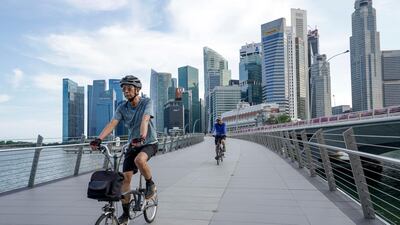
Singapore is betting on floating solar farms and vertical panels to increase its clean-energy supplies and cut carbon emissions, a model that could work in other densely populated cities, urban experts said.
With renewable energy options such as wind, hydro, nuclear and biomass ruled out, solar photovoltaic (PV) is the most viable option for Singapore, despite limited land for large-scale farms, and challenges such as frequent cloud cover.
Last month, Singapore inaugurated a 5 megawatt (MW) offshore floating PV system on the Johor Strait, part of its goal to install at least 2 gigawatt of solar power by 2030 – five times current capacity – and halving its carbon emissions by 2050.
Compared to bigger countries ... we do not have the natural resources, land area and climatic conditions for the large-scale deployment of renewable energy sources
“Compared to bigger countries ... we do not have the natural resources, land area and climatic conditions for the large-scale deployment of renewable energy sources,” said Lawrence Wong, minister for education.
This makes it extremely hard for the South-East Asian nation to cut its planet-heating emissions to net zero, Mr said Wong, adding that its clean-energy push could make it a “living laboratory” to provide ideas for other cities around the world.
Renewable sources are forecast to supply about 40 per cent of the world’s electricity supply in 2030, with hydropower making up about half that output, followed by wind and solar.
Elsewhere in Asia, Japan and South Korea have pledged to achieve carbon neutrality by 2050, and China by 2060.
Solar energy would only be able to produce 10 per cent to 20 per cent of Singapore’s power supply mix because of land constraints, said Thomas Reindl, a deputy chief executive at the Solar Energy Research Institute of Singapore.
To achieve this, the city-state is exploring novel options such as floating solar farms, solar panels on building facades, noise barriers and fencing, and mobile grids, besides panels on existing infrastructure such as rooftops, car parks and roads.
“Singapore needs to think out of the box and become more creative than other countries in where to put solar panels,” Mr Reindl said.
“New solar technology developments support these options. Also, the massive cost reductions over the past decade allow to cost-effectively install PV on the vertical parts of a building, for example,” he said.
Another area Singapore is exploring is Solar+, which combines PV systems with other technologies such as rooftop farming, or using offshore floating solar power to run desalination plants, Mr Reindl added.
Floating solar farms can generate more electricity than rooftop or on-ground installations, research by Mr Reindl has shown, and can even protect lakes and reservoirs from rising temperatures.
Singapore needs to think out of the box and become more creative than other countries in where to put solar panels
A floating solar project being built on Singapore’s Tengeh Reservoir will occupy an area equivalent to 45 football pitches, making it one of the largest in the region.
The clean-energy push is part of Singapore’s Green Plan, unveiled last month, that also includes measures such as planting more trees, adding electric vehicle charge points, and ceasing new registrations of diesel cars and taxis from 2025.
Singapore’s push for solar is “not only for providing green electricity, but also for creating jobs, economic value and innovations”, Mr Reindl said.
“The new technologies would not only solve Singapore’s challenges but also have opportunities for other megacities.”

Green ambitions
- Trees: 1,500 to be planted, replacing 300 felled ones, with veteran oaks protected
- Lake: Brown's centrepiece to be cleaned of silt that makes it as shallow as 2.5cm
- Biodiversity: Bat cave to be added and habitats designed for kingfishers and little grebes
- Flood risk: Longer grass, deeper lake, restored ponds and absorbent paths all meant to siphon off water
Tips to keep your car cool
- Place a sun reflector in your windshield when not driving
- Park in shaded or covered areas
- Add tint to windows
- Wrap your car to change the exterior colour
- Pick light interiors - choose colours such as beige and cream for seats and dashboard furniture
- Avoid leather interiors as these absorb more heat
Mercer, the investment consulting arm of US services company Marsh & McLennan, expects its wealth division to at least double its assets under management (AUM) in the Middle East as wealth in the region continues to grow despite economic headwinds, a company official said.
Mercer Wealth, which globally has $160 billion in AUM, plans to boost its AUM in the region to $2-$3bn in the next 2-3 years from the present $1bn, said Yasir AbuShaban, a Dubai-based principal with Mercer Wealth.
“Within the next two to three years, we are looking at reaching $2 to $3 billion as a conservative estimate and we do see an opportunity to do so,” said Mr AbuShaban.
Mercer does not directly make investments, but allocates clients’ money they have discretion to, to professional asset managers. They also provide advice to clients.
“We have buying power. We can negotiate on their (client’s) behalf with asset managers to provide them lower fees than they otherwise would have to get on their own,” he added.
Mercer Wealth’s clients include sovereign wealth funds, family offices, and insurance companies among others.
From its office in Dubai, Mercer also looks after Africa, India and Turkey, where they also see opportunity for growth.
Wealth creation in Middle East and Africa (MEA) grew 8.5 per cent to $8.1 trillion last year from $7.5tn in 2015, higher than last year’s global average of 6 per cent and the second-highest growth in a region after Asia-Pacific which grew 9.9 per cent, according to consultancy Boston Consulting Group (BCG). In the region, where wealth grew just 1.9 per cent in 2015 compared with 2014, a pickup in oil prices has helped in wealth generation.
BCG is forecasting MEA wealth will rise to $12tn by 2021, growing at an annual average of 8 per cent.
Drivers of wealth generation in the region will be split evenly between new wealth creation and growth of performance of existing assets, according to BCG.
Another general trend in the region is clients’ looking for a comprehensive approach to investing, according to Mr AbuShaban.
“Institutional investors or some of the families are seeing a slowdown in the available capital they have to invest and in that sense they are looking at optimizing the way they manage their portfolios and making sure they are not investing haphazardly and different parts of their investment are working together,” said Mr AbuShaban.
Some clients also have a higher appetite for risk, given the low interest-rate environment that does not provide enough yield for some institutional investors. These clients are keen to invest in illiquid assets, such as private equity and infrastructure.
“What we have seen is a desire for higher returns in what has been a low-return environment specifically in various fixed income or bonds,” he said.
“In this environment, we have seen a de facto increase in the risk that clients are taking in things like illiquid investments, private equity investments, infrastructure and private debt, those kind of investments were higher illiquidity results in incrementally higher returns.”
The Abu Dhabi Investment Authority, one of the largest sovereign wealth funds, said in its 2016 report that has gradually increased its exposure in direct private equity and private credit transactions, mainly in Asian markets and especially in China and India. The authority’s private equity department focused on structured equities owing to “their defensive characteristics.”
Going grey? A stylist's advice
If you’re going to go grey, a great style, well-cared for hair (in a sleek, classy style, like a bob), and a young spirit and attitude go a long way, says Maria Dowling, founder of the Maria Dowling Salon in Dubai.
It’s easier to go grey from a lighter colour, so you may want to do that first. And this is the time to try a shorter style, she advises. Then a stylist can introduce highlights, start lightening up the roots, and let it fade out. Once it’s entirely grey, a purple shampoo will prevent yellowing.
“Get professional help – there’s no other way to go around it,” she says. “And don’t just let it grow out because that looks really bad. Put effort into it: properly condition, straighten, get regular trims, make sure it’s glossy.”
UAE currency: the story behind the money in your pockets
Best Academy: Ajax and Benfica
Best Agent: Jorge Mendes
Best Club : Liverpool
Best Coach: Jurgen Klopp (Liverpool)
Best Goalkeeper: Alisson Becker
Best Men’s Player: Cristiano Ronaldo
Best Partnership of the Year Award by SportBusiness: Manchester City and SAP
Best Referee: Stephanie Frappart
Best Revelation Player: Joao Felix (Atletico Madrid and Portugal)
Best Sporting Director: Andrea Berta (Atletico Madrid)
Best Women's Player: Lucy Bronze
Best Young Arab Player: Achraf Hakimi
Kooora – Best Arab Club: Al Hilal (Saudi Arabia)
Kooora – Best Arab Player: Abderrazak Hamdallah (Al-Nassr FC, Saudi Arabia)
Player Career Award: Miralem Pjanic and Ryan Giggs
Specs
Engine: 51.5kW electric motor
Range: 400km
Power: 134bhp
Torque: 175Nm
Price: From Dh98,800
Available: Now
Globalization and its Discontents Revisited
Joseph E. Stiglitz
W. W. Norton & Company
Ruwais timeline
1971 Abu Dhabi National Oil Company established
1980 Ruwais Housing Complex built, located 10 kilometres away from industrial plants
1982 120,000 bpd capacity Ruwais refinery complex officially inaugurated by the founder of the UAE Sheikh Zayed
1984 Second phase of Ruwais Housing Complex built. Today the 7,000-unit complex houses some 24,000 people.
1985 The refinery is expanded with the commissioning of a 27,000 b/d hydro cracker complex
2009 Plans announced to build $1.2 billion fertilizer plant in Ruwais, producing urea
2010 Adnoc awards $10bn contracts for expansion of Ruwais refinery, to double capacity from 415,000 bpd
2014 Ruwais 261-outlet shopping mall opens
2014 Production starts at newly expanded Ruwais refinery, providing jet fuel and diesel and allowing the UAE to be self-sufficient for petrol supplies
2014 Etihad Rail begins transportation of sulphur from Shah and Habshan to Ruwais for export
2017 Aldar Academies to operate Adnoc’s schools including in Ruwais from September. Eight schools operate in total within the housing complex.
2018 Adnoc announces plans to invest $3.1 billion on upgrading its Ruwais refinery
2018 NMC Healthcare selected to manage operations of Ruwais Hospital
2018 Adnoc announces new downstream strategy at event in Abu Dhabi on May 13
Source: The National
UPI facts
More than 2.2 million Indian tourists arrived in UAE in 2023
More than 3.5 million Indians reside in UAE
Indian tourists can make purchases in UAE using rupee accounts in India through QR-code-based UPI real-time payment systems
Indian residents in UAE can use their non-resident NRO and NRE accounts held in Indian banks linked to a UAE mobile number for UPI transactions
The%20Emperor%20and%20the%20Elephant
%3Cp%3E%3Cstrong%3EAuthor%3A%20%3C%2Fstrong%3ESam%20Ottewill-Soulsby%3C%2Fp%3E%0A%3Cp%3E%3Cstrong%3EPublisher%3A%20%3C%2Fstrong%3EPrinceton%20University%20Press%3C%2Fp%3E%0A%3Cp%3E%3Cstrong%3EPages%3A%20%3C%2Fstrong%3E392%3C%2Fp%3E%0A%3Cp%3E%3Cstrong%3EAvailable%3A%20%3C%2Fstrong%3EJuly%2011%3C%2Fp%3E%0A
EA Sports FC 25
Developer: EA Vancouver, EA Romania
Publisher: EA Sports
Consoles: Nintendo Switch, PlayStation 4&5, Xbox One and Xbox Series X/S
Rating: 3.5/5
Madrid Open schedule
Men's semi-finals
Novak Djokovic (1) v Dominic Thiem (5) from 6pm
Stefanos Tsitsipas (8) v Rafael Nadal (2) from 11pm
Women's final
Simona Halep (3) v Kiki Bertens (7) from 8.30pm
