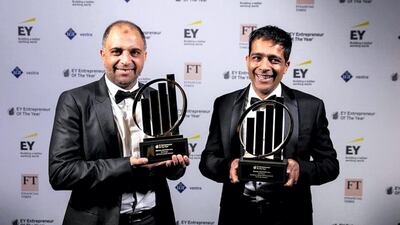
Despite their global business operations, Mohsin and Zuber Issa still run their company EG Group from their home town of Blackburn. Courtesy Euro Garages

Who are the British billionaire Issa brothers behind Walmart's £6.8bn sale of Asda?


Alice Haine
  • English
  • Arabic

Walmart's decision to sell Asda for £6.8 billion ($8.79bn) may not be a big surprise for many.

America’s largest retailer had been shopping around for a buyer for the British supermarket for some time, almost offloading the chain to Sainsbury’s last year for £7.3bn.

The bid was later rejected by an antitrust regulator over fears the merged company would dominate the UK grocery sector.

News on Friday, however, that Asda had been purchased by British billionaires Mohsin Issa, 49, and his brother Zuber, 48, was a little more of a surprise for the City of London.

We are very proud to be investing in Asda, an iconic British business that we have admired for many years.

After all, where did these brothers, who are reported to be worth £3.56bn, spring from?

The siblings are the owners of Euro Garages, now called EG Group – a company they set up in Blackburn in 2001 with the purchase of a single petrol station in Bury, on the outskirts of Manchester.

Since then, the company has become one of the country’s most recognisable forecourt operators and now has a global presence with 6,000 sites across 10 countries, including in the UK, Europe, the US and Australia.

EG Group also operates outlets for the supermarket chains Spar and Carrefour, as well as the coffee company Starbucks and takeaway brands such as Subway, Burger King, KFC and Greggs.

Despite this global reach, the brothers still run the company from their home town of Blackburn in the county of Lancashire. They recently unveiled a new headquarters worth £35m.

It is quite the rags-to-riches tale that started in the early 1970s when their parents immigrated to Britain from Gujarat in India, with the brothers born shortly after.

After settling in Blackburn, the family bought a petrol station where the brothers started their career selling fuel and refreshments.

Mohsin and Zuber Issa. The brothers committed to invest £1bn over the next three years to strengthen Asda's supply chain and pledged to keep prices low. Courtesy Euro Garages

When their parents later sold the business, it gave the brothers an idea.
"Fuel sales were declining," Zuber told the Financial Times in an interview in 2018.

“We wanted to create a destination where you could get fuel, food-to-go and shopping. This is the formula and it works. We were fortunate that the big players were leaving the market just as we were growing."

That business decision helped them amass a fortune that includes a £25m townhouse in Kensington in London and a private jet housed in a hangar at Blackpool airport alongside Donald Trump’s personal helicopter, according to media reports.

The brothers are now building five identical mansions about 4.8 kilometres away from the £115,000 home in which they grew up in. Mohsin is expected to live there with his wife and two grown-up children.

"People are always asking when we will move to London or Manchester," Zuber told the Financial Times.

"But the quality of life here is great. A lot of people do a few years in London then come to the north-west. They want to raise a family and have less pressure. We have got a lot of fantastic people that way."

Staying close to home has paid off for the pair, with their incredible fortune coming from their transformation of the petrol station experience.

They turned forecourts from places where you merely filled up your car and collected a couple of snacks or pre-packaged sandwiches, to locations offering appetising food to a captive audience.

Franchise agreements followed with leading brands such as Starbucks, with the company now the largest Subway franchisee in Europe.

Private equity group TDR Capital spotted their potential and bought a 50 per cent stake in the company in 2015. The Issa brothers retain the other 50 per cent.

In 2017, Euro Garages bought Dutch-based forecourt operator EFR Group, and the company was renamed EG Group. The new company later bought 1,000 garages from Esso in Germany.

Since then, EG Group has been on a spending spree, snapping up sites in the US, Italy and Australia. It also became the largest KFC franchisee in Europe this year after buying 145 outlets in the UK and Ireland.

Now the brothers are global names, after winning the bid to acquire Asda from Walmart in an auction process that lasted several months.

An Asda store in Wallington, England. Brothers Mohsin and Zuber Issa, along with investors TDR Capital will acquire a majority of Asda, while Walmart will retain a minority stake and a seat of the board, the parties said on Friday in a joint statement. Associated Press

Under Asda’s ownership structure, the Issa brothers, along with TDR Capital, will take up a majority stake in the supermarket chain on a debt-free and cash-free basis, while Walmart retains a minority stake and a seat on the board.

The brothers said on Friday that they were “proud” to be investing in an “iconic British business that we have admired for many years”.

They also stressed that their experience, including their “expertise” around convenience and brand partnerships, would help to hasten Asda’s growth strategy.

Some of that know-how comes from their shop-floor experience at the very start of their career.

"We grew [EG] from nothing," Zuber told the Financial Times before the company's interest in Asda was disclosed.

“We have been on the pumps, we have been stocking the shelves, cleaning the toilets. You do everything. And once you do the foundation work, it is no different wherever you go in the world. It is a petrol station; you are selling fuel, you are selling coffee, you are selling convenience.”

The Issas’ statement on Friday highlighted their commitment to focus on British-sourced products, such as meat, in Asda supermarkets, a strategy that may be key as the UK heads towards its exit from the European Union later this year.

Their company cares about the environment too. To help consume less energy, Euro Garages invested £3.2m in the installation of LED lighting across its UK sites to consume less energy, according to the company's website.

A further £2.6m provided solar panels for more than 20 per cent of EG sites to reduce their carbon footprint. Six of its motorway service stations feature rainwater harvesting systems, while the company invested £6m on renewable energy sources across its UK sites.

Like their luxury houses and their company headquarters, which are located close to where they grew up, the brothers said Asda’s base would remain at its home in Leeds and that Mr Burnley will remain as chief executive.

One thing is for sure: the brothers understand how to make money, even during a pandemic, with their non-fuel business trading around normal levels throughout the crisis.

The company "makes more money selling a cup of coffee than we would do on an average tank fill-up", Mohsin told the Financial Times.


Ten tax points to be aware of in 2026

1. Domestic VAT refund amendments: request your refund within five years

If a business does not apply for the refund on time, they lose their credit.

2. E-invoicing in the UAE

Businesses should continue preparing for the implementation of e-invoicing in the UAE, with 2026 a preparation and transition period ahead of phased mandatory adoption. 

3. More tax audits

Tax authorities are increasingly using data already available across multiple filings to identify audit risks. 

4. More beneficial VAT and excise tax penalty regime

Tax disputes are expected to become more frequent and more structured, with clearer administrative objection and appeal processes. The UAE has adopted a new penalty regime for VAT and excise disputes, which now mirrors the penalty regime for corporate tax.

5. Greater emphasis on statutory audit

There is a greater need for the accuracy of financial statements. The International Financial Reporting Standards standards need to be strictly adhered to and, as a result, the quality of the audits will need to increase.

6. Further transfer pricing enforcement

Transfer pricing enforcement, which refers to the practice of establishing prices for internal transactions between related entities, is expected to broaden in scope. The UAE will shortly open the possibility to negotiate advance pricing agreements, or essentially rulings for transfer pricing purposes. 

7. Limited time periods for audits

Recent amendments also introduce a default five-year limitation period for tax audits and assessments, subject to specific statutory exceptions. While the standard audit and assessment period is five years, this may be extended to up to 15 years in cases involving fraud or tax evasion. 

8. Pillar 2 implementation 

Many multinational groups will begin to feel the practical effect of the Domestic Minimum Top-Up Tax (DMTT), the UAE's implementation of the OECD’s global minimum tax under Pillar 2. While the rules apply for financial years starting on or after January 1, 2025, it is 2026 that marks the transition to an operational phase.

9. Reduced compliance obligations for imported goods and services

Businesses that apply the reverse-charge mechanism for VAT purposes in the UAE may benefit from reduced compliance obligations. 

10. Substance and CbC reporting focus

Tax authorities are expected to continue strengthening the enforcement of economic substance and Country-by-Country (CbC) reporting frameworks. In the UAE, these regimes are increasingly being used as risk-assessment tools, providing tax authorities with a comprehensive view of multinational groups’ global footprints and enabling them to assess whether profits are aligned with real economic activity. 

Contributed by Thomas Vanhee and Hend Rashwan, Aurifer

PROFILE OF CURE.FIT

Started: July 2016

Founders: Mukesh Bansal and Ankit Nagori

Based: Bangalore, India

Sector: Health & wellness

Size: 500 employees

Investment: $250 million

Investors: Accel, Oaktree Capital (US); Chiratae Ventures, Epiq Capital, Innoven Capital, Kalaari Capital, Kotak Mahindra Bank, Piramal Group’s Anand Piramal, Pratithi Investment Trust, Ratan Tata (India); and Unilever Ventures (Unilever’s global venture capital arm)

The burning issue

The internal combustion engine is facing a watershed moment – major manufacturer Volvo is to stop producing petroleum-powered vehicles by 2021 and countries in Europe, including the UK, have vowed to ban their sale before 2040. The National takes a look at the story of one of the most successful technologies of the last 100 years and how it has impacted life in the UAE. 

Read part four: an affection for classic cars lives on

Read part three: the age of the electric vehicle begins

Read part two: how climate change drove the race for an alternative 

How to apply for a drone permit
  • Individuals must register on UAE Drone app or website using their UAE Pass
  • Add all their personal details, including name, nationality, passport number, Emiratis ID, email and phone number
  • Upload the training certificate from a centre accredited by the GCAA
  • Submit their request
What are the regulations?
  • Fly it within visual line of sight
  • Never over populated areas
  • Ensure maximum flying height of 400 feet (122 metres) above ground level is not crossed
  • Users must avoid flying over restricted areas listed on the UAE Drone app
  • Only fly the drone during the day, and never at night
  • Should have a live feed of the drone flight
  • Drones must weigh 5 kg or less