

Saudi Arabia’s Public Investment Fund (PIF) is targeting at least US$2 trillion of assets under management by 2030, as it seeks to diversify the kingdom’s oil-dependent economy.
The fund's managing director, Yasir Al Rumayyan, told Bloomberg it would
increasingly use leverage to boost returns, targeted at 8 to 9 per cent.
“If you look at investments we have today, it’s basically all equity – we need to look at leverage,” Mr Al Rumayyan said on the sidelines of the Future Investment Initiative in Riyadh on Tuesday. “If we’re in one project, we can use the underlying project as the base for the leverage with no recourse to the rest of the portfolio.”
Mr Al Rumayyan told an audience of 2,500 delegates at the Riyadh summit that PIF would look for more partnerships such as its tie-ups with money managers Blackstone Group and SoftBank Group.
___________
Read more:
Exclusive: Female founder of Saudi bank sets up $100bn fund
Aramco chief says lack of investment may hit oil supplies
___________
Average returns on PIF's current portfolio of investments currently vary between 3 per cent and 9 per cent, he said.
PIF, which has about $230bn in assets, will continue to diversify and embrace different facets of the economy in parallel to leveraging investments that may arise as technology continues to advance and disrupt conventional businesses, added Mr Al Rumayyan.
He insisted that the fund would also continue to invest in the conventional economy.
“PIF is a long-term investor, we are looking beyond 2030, the cyclicity of the world economy is there but we’re there for the long term,” he said.
“We don’t want to be sitting ducks…we want to go beyond…we’re not going to sell out of our conventional
investments.”
The sovereign wealth fund has a $3.5bn stake in the ride-hailing firm Uber, acquired in June 2016. In May this year, it took a giant leap and became a co-investor with Abu Dhabi strategic firm, Mubadala Investment Company, in SoftBank Group's $100bn Vision Fund. PIF's contribution to the Japanese-led technology fund is expected to reach $45bn.
-

Saudi oil minister Khalid al-Falih arrives to attend the Future Investment Initiative conference in Riyadh, Saudi Arabia on October 24, 2017. Faisal Al Nasser / Reuters -

Managing director of the International Monetary Fund Christine Lagarde, centre, looks at the president and CEO of the Saudi Aramco Amin Nasser, right, during the Future Investment Initiative (FII) conference in Riyadh, on October 24, 2017. The head of oil giant Saudi Aramco said that a lack of recent investments in the oil sector could lead to a shortage of supplies. Fayez Nureldine / AFP -

Participants attend the Future Investment Initiative conference in Riyadh, Saudi Arabia. Hamad I Mohammed / Reuters -

Managing director of the International Monetary Fund Christine Lagarde, centre, takes part in a panel discussion during the Future Investment Initiative (FII) conference in Riyadh, on October 24, 2017. Fayez Nureldine / AFP -
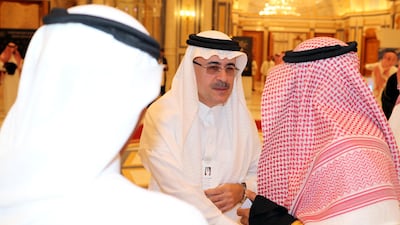
Amin Nasser, president and chief executive of Aramco arrives to the Future Investment Initiative conference in Riyadh, Saudi Arabia, on October 24, 2017. Hamad I Mohammed / Reuters -

A man walks past a sign at the Future Investment Initiative conference in Riyadh, Saudi Arabia on October 24, 2017. Hamad I Mohammed / Reuters -

People attend the Future Investment Initiative (FII) conference in Riyadh, on October 24, 2017. The head of oil giant Saudi Aramco said that a lack of recent investments in the oil sector could lead to a shortage of supplies. Fayez Nureldine / AFP -

People attend the Future Investment Initiative conference in Riyadh, Saudi Arabia on October 24, 2017. Faisal Al Nasser / Reuters


Mr Al Rumayyan reiterated the fund’s strategic imperatives: growing revenue streams while diversifying investments, localising technologies from abroad with the aim of creating 20,000 jobs by 2020, establishing new sectors in Saudi Arabia such as waste management and entertainment.
“It’s better for us not to sit around and wait as the world is changing,” he said.
The global economy and business environment will be influenced by artificial intelligence, robotics, the Internet of Things, and life sciences, which are underpinning the investment outlook of PIF as it looks to a post-oil 21st century.
“We would like more partnerships, better investment opportunities,” Mr Al Rumayyan said.
“This is our way of trying to mitigate for the future.”

