
Saudi Arabia is reducing various expenditures, suspending the cost of living allowance and tripling VAT as the kingdom looks to offset the impact of the coronavirus pandemic on its economy and buttress its finances amid lower oil prices.
The kingdom will cancel, extend or postpone some operational and capital expenditures for some government agencies, finance minister Mohammed Al Jadaan said, according to the state-run Saudi Press Agency.
Mr Al Jaadan said provisions for a number of initiatives from its Vision 2030 economic diversification programme and major projects for the 2020 fiscal year will be reduced.
The cost of living allowance will be discontinued next month and VAT will increase from 5 per cent to 15 per cent from July, he said.
The measures are intended "to protect the kingdom's economy to overcome the unprecedented global corona[virus] pandemic and its financial and economic repercussions with minimal damage," he said.
-

Workers clean and sterilise the roof of Kaaba at the Grand Mosque in Makkah, Saudi Arabia, amid the coronavirus pandemic on April 21, 2020. Saudi Press Agency via Reuters -
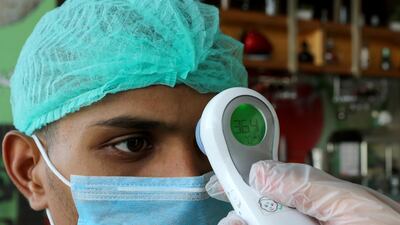
A manager wearing protective gloves checks the temprature of a worker amid the coronavirus pandemic at a restaurant, in Riyadh, Saudi Arabia, on April 26, 2020. Reuters -

Restaurant workers wearing protective suits walk to disinfect the restaurant's cars to prepare them for food delivery during the month of Ramadan on April 19, 2020. Reuters -
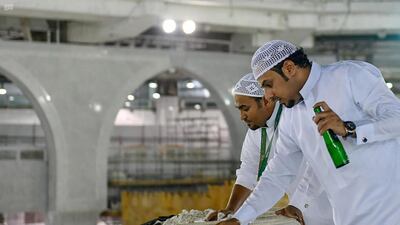
Workers clean and sterilise the roof of Kaaba at the Grand Mosque in Makkah during the month of Ramadan on April 21, 2020. Saudi Press Agency handout via Reuters -

A worker cleans and sterilises the roof of Kaaba at the Grand Mosque in Saudi city of Makkah amid the outbreak of the coronavirus on April 21, 2020. Saudi Press Agency handout via Reuters -

A man loads grocery bags on to his vehicle amid a nationwide curfew to stem the spread of Covid-19 in the Saudi capital Riyadh on April 13, 2020. AFP -

Customers queue outside a supermarket while maintaining social distancing during a nationwide curfew to stem the spread of Covid-19 in the Saudi capital Riyadh on April 13, 2020, ahead of the month of Ramadan. AFP -
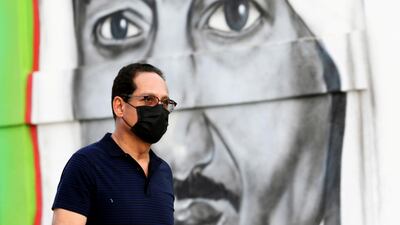
A Saudi man walks past a poster depicting Saudi King Salman, after a curfew was imposed to prevent the spread of the coronavirus in Riyadh, Saudi Arabia on March 25, 2020. Reuters -
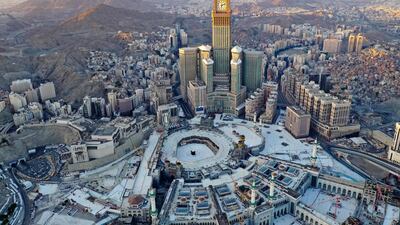
An aerial view shows the Grand Mosque and the Makkah Tower, deserted on the first day of Ramadan, in the Saudi city of Makkah, on April 24, 2020, amid the novel coronavirus crisis AFP -

A Saudi nurse checks a patient's temperature at a mobile clinic in Ajyad Almasafi district of Makkah on April 7, 2020 amid the Covid-19. pandemic. AFP -
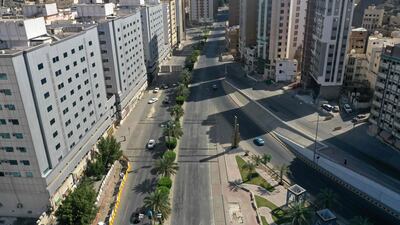
An aerial view shows deserted streets in the Saudi holy city of Makkah. AFP -
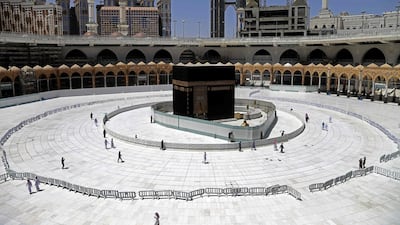
Worshippers circumambulate the Kaaba at the Grand Mosque in Makkah on April 3, 2020. AFP -
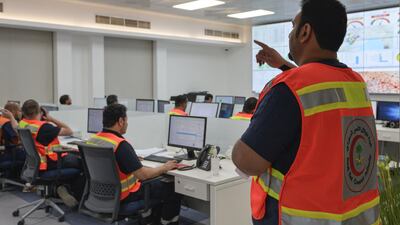
Employees of the Covid-19 coronavirus disease operations room of the Saudi Red Crescent. AFP


On Monday, the UAE said it has no plans to increase the consumption tax. Bahrain implemented VAT in 2019 while GCC member states Kuwait, Oman and Qatar have not introduced tax.
The Covid-19 crisis wiped at least $17 trillion (Dh62.4tn) from stock markets worldwide and led to governments introduce stimulus packages worth more than $8tn (Dh29.4tn) after global trade came to a standstill and countries went into lockdowns.
Saudi Arabia introduced VAT on January 1, 2018, along with other GCC states.
The consumption tax yielded more than Dh44bn in revenue in its first year for the kingdom, more than double the government's own initial estimate.
The Covid-19 crisis has produced three economic shocks, "each of which could in itself have an extremely negative effect on the performance and stability of public finance had the government not intervened by taking measures to absorb them," Mr Al Jaadan said.
The first shock was the unprecedented decline in oil demand, which led to lower prices and a sharp decline in revenue, Mr Al Jadaan said. Oil is key revenue source in the kingdom's state budget.
Oil prices fell more than 60 per cent from their peak in January this year. The decline in demand caused by the outbreak, which brought air and land transport to a standstill amid worldwide travel restrictions, resulted in a decline equivalent to losing all of India's energy needs, according to the International Energy Agency.
India is the third highest primary energy consumer after China and the US.
Prices rebounded this month after the April retreat into negative territory by West Texas Intermediate, the benchmark for US oil, which dropped to as much as -$40.
International benchmark Brent clawed back after it fell to a 21-year low.
WTI was trading at $25.15 and Brent at $30.73 at 6.18pm UAE time on Monday.
Together with major production cuts agreed by Opec and its allies, the coronavirus pandemic is widening the kingdom's budget deficit.
Saudi Arabia, the world's biggest crude exporter, has vast reserves that provide a buffer to cushion the economic blow of Covid-19.
“The new fiscal austerity package ... will help offset a portion of this year’s revenue loss caused by the sharp decline in oil prices and lower oil production," said Alex Perjessy, vice president at Moody’s Investors Service.
"It also points to the government’s capacity to adjust to shocks," he added, noting that the new spending cuts, along with those announced in March and others approved in the 2020 budget, are equivalent to nearly 8 per cent of GDP.
The decision to triple the VAT could generate up to 5 per cent of GDP in extra revenue annually, Mr Perjessy said.
The second shock came in the form of the necessary precautionary measures taken to prevent the spread of the pandemic that led "to the suspension or reduction of many local economic activities, which had a negative impact on non-oil revenue and economic growth", Mr Al Jadaan said.
He said the third shock comprised of unplanned expenses that required government intervention such as increased allocations to support the preventive and treatment capacity of the healthcare sector, as well as initiatives to support the economy, soften the blow of the pandemic and maintain jobs for citizens.
"These challenges combined have led to a decline in public revenue and exerted pressure on public finances in a way that could not be dealt with later without causing harm to the overall economy of the kingdom in the midsummer and long-term," Mr Al Jadaan said.
"Therefore, further reduction in expenditures is needed, as well as undertaking measures that support the stabilisation of non-oil revenue."
The expenditure reduction and other cost cuts will save the kingdom 100 billion riyals (Dh97.6bn), Mr Al Jadaan said.
Saudi Arabia has also set up a ministerial committee to study the financial benefits paid to all employees, contractors and those of similar status whom are not subject to Civil Service Law in government ministries, institutions, authorities, centres and programmes.
The committee will present its findings in 30 days.

"We are facing a crisis the world has never seen the likes of which in modern history," Mr Al Jadaan said.
"A crisis marked by uncertainty and difficulty to forecast its range and ramifications due to daily developments that require governments to deal with it vigilantly, [as well as] make suitable decisions at the right time and adapt to conditions in a way that safeguards public interest, protects citizens and residents and provides basic needs and the necessary healthcare services.
“These measures that have been undertaken today, as tough as they are, are necessary and beneficial to maintain comprehensive financial and economic stability in the medium and long term, for the interest of the country and its citizens."
The pandemic has tipped the global economy into a recession that is expected to be the most severe since the Great Depression of the 1930s, with output shrinking 3 per cent this year, according to the International Monetary Fund.

