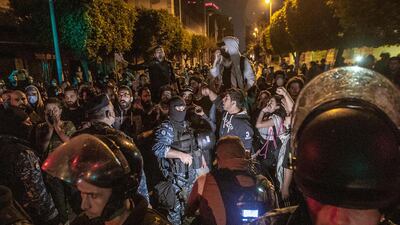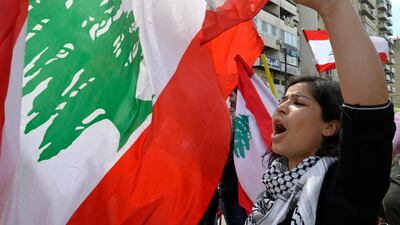
epa08398899 A protester shouts slogans during a protest at Al Nour Square in Tripoli, northern Lebanon, 03 May 2020. Anti-government protesters from across Lebanon arrived in the Lebanese city of Tripoli to show support of demonstrators of the city after the alleged death of a protester Fawaz Al Samman in clashes with the Lebanese army on 28 April 2020. EPA/WAEL HAMZEH
epa08398899 A protester shouts slogans during a protest at Al Nour Square in Tripoli, northern Lebanon, 03 May 2020. Anti-government protesters from across Lebanon arrived in the Lebanese city of Trip

Lebanese PM and IMF head discuss country's worst economic crisis in three decades


Massoud A Derhally
  • English
  • Arabic

Lebanese Prime Minister Hassan Diab and International Monetary Fund managing director Kristalina Georgieva discussed the government’s plan to rescue the economy from its worst crisis in three decades.

“I had a productive call with Lebanon’s PM @Hassan_B_Diab today to discuss the government’s Recovery Plan, which is an important step forward to address #Lebanon’s economic challenges,” Ms Georgieva said in a tweet on Monday.

“We agreed that our teams will soon start discussions on much-needed reforms to restore sustainability and growth for the benefit of the Lebanese people.”

Lebanon formally asked the IMF for a loan of at least $10 billion (Dh36.7bn) on Thursday. The economy has buckled under the weight of mounting debt that forced the country to default on eurobonds in March.

Lebanon's gross domestic product is set to contract 12 per cent this year, according to IMF projections. The country's debt ballooned to $92 billion at the end of January, making it one of the highest debt-to-GDP ratios worldwide.

In total, Lebanon has about $31bn in bond maturities and the bulk of that is held by local financial institutions, with lenders and the central bank accounting for 33.4 per cent and 43 per cent, respectively.

Deposit flows, which financed the country’s deficits and shored up its banking system, have dried up while credit has been frozen and the Lebanese pound has lost more than half of its value against the US dollar.

Long-running political disputes and successive changes of government have prevented Lebanon from carrying out structural reforms needed to unlock pledges worth $11bn by international donors.

The Association of Banks in Lebanon rejected the government's rescue plan and said it was "not consulted" by Mr Diab's administration.

“The association is an essential part of any solution, as the economy requires a strong banking sector capable of playing its role as a means of social integration and growth by granting credit to individuals and companies,” ABL said, a day after the government submitted its request to the fund.

The government’s recovery plan is comprised of measures to adjust the exchange rate regime and restructure public debt and the financial sector.

It also intends to bring about fiscal consolidation and structural, social and environmental reforms while seeking international financial aid.

The programme assumes an exchange rate that fixes the pound at 3,500 to the US dollar – more than double the peg that has existed since 1997.

There are plans to move to a flexible system in the future through a float or a crawling peg, where the rate is frequently adjusted in line with market conditions.

Furthermore, the plan assumes that the country will receive external financial support and the government will successfully execute the reforms in full.

It also assumes that the government will reach a debt restructuring agreement with creditors this year.

The government’s programme envisages the restructuring of the central bank and commercial lenders.

It estimates the central bank’s losses at 117 trillion pounds ($77.6bn/Dh285bn) and impaired liabilities at 121tn pounds.

Commercial bank losses incurred as a result of the crisis and restructuring of public debt are estimated at 186tn pounds.

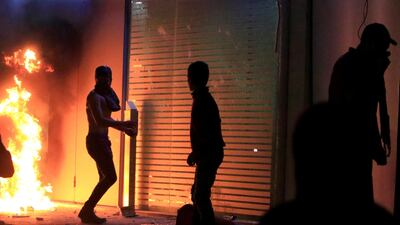
  • A demonstrator is seen next to a burning fire in front of a bank during a protest against growing economic hardship in Sidon, Lebanon. Reuters
    A demonstrator is seen next to a burning fire in front of a bank during a protest against growing economic hardship in Sidon, Lebanon. Reuters
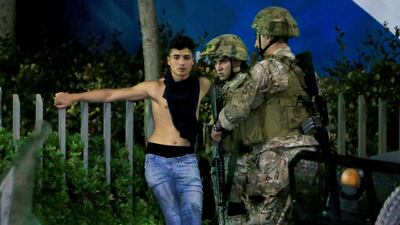
  • A detained demonstrator stands near Lebanese army soldiers during a protest against growing economic hardship in Sidon, Lebanon. Reuters
    A detained demonstrator stands near Lebanese army soldiers during a protest against growing economic hardship in Sidon, Lebanon. Reuters
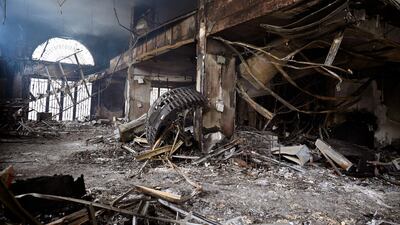
  • Interior view of a damaged bank that was set ablaze by protesters in Tripoli, northern Lebanon. EPA
    Interior view of a damaged bank that was set ablaze by protesters in Tripoli, northern Lebanon. EPA
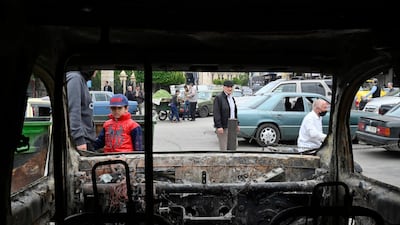
  • Lebanese people inspect a burnt out car of the Lebanese Internal Security Forces which was set ablaze by protesters in Tripoli, northern Lebanon. EPA
    Lebanese people inspect a burnt out car of the Lebanese Internal Security Forces which was set ablaze by protesters in Tripoli, northern Lebanon. EPA
  • Anti-government protesters shout slogans during a protest against the collapsing Lebanese currency and the price hikes of goods, in front the central bank in Beirut, Lebanon. EPA
    Anti-government protesters shout slogans during a protest against the collapsing Lebanese currency and the price hikes of goods, in front the central bank in Beirut, Lebanon. EPA
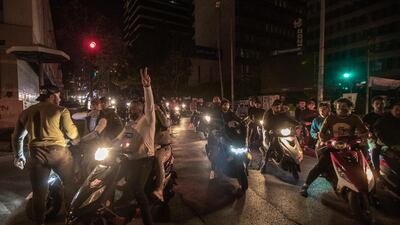
  • Anti-government protesters ride their motorcycles during a protest against the collapsing Lebanese currency and the price hikes of goods, in front the central bank in Beirut, Lebanon. EPA
    Anti-government protesters ride their motorcycles during a protest against the collapsing Lebanese currency and the price hikes of goods, in front the central bank in Beirut, Lebanon. EPA
  • Lebanese men inspect a burnt out car of the Lebanese Internal Security Forces which was set ablaze by protesters in Tripoli, northern Lebanon. EPA
    Lebanese men inspect a burnt out car of the Lebanese Internal Security Forces which was set ablaze by protesters in Tripoli, northern Lebanon. EPA
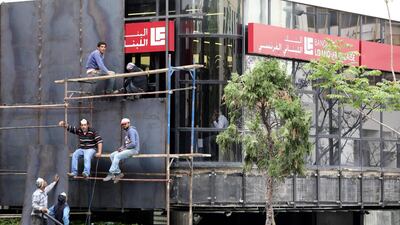
  • Workers install metallic barriers on the facade of a bank as a protective measure against vandalism in Tripoli, northern Lebanon. EPA
    Workers install metallic barriers on the facade of a bank as a protective measure against vandalism in Tripoli, northern Lebanon. EPA
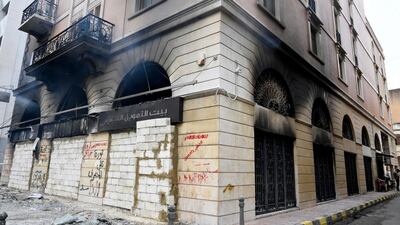
  • Exterior view of a damaged bank that was set ablaze by protesters in Tripoli, northern Lebanon. EPA
    Exterior view of a damaged bank that was set ablaze by protesters in Tripoli, northern Lebanon. EPA
  • Workers install metallic barriers along the facade of a bank as a protective measure against vandalism in the Lebanese capital Beirut. AFP
    Workers install metallic barriers along the facade of a bank as a protective measure against vandalism in the Lebanese capital Beirut. AFP
  • Anti-government protesters shout slogans during a protest against the collapsing Lebanese currency and the price hikes of goods, in front the central bank in Beirut, Lebanon. EPA
    Anti-government protesters shout slogans during a protest against the collapsing Lebanese currency and the price hikes of goods, in front the central bank in Beirut, Lebanon. EPA
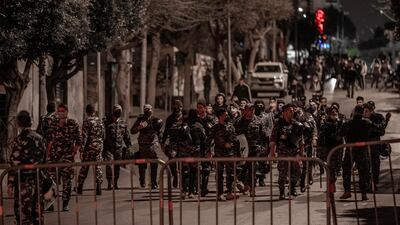
  • Lebanese riot control police watch as annti-government protesters gather during a demonstration against the collapsing Lebanese currency and the price hikes of goods, in Beirut, Lebanon. EPA
    Lebanese riot control police watch as annti-government protesters gather during a demonstration against the collapsing Lebanese currency and the price hikes of goods, in Beirut, Lebanon. EPA
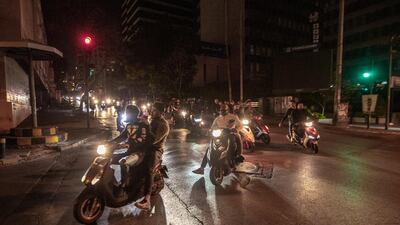
  • Anti-government protesters ride their motorcycles during a protest against the collapsing Lebanese currency and the price hikes of goods, in front the central bank in Beirut, Lebanon. EPA
    Anti-government protesters ride their motorcycles during a protest against the collapsing Lebanese currency and the price hikes of goods, in front the central bank in Beirut, Lebanon. EPA
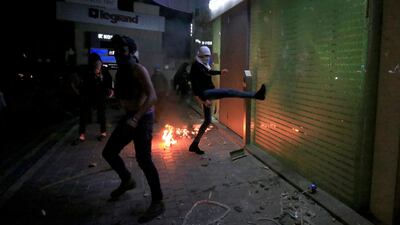
  • A demonstrator smashes a window of a bank during a protest against growing economic hardship in Sidon, Lebanon. Reuters
    A demonstrator smashes a window of a bank during a protest against growing economic hardship in Sidon, Lebanon. Reuters

ABL, however, said that "the local restructuring process, as outlined in the plan, would further undermine confidence in Lebanon, domestically and internationally”.

“At the same time, the plan cited key elements for restoring and strengthening investor confidence, such as an effective anti-corruption strategy, but not being detailed – raising questions about the timing of implementation," it said.

"In fact, the plan is likely to hinder investment in the economy, and therefore the prospects for recovery.”

ABL said the government’s plan does not address inflationary pressures, and may lead to high inflation.

It also said “the social inclusion component of the plan ... requires further explanation and detail, particularly on the following three priorities: job retention, poverty alleviation and inequality reduction.”

ABL said there was an urgent call "for a constructive dialogue" and promised to play its part in supporting the country while adhering to its “fiduciary duties as we have done in the past”. It also called for concrete action and consensus among all concerned parties.

“Every day that passes without reform exacerbates the situation,” ABL said.

It said it intends to present to the government a plan to mitigate the effects of the recession and pave the way for sustainable growth.


Mercer, the investment consulting arm of US services company Marsh & McLennan, expects its wealth division to at least double its assets under management (AUM) in the Middle East as wealth in the region continues to grow despite economic headwinds, a company official said.

Mercer Wealth, which globally has $160 billion in AUM, plans to boost its AUM in the region to $2-$3bn in the next 2-3 years from the present $1bn, said Yasir AbuShaban, a Dubai-based principal with Mercer Wealth.

Within the next two to three years, we are looking at reaching $2 to $3 billion as a conservative estimate and we do see an opportunity to do so,” said Mr AbuShaban.

Mercer does not directly make investments, but allocates clients’ money they have discretion to, to professional asset managers. They also provide advice to clients.

“We have buying power. We can negotiate on their (client’s) behalf with asset managers to provide them lower fees than they otherwise would have to get on their own,” he added.

Mercer Wealth’s clients include sovereign wealth funds, family offices, and insurance companies among others.

From its office in Dubai, Mercer also looks after Africa, India and Turkey, where they also see opportunity for growth.

Wealth creation in Middle East and Africa (MEA) grew 8.5 per cent to $8.1 trillion last year from $7.5tn in 2015, higher than last year’s global average of 6 per cent and the second-highest growth in a region after Asia-Pacific which grew 9.9 per cent, according to consultancy Boston Consulting Group (BCG). In the region, where wealth grew just 1.9 per cent in 2015 compared with 2014, a pickup in oil prices has helped in wealth generation.

BCG is forecasting MEA wealth will rise to $12tn by 2021, growing at an annual average of 8 per cent.

Drivers of wealth generation in the region will be split evenly between new wealth creation and growth of performance of existing assets, according to BCG.

Another general trend in the region is clients’ looking for a comprehensive approach to investing, according to Mr AbuShaban.

“Institutional investors or some of the families are seeing a slowdown in the available capital they have to invest and in that sense they are looking at optimizing the way they manage their portfolios and making sure they are not investing haphazardly and different parts of their investment are working together,” said Mr AbuShaban.

Some clients also have a higher appetite for risk, given the low interest-rate environment that does not provide enough yield for some institutional investors. These clients are keen to invest in illiquid assets, such as private equity and infrastructure.

“What we have seen is a desire for higher returns in what has been a low-return environment specifically in various fixed income or bonds,” he said.

“In this environment, we have seen a de facto increase in the risk that clients are taking in things like illiquid investments, private equity investments, infrastructure and private debt, those kind of investments were higher illiquidity results in incrementally higher returns.”

The Abu Dhabi Investment Authority, one of the largest sovereign wealth funds, said in its 2016 report that has gradually increased its exposure in direct private equity and private credit transactions, mainly in Asian markets and especially in China and India. The authority’s private equity department focused on structured equities owing to “their defensive characteristics.”

MO
%3Cp%3E%3Cstrong%3ECreators%3A%20%3C%2Fstrong%3EMohammed%20Amer%2C%20Ramy%20Youssef%3C%2Fp%3E%0A%3Cp%3E%3Cstrong%3EStars%3A%20%3C%2Fstrong%3EMohammed%20Amer%2C%20Teresa%20Ruiz%2C%20Omar%20Elba%3C%2Fp%3E%0A%3Cp%3E%3Cstrong%3ERating%3A%3C%2Fstrong%3E%204%2F5%3C%2Fp%3E%0A

Director: Laxman Utekar

Cast: Vicky Kaushal, Akshaye Khanna, Diana Penty, Vineet Kumar Singh, Rashmika Mandanna

Rating: 1/5

%3Cp%3E%3Cstrong%3EDirector%3A%3C%2Fstrong%3E%20Nag%20Ashwin%3C%2Fp%3E%0A%3Cp%3E%3Cstrong%3EStarring%3A%20%3C%2Fstrong%3EPrabhas%2C%20Saswata%20Chatterjee%2C%20Deepika%20Padukone%2C%20Amitabh%20Bachchan%2C%20Shobhana%3C%2Fp%3E%0A%3Cp%3E%3Cstrong%3ERating%3A%20%3C%2Fstrong%3E%E2%98%85%E2%98%85%E2%98%85%E2%98%85%3C%2Fp%3E%0A
Boulder shooting victims

• Denny Strong, 20
• Neven Stanisic, 23
• Rikki Olds, 25
• Tralona Bartkowiak, 49
• Suzanne Fountain, 59
• Teri Leiker, 51
• Eric Talley, 51
• Kevin Mahoney, 61
• Lynn Murray, 62
• Jody Waters, 65