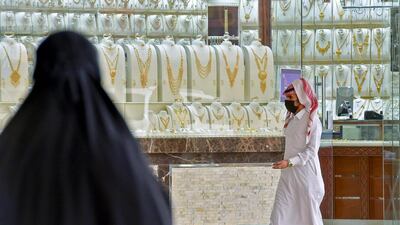
A Saudi man, wearing a protective mask, walks past a jewellery shop in Riyadh. Saudi Arabia's non-oil private sector economy improved slightly in April, but remained in contraction territory. AFP

Gulf non-oil economies show resilience despite coronavirus-induced decline


Sarmad Khan
  • English
  • Arabic

Non-oil economic activity in the GCC’s two biggest economies – Saudi Arabia and the UAE – weakened in April, reflecting the global economic slowdown, as nations across the world continue to enforce lockdowns to stem the spread of the pandemic.

The seasonally-adjusted IHS Markit Saudi Arabia Purchasing Managers' Index – a composite gauge designed to give a single-figure snapshot of operating conditions in the non-oil private sector economy – improved slightly to 44.4 in April from 42.4 in March, reflecting a slower reduction in new work and stronger contribution from the suppliers' delivery times. A reading above neutral 50 level indicates economic expansion and below points to a contraction.

April data signalled a survey-record decline in Saudi Arabia’s private sector business activity. Lower business volumes were attributed to business closures on the back of government imposed restrictions on movements and shrinking customer demand. There were pockets of growth in business activity, though, on the back of a rise in healthcare spending.

"The small minority of Saudi Arabian companies reporting business activity growth in April often linked this to higher spending on healthcare products and services,” Tim Moore, economics director at IHS Markit, which compiles the survey, said. “There were also sporadic reports that a successful shift to online operations had helped to limit the overall decline in new work, especially among service providers.”

Survey respondents, however, remained cautious about business prospects for the year ahead, with sentiment lifting fractionally from the record-low seen in March, he noted.

New work in Saudi Arabia also decreased sharply in April, with export sales particularly hard hit by international border closures and lockdown measures abroad. The latest fall in new orders from abroad was the fastest since the survey began in August 2009.

Firms in the UAE were also impacted in April by public health measures taken to curb the spread of the coronavirus. Movement restrictions and company closures led to a record fall in activity, as many companies lowered output and adopted working-from-home policies.

The IHS Markit UAE Purchasing Managers' Index fell to 44.1 in April, down from 45.2 in March. April data also showed that measures to stop the virus's spread led to falls in new business and export sales. Input cost, however, fell last month on lower expenses as employment fell and wages were cut.

On the demand side, firms saw a slowdown in client activity, while shop closures and movement restrictions led to a decline in consumer demand. That said, some businesses noted a rise in online sales. Tourism activity, however, declined sharply again last month, as countries worldwide imposed similar restrictions amid the pandemic.

“Although the Mena PMIs remained firmly in contraction territory in April, the GCC PMIs look remarkably stable at first glance,” Khatija Haque – head of Mena research and Daniel Marc Richards, a Mena economist at Emirates NBD, wrote in a note on Tuesday.

The UAE PMI declined just over 1 point from March, while the Saudi PMI actually rose slightly from March. However, the disruption to global supply chains have resulted in PMI readings around the world being “artificially boosted by lengthening supplier delivery times”, they noted.

Purchasing managers' indexes and production gauges in most developed and emerging economies have dropped in the wake of the pandemic, which has tipped the world into the steepest recession since the 1930s Great Depression. Economies around the world are struggling and job losses are on the rise as business activity slows. The number of people applying for unemployment benefits last week climbed to more than 30 million in the US, the world’s biggest economy, despite the country pouring trillions into its economy to offset the impact of the outbreak.

The pandemic has infected more than 3.5 million people and fatalities have risen to over 250,000, according to the Johns Hopkins University, which is tracking the outbreak. However, economies in Asia, the Middle East, Europe and North America, including some states in the US, are beginning a gradual reopening in a bid to revive business and boost employment.

Saudi Arabia and the UAE have also begun easing restrictions as the kingdom lifted a countrywide curfew and the UAE last week allowed for a controlled opening of malls and other businesses.

The pandemic also affected Egypt's non-oil private sector economy in April, with activity, new business and exports declining at record rates. Output was severely limited, leading firms to cut cost and reduce employment. Egypt’s PMI gauge fell significantly to 29.7 in April from  44.2 in March, the lowest figure recorded since the survey began in April 2011.

"The Egypt PMI sunk to an historic low … as the country faced the first full month of measures restricting activity and movement in the wake of the Covid-19 pandemic. Businesses lucky enough to remain open scaled back activity on a massive scale, as many highlighted sharp falls in domestic sales and foreign demand,” David Owen, an economist at IHS Markit, said.

Business expectations, however, remain strong, improving since March, which may suggest firms will look to retain or re-hire workers once the economy reopens, he noted.

How has net migration to UK changed?

The figure was broadly flat immediately before the Covid-19 pandemic, standing at 216,000 in the year to June 2018 and 224,000 in the year to June 2019.

It then dropped to an estimated 111,000 in the year to June 2020 when restrictions introduced during the pandemic limited travel and movement.

The total rose to 254,000 in the year to June 2021, followed by steep jumps to 634,000 in the year to June 2022 and 906,000 in the year to June 2023.

The latest available figure of 728,000 for the 12 months to June 2024 suggests levels are starting to decrease.

Jiu-jitsu calendar of events for 2017-2018:

August 5:

Round-1 of the President’s Cup in Al Ain.

August 11-13:

Asian Championship in Vietnam.

September 8-9:

Ajman International.

September 16-17

Asian Indoor and Martial Arts Games, Ashgabat.

September 22-24:

IJJF Balkan Junior Open, Montenegro.

September 23-24:

Grand Slam Los Angeles.

September 29:

Round-1 Mother of The Nation Cup.

October 13-14:

Al Ain U18 International.

September 20-21:

Al Ain International.

November 3:

Round-2 Mother of The National Cup.

November 4:

Round-2 President’s Cup.

November 10-12:

Grand Slam Rio de Janeiro.

November 24-26:

World Championship, Columbia.

November 30:

World Beach Championship, Columbia.

December 8-9:

Dubai International.

December 23:

Round-3 President’s Cup, Sharjah.

January 12-13:

Grand Slam Abu Dhabi.

January 26-27:

Fujairah International.

February 3:

Round-4 President’s Cup, Al Dhafra.

February 16-17:

Ras Al Khaimah International.

February 23-24:

The Challenge Championship.

March 10-11:

Grand Slam London.

March 16:

Final Round – Mother of The Nation.

March 17:

Final Round – President’s Cup.

GIANT REVIEW

Starring: Amir El-Masry, Pierce Brosnan

Director: Athale

Rating: 4/5

UPI facts

More than 2.2 million Indian tourists arrived in UAE in 2023
More than 3.5 million Indians reside in UAE
Indian tourists can make purchases in UAE using rupee accounts in India through QR-code-based UPI real-time payment systems
Indian residents in UAE can use their non-resident NRO and NRE accounts held in Indian banks linked to a UAE mobile number for UPI transactions

The lowdown

Badla

Rating: 2.5/5

Produced by: Red Chillies, Azure Entertainment 

Director: Sujoy Ghosh

Cast: Amitabh Bachchan, Taapsee Pannu, Amrita Singh, Tony Luke

Who's who in Yemen conflict

Houthis: Iran-backed rebels who occupy Sanaa and run unrecognised government

Yemeni government: Exiled government in Aden led by eight-member Presidential Leadership Council

Southern Transitional Council: Faction in Yemeni government that seeks autonomy for the south

Habrish 'rebels': Tribal-backed forces feuding with STC over control of oil in government territory

The%20Roundup
%3Cp%3EDirector%3A%20Lee%20Sang-yong%3Cbr%3EStars%3A%20Ma%20Dong-seok%2C%20Sukku%20Son%2C%20Choi%20Gwi-hwa%3Cbr%3ERating%3A%204%2F5%3C%2Fp%3E%0A
What sanctions would be reimposed?

Under ‘snapback’, measures imposed on Iran by the UN Security Council in six resolutions would be restored, including:

  • An arms embargo
  • A ban on uranium enrichment and reprocessing
  • A ban on launches and other activities with ballistic missiles capable of delivering nuclear weapons, as well as ballistic missile technology transfer and technical assistance
  • A targeted global asset freeze and travel ban on Iranian individuals and entities
  • Authorisation for countries to inspect Iran Air Cargo and Islamic Republic of Iran Shipping Lines cargoes for banned goods
Brown/Black belt finals

3pm: 49kg female: Mayssa Bastos (BRA) v Thamires Aquino (BRA)
3.07pm: 56kg male: Hiago George (BRA) v Carlos Alberto da Silva (BRA)
3.14pm: 55kg female: Amal Amjahid (BEL) v Bianca Basilio (BRA)
3.21pm: 62kg male: Gabriel de Sousa (BRA) v Joao Miyao (BRA)
3.28pm: 62kg female: Beatriz Mesquita (BRA) v Ffion Davies (GBR)
3.35pm: 69kg male: Isaac Doederlein (BRA) v Paulo Miyao (BRA)
3.42pm: 70kg female: Thamara Silva (BRA) v Alessandra Moss (AUS)
3.49pm: 77kg male: Oliver Lovell (GBR) v Tommy Langarkar (NOR)
3.56pm: 85kg male: Faisal Al Ketbi (UAE) v Rudson Mateus Teles (BRA)
4.03pm: 90kg female: Claire-France Thevenon (FRA) v Gabreili Passanha (BRA)
4.10pm: 94kg male: Adam Wardzinski (POL) v Kaynan Duarte (BRA)
4.17pm: 110kg male: Yahia Mansoor Al Hammadi (UAE) v Joao Rocha (BRA

LOVE%20AGAIN
%3Cp%3EDirector%3A%20Jim%20Strouse%3C%2Fp%3E%0A%3Cp%3EStars%3A%20Priyanka%20Chopra%20Jonas%2C%20Sam%20Heughan%2C%20Celine%20Dion%3C%2Fp%3E%0A%3Cp%3ERating%3A%202%2F5%3C%2Fp%3E%0A
COMPANY PROFILE

Company: Bidzi

● Started: 2024

● Founders: Akshay Dosaj and Asif Rashid

● Based: Dubai, UAE

● Industry: M&A

● Funding size: Bootstrapped

● No of employees: Nine

Mercer, the investment consulting arm of US services company Marsh & McLennan, expects its wealth division to at least double its assets under management (AUM) in the Middle East as wealth in the region continues to grow despite economic headwinds, a company official said.

Mercer Wealth, which globally has $160 billion in AUM, plans to boost its AUM in the region to $2-$3bn in the next 2-3 years from the present $1bn, said Yasir AbuShaban, a Dubai-based principal with Mercer Wealth.

Within the next two to three years, we are looking at reaching $2 to $3 billion as a conservative estimate and we do see an opportunity to do so,” said Mr AbuShaban.

Mercer does not directly make investments, but allocates clients’ money they have discretion to, to professional asset managers. They also provide advice to clients.

“We have buying power. We can negotiate on their (client’s) behalf with asset managers to provide them lower fees than they otherwise would have to get on their own,” he added.

Mercer Wealth’s clients include sovereign wealth funds, family offices, and insurance companies among others.

From its office in Dubai, Mercer also looks after Africa, India and Turkey, where they also see opportunity for growth.

Wealth creation in Middle East and Africa (MEA) grew 8.5 per cent to $8.1 trillion last year from $7.5tn in 2015, higher than last year’s global average of 6 per cent and the second-highest growth in a region after Asia-Pacific which grew 9.9 per cent, according to consultancy Boston Consulting Group (BCG). In the region, where wealth grew just 1.9 per cent in 2015 compared with 2014, a pickup in oil prices has helped in wealth generation.

BCG is forecasting MEA wealth will rise to $12tn by 2021, growing at an annual average of 8 per cent.

Drivers of wealth generation in the region will be split evenly between new wealth creation and growth of performance of existing assets, according to BCG.

Another general trend in the region is clients’ looking for a comprehensive approach to investing, according to Mr AbuShaban.

“Institutional investors or some of the families are seeing a slowdown in the available capital they have to invest and in that sense they are looking at optimizing the way they manage their portfolios and making sure they are not investing haphazardly and different parts of their investment are working together,” said Mr AbuShaban.

Some clients also have a higher appetite for risk, given the low interest-rate environment that does not provide enough yield for some institutional investors. These clients are keen to invest in illiquid assets, such as private equity and infrastructure.

“What we have seen is a desire for higher returns in what has been a low-return environment specifically in various fixed income or bonds,” he said.

“In this environment, we have seen a de facto increase in the risk that clients are taking in things like illiquid investments, private equity investments, infrastructure and private debt, those kind of investments were higher illiquidity results in incrementally higher returns.”

The Abu Dhabi Investment Authority, one of the largest sovereign wealth funds, said in its 2016 report that has gradually increased its exposure in direct private equity and private credit transactions, mainly in Asian markets and especially in China and India. The authority’s private equity department focused on structured equities owing to “their defensive characteristics.”

The specs

Engine: 3.9-litre twin-turbo V8
Power: 620hp from 5,750-7,500rpm
Torque: 760Nm from 3,000-5,750rpm
Transmission: Eight-speed dual-clutch auto
On sale: Now
Price: From Dh1.05 million ($286,000)
