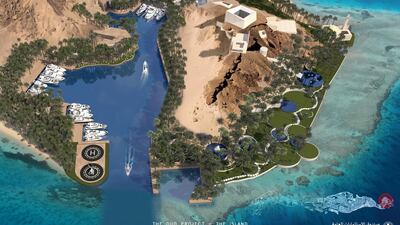
An illustration of the Amaala mega-project - one of a number of coastal and tourism schemes Saudi Arabia is developing under Vision 2030. Courtesy of the Saudi Commission for Tourism and Natural Heritage
An illustration of the Amaala mega-project - one of a number of coastal and tourism schemes Saudi Arabia is developing under Vision 2030. Courtesy of the Saudi Commission for Tourism and Natural Herit

The blue economy – riding a wave of optimism?


  • English
  • Arabic

Oceans have long been at the heart of our planet.

They provide jobs, food security, water, transport, energy and are key drivers of wealth and prosperity.

If they were a single economy, oceans would be the seventh-largest, with an annual estimated value of $1.5 trillion per year, according to The Commonwealth.

More and more interest is emerging around the ‘blue economy’. which is made up of a number of ocean industries such as fisheries, tourism, maritime transport, aquaculture, renewable energy and other economic activities associated with the ocean.

The World Bank has estimated that fisheries contribute $270 billion annually to global gross domestic product. More than 80 percent of trade takes place by sea and the volume of trade by sea is expected to double by 2030.

As more governments are taking steps to promote ocean-based economies, how can the Middle East and North Africa ride the wave?

Pursuing the blue economy and the sustainable use of the oceans can help enable economic diversification and move the region towards a post-oil era.

With diversification plans underway in the region, developing sustainable coastal and marine tourism has vast potential. It is projected to be the largest value-adding segment of the ocean economy by 2030, with global growth rates of more than 3.5 percent forecast by the World Bank. This indicates that investing in non-oil sectors such as the tourism industry is an opportunity to help better diversify the economy.

New waves of investments are encouraging the development of such sectors. As the country with the longest Red Sea coastline, Saudi Arabia has unveiled ambitious plans to invest and develop its Red Sea Coast.

Through Vision 2030, the country is seeking to develop its coastline under a portfolio of projects dubbed the “Riviera of the Middle East” that include Amaala and NEOM.

In the UAE, initiatives have been launched to promote ecotourism across the country.

The National Ecotourism Project was announced by the Ministry of Climate Change and the Environment in a bid to transform and position the country into a leading ecotourism destination.

Another opportunity to boost the blue economy is through developing the maritime industry.

As a backbone of the blue economy, maritime transport remains an integral part of international trade.

Nearly 90 percent of the world’s trade is carried by sea, according to the UN’s International Maritime Organisation. The Indian Ocean alone has the world’s busiest trade route and almost 80 percent of global maritime oil trade flows transits through three of its narrow passages of water.

The region can leverage its strategic location by giving priority to maritime growth.

Strengthening maritime cooperation can help make use of opportunities the blue economy offers. Steps have already been taken to improve the stability and enhance the prosperity of the Indian Ocean – whose coasts are home to nearly 2.7 billion people.

Last year, the UAE took the helm as chair of the Indian Ocean Rim Association (IORA) for the next two years. This was the first time the country has done so since joining the organisation in 1999.

As part of its mandate, the UAE pledged to revive the idea of establishing a development fund for the organisation.

The creation of such a fund has been a long source of disputes since the inception of IORA and will not be an easy task due to the diversity of member states.

However, given their complex interconnectedness, heavy reliance on the Indian Ocean and shared climate change woes, a development fund could further unlock the potential of the ocean.

The blue economy is aligned to the UN’s Sustainable Development Goal number 14, which aims to “conserve and sustainably use the ocean, seas and marine resources for sustainable development”. While the potential of the blue economy has garnered interest from policymakers globally, this comes at a time where the oceans are at a tipping point.

The compounding effects of climate change, pollution, overfishing and the loss of biodiversity put added strain on the oceans.

While the blue economy offers vast potential, ocean health should be at the heart of the agenda.

Strategies taken to advance the blue economy’s potential must be taken through a climate and sustainability lens with a collective responsibility to support ocean health.

The blue economy depends on it.

Maram Ahmed is a Senior Fellow at SOAS, University of London

Results

Final: Iran beat Spain 6-3.

Play-off 3rd: UAE beat Russia 2-1 (in extra time).

Play-off 5th: Japan beat Egypt 7-2.

Play-off 7th: Italy beat Mexico 3-2.

India squads

T20: Rohit Sharma (c), Shikhar Dhawan, KL Rahul, Sanju Samson, Shreyas Iyer, Manish Pandey, Rishabh Pant, Washington Sundar, Krunal Pandya, Yuzvendra Chahal, Rahul Chahar, Deepak Chahar, Khaleel Ahmed, Shivam Dube, Shardul Thakur

Test: Virat Kohli (c), Rohit Sharma, Mayank Agarwal, Cheteshwar Pujara, Ajinkya Rahane, Hanuma Vihari, Wriddhiman Saha (wk), Ravindra Jadeja, Ravichandran Ashwin, Kuldeep Yadav, Mohammed Shami, Umesh Yadav, Ishant Sharma, Shubman Gill, Rishabh Pant

2025 Fifa Club World Cup groups

Group A: Palmeiras, Porto, Al Ahly, Inter Miami.

Group B: Paris Saint-Germain, Atletico Madrid, Botafogo, Seattle.

Group C: Bayern Munich, Auckland City, Boca Juniors, Benfica.

Group D: Flamengo, ES Tunis, Chelsea, Leon.

Group E: River Plate, Urawa, Monterrey, Inter Milan.

Group F: Fluminense, Borussia Dortmund, Ulsan, Mamelodi Sundowns.

Group G: Manchester City, Wydad, Al Ain, Juventus.

Group H: Real Madrid, Al Hilal, Pachuca, Salzburg.

The specs

Engine: 2.0-litre 4cyl turbo

Power: 261hp at 5,500rpm

Torque: 405Nm at 1,750-3,500rpm

Transmission: 9-speed auto

Fuel consumption: 6.9L/100km

On sale: Now

Price: From Dh117,059

MOUNTAINHEAD REVIEW

Starring: Ramy Youssef, Steve Carell, Jason Schwartzman

Director: Jesse Armstrong

Rating: 3.5/5

Indoor cricket World Cup:
Insportz, Dubai, September 16-23

UAE fixtures:
Men

Saturday, September 16 – 1.45pm, v New Zealand
Sunday, September 17 – 10.30am, v Australia; 3.45pm, v South Africa
Monday, September 18 – 2pm, v England; 7.15pm, v India
Tuesday, September 19 – 12.15pm, v Singapore; 5.30pm, v Sri Lanka
Thursday, September 21 – 2pm v Malaysia
Friday, September 22 – 3.30pm, semi-final
Saturday, September 23 – 3pm, grand final

Women
Saturday, September 16 – 5.15pm, v Australia
Sunday, September 17 – 2pm, v South Africa; 7.15pm, v New Zealand
Monday, September 18 – 5.30pm, v England
Tuesday, September 19 – 10.30am, v New Zealand; 3.45pm, v South Africa
Thursday, September 21 – 12.15pm, v Australia
Friday, September 22 – 1.30pm, semi-final
Saturday, September 23 – 1pm, grand final

WHAT IS A BLACK HOLE?

1. Black holes are objects whose gravity is so strong not even light can escape their pull

2. They can be created when massive stars collapse under their own weight

3. Large black holes can also be formed when smaller ones collide and merge

4. The biggest black holes lurk at the centre of many galaxies, including our own

5. Astronomers believe that when the universe was very young, black holes affected how galaxies formed

The specs
  • Engine: 3.9-litre twin-turbo V8
  • Power: 640hp
  • Torque: 760nm
  • On sale: 2026
  • Price: Not announced yet
'Cheb%20Khaled'
%3Cp%3E%3Cstrong%3EArtist%3A%20%3C%2Fstrong%3EKhaled%3Cbr%3E%3Cstrong%3ELabel%3A%20%3C%2Fstrong%3EBelieve%3Cbr%3E%3Cstrong%3ERating%3A%3C%2Fstrong%3E%204%2F5%3C%2Fp%3E%0A
Our family matters legal consultant

Name: Hassan Mohsen Elhais

Position: legal consultant with Al Rowaad Advocates and Legal Consultants.

Milestones on the road to union

1970

October 26: Bahrain withdraws from a proposal to create a federation of nine with the seven Trucial States and Qatar. 

December: Ahmed Al Suwaidi visits New York to discuss potential UN membership.

1971

March 1:  Alex Douglas Hume, Conservative foreign secretary confirms that Britain will leave the Gulf and “strongly supports” the creation of a Union of Arab Emirates.

July 12: Historic meeting at which Sheikh Zayed and Sheikh Rashid make a binding agreement to create what will become the UAE.

July 18: It is announced that the UAE will be formed from six emirates, with a proposed constitution signed. RAK is not yet part of the agreement.

August 6:  The fifth anniversary of Sheikh Zayed becoming Ruler of Abu Dhabi, with official celebrations deferred until later in the year.

August 15: Bahrain becomes independent.

September 3: Qatar becomes independent.

November 23-25: Meeting with Sheikh Zayed and Sheikh Rashid and senior British officials to fix December 2 as date of creation of the UAE.

November 29:  At 5.30pm Iranian forces seize the Greater and Lesser Tunbs by force.

November 30: Despite  a power sharing agreement, Tehran takes full control of Abu Musa. 

November 31: UK officials visit all six participating Emirates to formally end the Trucial States treaties

December 2: 11am, Dubai. New Supreme Council formally elects Sheikh Zayed as President. Treaty of Friendship signed with the UK. 11.30am. Flag raising ceremony at Union House and Al Manhal Palace in Abu Dhabi witnessed by Sheikh Khalifa, then Crown Prince of Abu Dhabi.

December 6: Arab League formally admits the UAE. The first British Ambassador presents his credentials to Sheikh Zayed.

December 9: UAE joins the United Nations.

Mercer, the investment consulting arm of US services company Marsh & McLennan, expects its wealth division to at least double its assets under management (AUM) in the Middle East as wealth in the region continues to grow despite economic headwinds, a company official said.

Mercer Wealth, which globally has $160 billion in AUM, plans to boost its AUM in the region to $2-$3bn in the next 2-3 years from the present $1bn, said Yasir AbuShaban, a Dubai-based principal with Mercer Wealth.

Within the next two to three years, we are looking at reaching $2 to $3 billion as a conservative estimate and we do see an opportunity to do so,” said Mr AbuShaban.

Mercer does not directly make investments, but allocates clients’ money they have discretion to, to professional asset managers. They also provide advice to clients.

“We have buying power. We can negotiate on their (client’s) behalf with asset managers to provide them lower fees than they otherwise would have to get on their own,” he added.

Mercer Wealth’s clients include sovereign wealth funds, family offices, and insurance companies among others.

From its office in Dubai, Mercer also looks after Africa, India and Turkey, where they also see opportunity for growth.

Wealth creation in Middle East and Africa (MEA) grew 8.5 per cent to $8.1 trillion last year from $7.5tn in 2015, higher than last year’s global average of 6 per cent and the second-highest growth in a region after Asia-Pacific which grew 9.9 per cent, according to consultancy Boston Consulting Group (BCG). In the region, where wealth grew just 1.9 per cent in 2015 compared with 2014, a pickup in oil prices has helped in wealth generation.

BCG is forecasting MEA wealth will rise to $12tn by 2021, growing at an annual average of 8 per cent.

Drivers of wealth generation in the region will be split evenly between new wealth creation and growth of performance of existing assets, according to BCG.

Another general trend in the region is clients’ looking for a comprehensive approach to investing, according to Mr AbuShaban.

“Institutional investors or some of the families are seeing a slowdown in the available capital they have to invest and in that sense they are looking at optimizing the way they manage their portfolios and making sure they are not investing haphazardly and different parts of their investment are working together,” said Mr AbuShaban.

Some clients also have a higher appetite for risk, given the low interest-rate environment that does not provide enough yield for some institutional investors. These clients are keen to invest in illiquid assets, such as private equity and infrastructure.

“What we have seen is a desire for higher returns in what has been a low-return environment specifically in various fixed income or bonds,” he said.

“In this environment, we have seen a de facto increase in the risk that clients are taking in things like illiquid investments, private equity investments, infrastructure and private debt, those kind of investments were higher illiquidity results in incrementally higher returns.”

The Abu Dhabi Investment Authority, one of the largest sovereign wealth funds, said in its 2016 report that has gradually increased its exposure in direct private equity and private credit transactions, mainly in Asian markets and especially in China and India. The authority’s private equity department focused on structured equities owing to “their defensive characteristics.”

Specs

Engine: Dual-motor all-wheel-drive electric

Range: Up to 610km

Power: 905hp

Torque: 985Nm

Price: From Dh439,000

Available: Now


Disposing of non-recycleable masks
    Use your ‘black bag’ bin at home Do not put them in a recycling bin Take them home with you if there is no litter bin
  • No need to bag the mask
