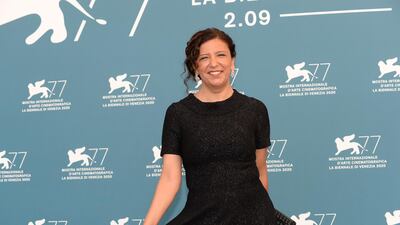
Tunisian director Kaouther Ben Hania. La Biennale di Venezia

'The Man Who Sold His Skin': How a back tattoo inspired Tunisian director Kaouther Ben Hania's latest film


  • English
  • Arabic

A wealthy, celebrated Euro-American artist meets a Syrian refugee and makes an unusual proposal: to use his back as a living, breathing canvas for his latest masterpiece. This conceit is at the heart of Tunisian director Kaouther Ben Hania's second feature film, The Man Who Sold His Skin, which recently had its world premiere at the Venice International Film Festival. "It's shocking," says Ben Hania, of the film's central notion. "And it's intellectually exciting to think about all the repercussions of this."

As far-fetched as it sounds, the inspiration for the film came from real life. In 2006, Belgian artist Wim Delvoye produced the piece Tim, for which he tattooed the back of Tim Steiner, a former tattoo parlour owner from Zurich. He sold the living artwork to a collector, and as part of the slightly macabre contract, Steiner received a third of the sale price and agreed to have his back skinned after his death so the owner could hang this unique piece on their wall.

Ben Hania, 43, who now lives in Paris, saw Delvoye’s human artwork as part of an exhibition in the city’s Louvre museum and the idea for her film began to take shape.

You don't have a choice when you are a refugee. When you don't have much of a choice, what does it mean to be free or to seek freedom?

"The original work of art was just a starting point," she tells The National. "Many movies start with an image, then you have to have a story with an emotional journey." The director met Delvoye, who even has a cameo in the film, but went much further than his tattoo – which features a somewhat generic Madonna and a Mexican-style skull – on Steiner's back.

When Sam Ali (Syrian-born newcomer Yahya Mahayni) first appears in the film, the refugee has fled from Syria to neighbouring Lebanon, where he meets, by chance, artist Jeffrey Godefroi (Flemish actor Koen De Bouw). The artist's evocative idea is to tattoo Sam's back with the image of a Schengen visa, the much-desired legal requirement to enter Europe. Visas were on Ben Hania's mind even before she saw Delvoye's exhibition. "I'm Tunisian, and I went through this process to come to Europe," she says. "You have to get the Schengen visa, so I went through this crazy process for my residency permit in France."

She specifically remembers frustrations about being unable to travel to England when her first feature, 2017's Beauty and the Dogs was selected for the BFI London Film Festival. "I was angry because I'm not born in the right place … I was asking myself: 'What's the difference? Why?'"

The same questions, you imagine, run through Sam's mind in the film.

Making its premiere last week in Venice's Horizons section, which is meant for more daring movies, and winning the Best Actor award for Mahayni, The Man Who Sold His Skin certainly lives up to this billing. Flush with challenging ideas – about art, commerce and exploitation – it also deals with freedom. "What does it mean to be free?" Ben Hania asks. "You don't have a choice when you are a refugee. When you don't have much of a choice, what does it mean to be free or to seek freedom?"

Actor Yahya Mahayni during the photocall for 'The Man Who Sold His Skin' at the Venice Film Festival. La Biennale di Venezia

The Man Who Sold His Skin is also a film that re-examines the portrait of the artist – here envisioned as Mephistopheles-like character. "I was at some point fed up with classic profiles of artists in cinema," Ben Hania says. "They are marginalised, tormented, sometimes alcoholic, sometimes misunderstood. They are struggling with their demons; but we are in an era where artists are becoming entrepreneurs. I wanted to create a more modern profile of an artist."

Ben Hania draws comparisons between art and religion. "People go to museums searching for meaning, trying to understand things. They think that artists can give them meaning. There is this kind of relationship ... People are thirsty for meaning. This is their relationship with art in general."

Having studied in Tunisia and France, where she attended the Sorbonne University, Ben Hania's refined tastes shine through in The Man Who Sold His Skin. It's a visually rich work, thanks in part to cinematographer Christopher Aoun, who shot Lebanese director Nadine Labaki's Oscar-nominated Capernaum. It even stars Italian screen siren Monica Bellucci, who plays Godefroi's scheming assistant, yet for all this, it was "very difficult" to get financed, the director says.

The film also stars Italian actress Monica Bellucci. La Biennale di Venezia

“The first reason was because of my profile. Since I’m used to doing movies only in Tunisia, my country and about women … it defines you.”

Her earlier film, Beauty and the Dogs, which opened in Cannes, was a powerful story of a woman raped by several policemen who must report the crime to the authorities. But when she began to pitch The Man Who Sold His Skin, the feedback was ignorant. "[People would say] 'We don't expect a director from Tunisia to talk about contemporary art … it's too international for you.'"

Ben Hania refused to be deterred until she found financing. Whether she will continue to make international films, however, remains to be seen, but she does not think in those terms. “I don’t take the decision to make a movie that way. It’s about my desire to tell a story,” she says.

For the moment, she is returning to the documentary format where she began her career with films such as 2010's Les imams vont a l'ecole, which dealt with apprentice imams at the Great Mosque of Paris.

Her latest non-fiction tale is still a work in progress, she says. It concerns a woman with four daughters – two of whom were in ISIS. "Sometimes, I think I am doing this job to learn stuff, to research," Ben Hania says.

“I love it when I start a new project in a completely different zone, where I am an outsider and I become very familiar with things. That is why with my films – there is no one film like the other.”

You might say her work is as unique as that tattoo on her actor’s back. 

CREW
%3Cp%3E%3Cstrong%3EDirector%3A%20%3C%2Fstrong%3ERajesh%20A%20Krishnan%3C%2Fp%3E%0A%3Cp%3E%3Cstrong%3EStarring%3A%20%3C%2Fstrong%3ETabu%2C%20Kareena%20Kapoor%20Khan%2C%20Kriti%20Sanon%26nbsp%3B%3C%2Fp%3E%0A%3Cp%3E%3Cstrong%3ERating%3A%3C%2Fstrong%3E%203.5%2F5%3C%2Fp%3E%0A
The%20specs
%3Cp%3E%3Cstrong%3EEngine%3A%3C%2Fstrong%3E%20Twin%20electric%20motors%20and%20105kWh%20battery%20pack%0D%3Cbr%3E%3Cstrong%3EPower%3A%20%3C%2Fstrong%3E619hp%0D%3Cbr%3E%3Cstrong%3ETorque%3A%20%3C%2Fstrong%3E1%2C015Nm%0D%3Cbr%3E%3Cstrong%3ETransmission%3A%20%3C%2Fstrong%3ESingle-speed%20auto%0D%3Cbr%3E%3Cstrong%3ETouring%20range%3A%20%3C%2Fstrong%3EUp%20to%20561km%0D%3Cbr%3E%3Cstrong%3EOn%20sale%3A%20%3C%2Fstrong%3EQ3%20or%20Q4%202022%0D%3Cbr%3E%3Cstrong%3EPrice%3A%20%3C%2Fstrong%3EFrom%20Dh635%2C000%3C%2Fp%3E%0A
Ten tax points to be aware of in 2026

1. Domestic VAT refund amendments: request your refund within five years

If a business does not apply for the refund on time, they lose their credit.

2. E-invoicing in the UAE

Businesses should continue preparing for the implementation of e-invoicing in the UAE, with 2026 a preparation and transition period ahead of phased mandatory adoption. 

3. More tax audits

Tax authorities are increasingly using data already available across multiple filings to identify audit risks. 

4. More beneficial VAT and excise tax penalty regime

Tax disputes are expected to become more frequent and more structured, with clearer administrative objection and appeal processes. The UAE has adopted a new penalty regime for VAT and excise disputes, which now mirrors the penalty regime for corporate tax.

5. Greater emphasis on statutory audit

There is a greater need for the accuracy of financial statements. The International Financial Reporting Standards standards need to be strictly adhered to and, as a result, the quality of the audits will need to increase.

6. Further transfer pricing enforcement

Transfer pricing enforcement, which refers to the practice of establishing prices for internal transactions between related entities, is expected to broaden in scope. The UAE will shortly open the possibility to negotiate advance pricing agreements, or essentially rulings for transfer pricing purposes. 

7. Limited time periods for audits

Recent amendments also introduce a default five-year limitation period for tax audits and assessments, subject to specific statutory exceptions. While the standard audit and assessment period is five years, this may be extended to up to 15 years in cases involving fraud or tax evasion. 

8. Pillar 2 implementation 

Many multinational groups will begin to feel the practical effect of the Domestic Minimum Top-Up Tax (DMTT), the UAE's implementation of the OECD’s global minimum tax under Pillar 2. While the rules apply for financial years starting on or after January 1, 2025, it is 2026 that marks the transition to an operational phase.

9. Reduced compliance obligations for imported goods and services

Businesses that apply the reverse-charge mechanism for VAT purposes in the UAE may benefit from reduced compliance obligations. 

10. Substance and CbC reporting focus

Tax authorities are expected to continue strengthening the enforcement of economic substance and Country-by-Country (CbC) reporting frameworks. In the UAE, these regimes are increasingly being used as risk-assessment tools, providing tax authorities with a comprehensive view of multinational groups’ global footprints and enabling them to assess whether profits are aligned with real economic activity. 

Contributed by Thomas Vanhee and Hend Rashwan, Aurifer

The specs

Engine: 2.0-litre four-cylinder turbo

Power: 268hp at 5,600rpm

Torque: 380Nm at 4,800rpm

Transmission: CVT auto

Fuel consumption: 9.5L/100km

On sale: now

Price: from Dh195,000 

Company%20Profile
%3Cp%3E%3Cstrong%3ECompany%20name%3A%3C%2Fstrong%3E%20Cargoz%3Cbr%3E%3Cstrong%3EDate%20started%3A%3C%2Fstrong%3E%20January%202022%3Cbr%3E%3Cstrong%3EFounders%3A%3C%2Fstrong%3E%20Premlal%20Pullisserry%20and%20Lijo%20Antony%3Cbr%3E%3Cstrong%3EBased%3A%3C%2Fstrong%3E%20Dubai%3Cbr%3E%3Cstrong%3ENumber%20of%20staff%3A%3C%2Fstrong%3E%2030%3Cbr%3E%3Cstrong%3EInvestment%20stage%3A%3C%2Fstrong%3E%20Seed%3C%2Fp%3E%0A
While you're here
Company%20profile
%3Cp%3E%3Cstrong%3ECompany%3A%20%3C%2Fstrong%3EPOPC%3Cbr%3E%3Cstrong%3EStarted%3A%20%3C%2Fstrong%3E2022%3Cbr%3E%3Cstrong%3EFounders%3A%20%3C%2Fstrong%3EAmna%20Aijaz%2C%20Haroon%20Tahir%20and%20Arafat%20Ali%20Khan%3Cbr%3E%3Cstrong%3EBased%3A%3C%2Fstrong%3E%20Dubai%2C%20UAE%3Cbr%3E%3Cstrong%3EIndustry%3A%20%3C%2Fstrong%3Eart%20and%20e-commerce%3Cbr%3E%3Cstrong%3EFunds%20raised%3A%20u%3C%2Fstrong%3Endisclosed%20amount%20raised%20through%20Waverider%20Entertainment%3C%2Fp%3E%0A
The specs

Engine: 4.0-litre V8

Power: 503hp at 6,000rpm

Torque: 685Nm at 2,000rpm

Transmission: 8-speed auto

Price: from Dh850,000

On sale: now

Company profile

Company: Rent Your Wardrobe 

Date started: May 2021 

Founder: Mamta Arora 

Based: Dubai 

Sector: Clothes rental subscription 

Stage: Bootstrapped, self-funded 

Specs

Engine: Dual-motor all-wheel-drive electric

Range: Up to 610km

Power: 905hp

Torque: 985Nm

Price: From Dh439,000

Available: Now

The burning issue

The internal combustion engine is facing a watershed moment – major manufacturer Volvo is to stop producing petroleum-powered vehicles by 2021 and countries in Europe, including the UK, have vowed to ban their sale before 2040. The National takes a look at the story of one of the most successful technologies of the last 100 years and how it has impacted life in the UAE. 

Read part four: an affection for classic cars lives on

Read part three: the age of the electric vehicle begins

Read part two: how climate change drove the race for an alternative 

Conflict, drought, famine

Estimates of the number of deaths caused by the famine range from 400,000 to 1 million, according to a document prepared for the UK House of Lords in 2024.
It has been claimed that the policies of the Ethiopian government, which took control after deposing Emperor Haile Selassie in a military-led revolution in 1974, contributed to the scale of the famine.
Dr Miriam Bradley, senior lecturer in humanitarian studies at the University of Manchester, has argued that, by the early 1980s, “several government policies combined to cause, rather than prevent, a famine which lasted from 1983 to 1985. Mengistu’s government imposed Stalinist-model agricultural policies involving forced collectivisation and villagisation [relocation of communities into planned villages].
The West became aware of the catastrophe through a series of BBC News reports by journalist Michael Buerk in October 1984 describing a “biblical famine” and containing graphic images of thousands of people, including children, facing starvation.

Band Aid

Bob Geldof, singer with the Irish rock group The Boomtown Rats, formed Band Aid in response to the horrific images shown in the news broadcasts.
With Midge Ure of the band Ultravox, he wrote the hit charity single Do They Know it’s Christmas in December 1984, featuring a string of high-profile musicians.
Following the single’s success, the idea to stage a rock concert evolved.
Live Aid was a series of simultaneous concerts that took place at Wembley Stadium in London, John F Kennedy Stadium in Philadelphia, the US, and at various other venues across the world.
The combined event was broadcast to an estimated worldwide audience of 1.5 billion.

Match info

Uefa Champions League Group H

Manchester United v Young Boys, Tuesday, midnight (UAE)

The specs

Engine: 3.8-litre twin-turbo V8

Power: 611bhp

Torque: 620Nm

Transmission: seven-speed automatic

Price: upon application

On sale: now

Profile

Company: Justmop.com

Date started: December 2015

Founders: Kerem Kuyucu and Cagatay Ozcan

Sector: Technology and home services

Based: Jumeirah Lake Towers, Dubai

Size: 55 employees and 100,000 cleaning requests a month

Funding:  The company’s investors include Collective Spark, Faith Capital Holding, Oak Capital, VentureFriends, and 500 Startups. 


Result

6.30pm: Al Maktoum Challenge Round-3 – Group 1 (PA) $65,000 (Dirt) 2,000m; Winner: Brraq, Ryan Curatolo (jockey), Jean-Claude Pecout (trainer)

7.05pm: Handicap (TB) $65,000 (Turf) 1,800m; Winner: Bright Melody, James Doyle, Charlie Appleby

7.40pm: Meydan Classic – Listed (TB) $88,000 (T) 1,600m; Winner: Naval Crown, Mickael Barzalona, Charlie Appleby

8.15pm: Nad Al Sheba Trophy – Group 3 (TB) $195,000 (T) 2,810m; Winner: Volcanic Sky, Frankie Dettori, Saeed bin Suroor

8.50pm: Dubai Millennium Stakes – Group 3 (TB) $130,000 (T) 2,000m; Winner: Star Safari, William Buick, Charlie Appleby

9.25pm: Meydan Challenge – Listed Handicap (TB) $88,000 (T) 1,400m; Winner: Zainhom, Dane O’Neill, Musabah Al Muhairi

Director: Laxman Utekar

Cast: Vicky Kaushal, Akshaye Khanna, Diana Penty, Vineet Kumar Singh, Rashmika Mandanna

Rating: 1/5

McLaren GT specs

Engine: 4-litre twin-turbo V8

Transmission: seven-speed

Power: 620bhp

Torque: 630Nm

Price: Dh875,000

On sale: now

The specs: 2018 Bentley Bentayga V8

Price, base: Dh853,226

Engine: 4.0-litre twin-turbo V8

Transmission: Eight-speed automatic

Power: 550hp @ 6,000pm

Torque: 770Nm @ 1,960rpm

Fuel economy, combined: 11.4L / 100km

The years Ramadan fell in May

1987

1954

1921

1888

First Person
Richard Flanagan
Chatto & Windus 

MATCH INFO

Burnley 1 (Brady 89')

Manchester City 4 (Jesus 24', 50', Rodri 68', Mahrez 87')

The specs

Engine: 2.0-litre 4cyl turbo

Power: 261hp at 5,500rpm

Torque: 405Nm at 1,750-3,500rpm

Transmission: 9-speed auto

Fuel consumption: 6.9L/100km

On sale: Now

Price: From Dh117,059
