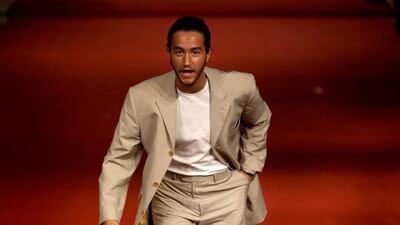
When Ahmed Malek was chosen to be one of the Toronto International Film Festival’s Rising Stars back in 2018, the young Egyptian knew it was a big moment. “Being a local actor in the Middle East, you won’t have this access to the international market,” he explains. From this, he got an agent and access to auditions, even if it meant self-taping in his parents’ basement in Cairo. “My young brother would help me and I would shout, ‘Mum, stay quiet! Don’t cook now!’”
Even before Toronto, Malek had starred in Clash, Mohamed Diab's powder-keg drama that opened the Un Certain Regard strand of the 2016 Cannes Film Festival. But this all rather shows the difficulties facing Mena actors looking to further their careers abroad. Sometimes, it takes a stroke of dumb luck. Take The Furnace, Malek's first English-speaking role, which has just premiered in Venice and is now set to play at El Gouna Film Festival.
An Australian drama from talented first-timer Roderick MacKay, it sheds light on the long-forgotten history of Australia's cameleers during the gold rush of the late 1800s. When the director started casting, "Rod very naively typed in Google, 'Middle Eastern actors'," says Malek. "And then he found me – I don't know where – and saw me in a scene that I did on Egyptian TV. And he liked it so much."
There’s something quite amusing about this fumbled method of discovery. “It sounds like a totally token ‘white guy’ thing to do,” admits MacKay, sheepishly. “I couldn’t understand what anybody was saying because it was all in Arabic, but I was glued to this guy. He struck me as a very emotionally generous actor.” He sent the clip to his producers, who readily agreed and set up a Skype session with Malek.
See photos from 'The Furnace' screening at the 2020 El Gouna Film Festival:
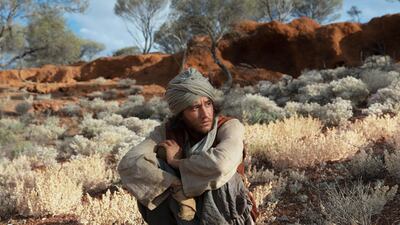
No doubt, Malek's magnetism is striking in The Furnace. He plays Hanif, a young Afghan cameleer who befriends a bushman (David Wenham) on the run with some stolen gold. Like The Proposition crossed with The Treasure of the Sierra Madre, "It's definitely a western," says Malek. "But it's a very unique western. It's western with Muslim cameleers, which you usually don't see, which would make it a one-of-a-kind western."
Malek knew very little about the history of the Muslim cameleers – predominantly Muslim and Sikh men from India, Afghanistan, and Persia. Transporting goods across the harsh Australian Outback, these men helped lay the nation’s infrastructure – railroads and telegraph lines. And then? “For pure racial, colonial reasons, they got kicked out after they’d done their work,” says Malek. “They weren’t permitted to come back.”
Tragically, these men had built lives in Australia, he adds. “This was what makes me sad, knowing the stories about how these men contributed so much. And then they were kicked out and left behind. It just makes you sad and reminds me of what’s going on nowadays, of the disaster that’s happening now between cultures. Everyone just clings to his culture, thinking that it’s superior.”
Sitting opposite me in a hotel garden on Venice's Lido, dressed in a natty green corduroy suit, the 25-year-old Malek speaks confidently in English. It's just one of four languages he had to use in The Furnace, alongside Dari, Pashto and Badimaya, an endangered tongue spoken by indigenous people in Western Australia. Linguistic difficulties were just one of the many things Malek had to overcome.
We are not only numbers dying on the news. We are humans, and we do art as well. And we are sensitive. We don't only have wars
Shot in a remote part of Western Australia, with temperatures pushing 50°C, air-conditioned trailers and hotel rooms were just a distant dream. “We were living in a cabin and next to my cabin … I had a sign that said ‘Beware of snakes’. I saw animals that I had never seen before in my whole life. Kangaroos, I’d never seen. So huge. I’d never seen koalas. I’d never seen dingos. I’d never seen tiger snakes.”
With swarms of flies constantly buzzing around the cast, it was a draining experience. “It was so hard to be honest. But I would say it helped me. The reality for me as an actor – feeling the toughness the heat, feeling the flies and the temperature – would also be the reality of the character. So it served me somehow.” Unsurprisingly, he spent a week recovering on a beach in Sydney afterwards.
Fortunately, Malek – who has been performing since he was 12 years old – is no newcomer to the business. "I come from a working class family. One of my family members saw me perform when I was a kid and he decided to take me to this casting agency and it started from there." In 2010, he got his big break starring as the young Hassan Al-Banna, founder of the Muslim Brotherhood, in the hit Egyptian television series El-Gama'a (The Brotherhood).
After attending the CCDC (Cairo Contemporary Dance Centre), a performing arts school that gave him a good grounding in movement and drama, Malek has worked steadily ever since. Believing the Egyptian film and TV industry is in good health, it’s vital that he and other homegrown actors get opportunities to “showcase our voices”, he adds, “to show the world that we are not only numbers dying on the news. We are humans, and we do art as well. And we are sensitive. We don’t only have wars.”
Since The Furnace, he's been back in Egypt filming several local projects – including multi-love story The Moon's Neighbor. But does he want to further his international career? "I am looking to make English films," he nods. "I'm just taking it step by step. If it's gonna happen, it's gonna happen." While he tells me Joaquin Phoenix is his favourite performer, he's evidently not been swayed by Hollywood glitz.
"Either it's on a small stage in my hometown, or on the big screen in Venice, acting is my passion … I would act anywhere," he says. "Of course, we all have dreams. And of course, you always want to hit a break. But I'm trying as much as possible to take it slowly. To take every opportunity and give it my best." After The Furnace, he may find his name is being Googled an awful lot more.
'The Furnace' plays at El Gouna Film Festival, which runs from October 23 to 31

Ten tax points to be aware of in 2026
1. Domestic VAT refund amendments: request your refund within five years
If a business does not apply for the refund on time, they lose their credit.
2. E-invoicing in the UAE
Businesses should continue preparing for the implementation of e-invoicing in the UAE, with 2026 a preparation and transition period ahead of phased mandatory adoption.
3. More tax audits
Tax authorities are increasingly using data already available across multiple filings to identify audit risks.
4. More beneficial VAT and excise tax penalty regime
Tax disputes are expected to become more frequent and more structured, with clearer administrative objection and appeal processes. The UAE has adopted a new penalty regime for VAT and excise disputes, which now mirrors the penalty regime for corporate tax.
5. Greater emphasis on statutory audit
There is a greater need for the accuracy of financial statements. The International Financial Reporting Standards standards need to be strictly adhered to and, as a result, the quality of the audits will need to increase.
6. Further transfer pricing enforcement
Transfer pricing enforcement, which refers to the practice of establishing prices for internal transactions between related entities, is expected to broaden in scope. The UAE will shortly open the possibility to negotiate advance pricing agreements, or essentially rulings for transfer pricing purposes.
7. Limited time periods for audits
Recent amendments also introduce a default five-year limitation period for tax audits and assessments, subject to specific statutory exceptions. While the standard audit and assessment period is five years, this may be extended to up to 15 years in cases involving fraud or tax evasion.
8. Pillar 2 implementation
Many multinational groups will begin to feel the practical effect of the Domestic Minimum Top-Up Tax (DMTT), the UAE's implementation of the OECD’s global minimum tax under Pillar 2. While the rules apply for financial years starting on or after January 1, 2025, it is 2026 that marks the transition to an operational phase.
9. Reduced compliance obligations for imported goods and services
Businesses that apply the reverse-charge mechanism for VAT purposes in the UAE may benefit from reduced compliance obligations.
10. Substance and CbC reporting focus
Tax authorities are expected to continue strengthening the enforcement of economic substance and Country-by-Country (CbC) reporting frameworks. In the UAE, these regimes are increasingly being used as risk-assessment tools, providing tax authorities with a comprehensive view of multinational groups’ global footprints and enabling them to assess whether profits are aligned with real economic activity.
Contributed by Thomas Vanhee and Hend Rashwan, Aurifer
Women & Power: A Manifesto
Mary Beard
Profile Books and London Review of Books
Classification of skills
A worker is categorised as skilled by the MOHRE based on nine levels given in the International Standard Classification of Occupations (ISCO) issued by the International Labour Organisation.
A skilled worker would be someone at a professional level (levels 1 – 5) which includes managers, professionals, technicians and associate professionals, clerical support workers, and service and sales workers.
The worker must also have an attested educational certificate higher than secondary or an equivalent certification, and earn a monthly salary of at least Dh4,000.
The five pillars of Islam
Pox that threatens the Middle East's native species
Camelpox
Caused by a virus related to the one that causes human smallpox, camelpox typically causes fever, swelling of lymph nodes and skin lesions in camels aged over three, but the animal usually recovers after a month or so. Younger animals may develop a more acute form that causes internal lesions and diarrhoea, and is often fatal, especially when secondary infections result. It is found across the Middle East as well as in parts of Asia, Africa, Russia and India.
Falconpox
Falconpox can cause a variety of types of lesions, which can affect, for example, the eyelids, feet and the areas above and below the beak. It is a problem among captive falcons and is one of many types of avian pox or avipox diseases that together affect dozens of bird species across the world. Among the other forms are pigeonpox, turkeypox, starlingpox and canarypox. Avipox viruses are spread by mosquitoes and direct bird-to-bird contact.
Houbarapox
Houbarapox is, like falconpox, one of the many forms of avipox diseases. It exists in various forms, with a type that causes skin lesions being least likely to result in death. Other forms cause more severe lesions, including internal lesions, and are more likely to kill the bird, often because secondary infections develop. This summer the CVRL reported an outbreak of pox in houbaras after rains in spring led to an increase in mosquito numbers.
Price, base / as tested From Dh173,775 (base model)
Engine 2.0-litre 4cyl turbo, AWD
Power 249hp at 5,500rpm
Torque 365Nm at 1,300-4,500rpm
Gearbox Nine-speed auto
Fuel economy, combined 7.9L/100km
Labour dispute
The insured employee may still file an ILOE claim even if a labour dispute is ongoing post termination, but the insurer may suspend or reject payment, until the courts resolve the dispute, especially if the reason for termination is contested. The outcome of the labour court proceedings can directly affect eligibility.
- Abdullah Ishnaneh, Partner, BSA Law
The President's Cake
Director: Hasan Hadi
Starring: Baneen Ahmad Nayyef, Waheed Thabet Khreibat, Sajad Mohamad Qasem
Rating: 4/5
About Karol Nawrocki
• Supports military aid for Ukraine, unlike other eurosceptic leaders, but he will oppose its membership in western alliances.
• A nationalist, his campaign slogan was Poland First. "Let's help others, but let's take care of our own citizens first," he said on social media in April.
• Cultivates tough-guy image, posting videos of himself at shooting ranges and in boxing rings.
• Met Donald Trump at the White House and received his backing.
What are the GCSE grade equivalents?
- Grade 9 = above an A*
- Grade 8 = between grades A* and A
- Grade 7 = grade A
- Grade 6 = just above a grade B
- Grade 5 = between grades B and C
- Grade 4 = grade C
- Grade 3 = between grades D and E
- Grade 2 = between grades E and F
- Grade 1 = between grades F and G
10 tips for entry-level job seekers
- Have an up-to-date, professional LinkedIn profile. If you don’t have a LinkedIn account, set one up today. Avoid poor-quality profile pictures with distracting backgrounds. Include a professional summary and begin to grow your network.
- Keep track of the job trends in your sector through the news. Apply for job alerts at your dream organisations and the types of jobs you want – LinkedIn uses AI to share similar relevant jobs based on your selections.
- Double check that you’ve highlighted relevant skills on your resume and LinkedIn profile.
- For most entry-level jobs, your resume will first be filtered by an applicant tracking system for keywords. Look closely at the description of the job you are applying for and mirror the language as much as possible (while being honest and accurate about your skills and experience).
- Keep your CV professional and in a simple format – make sure you tailor your cover letter and application to the company and role.
- Go online and look for details on job specifications for your target position. Make a list of skills required and set yourself some learning goals to tick off all the necessary skills one by one.
- Don’t be afraid to reach outside your immediate friends and family to other acquaintances and let them know you are looking for new opportunities.
- Make sure you’ve set your LinkedIn profile to signal that you are “open to opportunities”. Also be sure to use LinkedIn to search for people who are still actively hiring by searching for those that have the headline “I’m hiring” or “We’re hiring” in their profile.
- Prepare for online interviews using mock interview tools. Even before landing interviews, it can be useful to start practising.
- Be professional and patient. Always be professional with whoever you are interacting with throughout your search process, this will be remembered. You need to be patient, dedicated and not give up on your search. Candidates need to make sure they are following up appropriately for roles they have applied.
Arda Atalay, head of Mena private sector at LinkedIn Talent Solutions, Rudy Bier, managing partner of Kinetic Business Solutions and Ben Kinerman Daltrey, co-founder of KinFitz
Winners
Ballon d’Or (Men’s)
Ousmane Dembélé (Paris Saint-Germain / France)
Ballon d’Or Féminin (Women’s)
Aitana Bonmatí (Barcelona / Spain)
Kopa Trophy (Best player under 21 – Men’s)
Lamine Yamal (Barcelona / Spain)
Best Young Women’s Player
Vicky López (Barcelona / Spain)
Yashin Trophy (Best Goalkeeper – Men’s)
Gianluigi Donnarumma (Paris Saint-Germain and Manchester City / Italy)
Best Women’s Goalkeeper
Hannah Hampton (England / Aston Villa and Chelsea)
Men’s Coach of the Year
Luis Enrique (Paris Saint-Germain)
Women’s Coach of the Year
Sarina Wiegman (England)
Spain drain
CONVICTED
Lionel Messi Found guilty in 2016 of of using companies in Belize, Britain, Switzerland and Uruguay to avoid paying €4.1m in taxes on income earned from image rights. Sentenced to 21 months in jail and fined more than €2m. But prison sentence has since been replaced by another fine of €252,000.
Javier Mascherano Accepted one-year suspended sentence in January 2016 for tax fraud after found guilty of failing to pay €1.5m in taxes for 2011 and 2012. Unlike Messi he avoided trial by admitting to tax evasion.
Angel di Maria Argentina and Paris Saint-Germain star Angel di Maria was fined and given a 16-month prison sentence for tax fraud during his time at Real Madrid. But he is unlikely to go to prison as is normal in Spain for first offences for non-violent crimes carrying sentence of less than two years.
SUSPECTED
Cristiano Ronaldo Real Madrid's star striker, accused of evading €14.7m in taxes, appears in court on Monday. Portuguese star faces four charges of fraud through offshore companies.
Jose Mourinho Manchester United manager accused of evading €3.3m in tax in 2011 and 2012, during time in charge at Real Madrid. But Gestifute, which represents him, says he has already settled matter with Spanish tax authorities.
Samuel Eto'o In November 2016, Spanish prosecutors sought jail sentence of 10 years and fines totalling €18m for Cameroonian, accused of failing to pay €3.9m in taxes during time at Barcelona from 2004 to 2009.
Radamel Falcao Colombian striker Falcao suspected of failing to correctly declare €7.4m of income earned from image rights between 2012 and 2013 while at Atletico Madrid. He has since paid €8.2m to Spanish tax authorities, a sum that includes interest on the original amount.
Jorge Mendes Portuguese super-agent put under official investigation last month by Spanish court investigating alleged tax evasion by Falcao, a client of his. He defended himself, telling closed-door hearing he "never" advised players in tax matters.
The Melbourne Mercer Global Pension Index
Mazen Abukhater, principal and actuary at global consultancy Mercer, Middle East, says the company’s Melbourne Mercer Global Pension Index - which benchmarks 34 pension schemes across the globe to assess their adequacy, sustainability and integrity - included Saudi Arabia for the first time this year to offer a glimpse into the region.
The index highlighted fundamental issues for all 34 countries, such as a rapid ageing population and a low growth / low interest environment putting pressure on expected returns. It also highlighted the increasing popularity around the world of defined contribution schemes.
“Average life expectancy has been increasing by about three years every 10 years. Someone born in 1947 is expected to live until 85 whereas someone born in 2007 is expected to live to 103,” Mr Abukhater told the Mena Pensions Conference.
“Are our systems equipped to handle these kind of life expectancies in the future? If so many people retire at 60, they are going to be in retirement for 43 years – so we need to adapt our retirement age to our changing life expectancy.”
Saudi Arabia came in the middle of Mercer’s ranking with a score of 58.9. The report said the country's index could be raised by improving the minimum level of support for the poorest aged individuals and increasing the labour force participation rate at older ages as life expectancies rise.
Mr Abukhater said the challenges of an ageing population, increased life expectancy and some individuals relying solely on their government for financial support in their retirement years will put the system under strain.
“To relieve that pressure, governments need to consider whether it is time to switch to a defined contribution scheme so that individuals can supplement their own future with the help of government support,” he said.
Avatar: Fire and Ash
Director: James Cameron
Starring: Sam Worthington, Sigourney Weaver, Zoe Saldana
Rating: 4.5/5