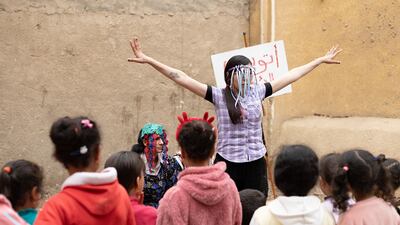
The streets of Cannes are always filled with remarkable sights during the film festival. But this year, passers-by on the famed French boulevard, La Croisette, will be treated to something very unique.
The Panorama Barsha Troupe, an all-female group of young Egyptian dancers, will perform heralding the premiere of a new documentary, The Brink of Dreams, of which they are the stars. It will have its premiere on Friday in the Critics’ Week sidebar and is the only Egyptian film in this year's official selection.
Needless to say, the excitement among these girls is palpable.
“They are still rehearsing and brainstorming,” smiles filmmaker Ayman El Amir, speaking just days before the premiere. Chatting over Zoom, he’s sitting with his wife – and the project’s co-director – Nada Riyadh. They have been to Cannes with The Trap in 2019, Riyadh’s short film about an unmarried young couple facing difficulties, which was produced by El Amir.
“Documentaries we like directing together,” explains Riyadh. “With fiction, we each direct our own.”

It’s no surprise that they took on double duties for The Brink of Dreams, a project they shot over four years in the remote village of Barsha in southern Egypt. The project's origins stretch back to 2016.
“We used to work with a Cairo-based feminist institute that supported women in the arts in marginalised communities,” adds Riyadh. “That’s when we first met the Panorama Barsha Troupe. And we were fascinated with their performance.”
After staying in touch for two years, Riyadh and El Amir were invited to screen their shorts in the village.
From then, Riyadh and El Amir began filming this troupe, who all have dreams of pursuing careers in theatre, dance and the arts. The filmmakers weren’t the first to approach them, but the girls refused earlier advances.
“They didn’t feel like they were being heard or that they would be represented in a way that is acceptable to them,” say Riyadh. “It’s not a one-way relationship. It’s a two-way relationship. I think we wanted to understand more about this community and we were open to listening and that’s what allowed us time to build a strong connection [with them].”
More than anything, The Brink of Dreams eloquently captures a period of transition, as the main protagonists grow from girls into young women. “At the beginning of the film they are free, and they could be anything that they could be or wish to be,” says El Amir. “But in the end, they are taking decisions that will make them as a person.”

Of course, girls from the troupe like Haidi and Majda face external pressures, with not everyone in their network able to understand or appreciate their desire to work in the arts.
One of the film’s most important moments comes as El Amir and Riyadh capture an argument between Haidi and her fiance, who forcefully suggests she delete the other girls’ numbers from her phone, before snatching the mobile and throwing it away. While the filmmakers had expected something to “erupt” between these two, they claim the fiance never wanted the cameras turned off.
“I think every character is representing their true self,” says El Amir. “The man has nothing to hide. That’s really what he is very proud of believing in and of wanting to be.”
Do they think the film is a perfect representation of old-fashioned patriarchal attitudes towards women? “I think one of our main – let’s say hope or vision – from the beginning was to break the stereotypes about men and women,” says El Amir. “So in the film, you see many men and, of course, the fiance is one of them, but also we see Haidi’s father and he’s very supportive of what his girl is doing. I don’t think we could generalise that all of the men are old-fashioned or are sticking to traditions or are conservative.”

Riyadh nods in agreement. “I think it’s very easy to just think women in conservative societies are oppressed because of men, but that’s not really the truth,” she adds. “The truth is that we live in complicated contexts where both men and women are entrapped into gender roles and are being pressured by economic, societal and structures around them. So first, the important thing is to take a step back and analyse why there are limitations on women’s dreams, but not to judge a southern man per se.”
Since completing the film, they’ve remained in regular contact with the troupe, even starting up an impact campaign that took the girls to Cairo last year to meet with different arts and cultural institutes.
“We’re hoping with the release of the film that we can not only maintain a relationship with these girls,” says Riyadh, “but also use the film as a tool for other similar troupes and other women in marginalised areas to become aware of the possibilities of being an artist.”
That journey starts Friday, on the streets of Cannes.

