
Serendipity is at the heart of an extraordinary true story that has just hit bookshop shelves. It is remarkable by all accounts; the tale of a Syrian man in Aleppo who perilously dedicates years of his life and his own finances to becoming an impromptu ambulance driver to help locals injured during the war. Not only that, but he also opens a sanctuary to help cats displaced after their owners fled the conflict.
A British journalist covers the story, many around the world are touched by his kindness to cats and, with the help of a young, social media-savvy woman in Italy, his name and compassionate work with cats go viral. The next thing he knows, donations are flooding in and he is able to support hundreds of cats, as well as thousands of desperate people trapped in Aleppo.
The Last Sanctuary in Aleppo is a gentle, easy read in one regard: the prose is simple, with Alaa Aljaleel telling his own story, in his own words. Bookended by a prologue and an epilogue, it is a linear and engaging story of Aljaleel's life: growing up as an ordinary boy in Syria, going to school, learning to become an electrician, doing his military service, running a successful business, starting a family and so on, before the war changes everything. It also tracks Aljaleel's love of animals, particularly cats, from an early age, as well as his longing to be a rescue worker like his father, who was a fireman, although corruption and a system of wasta (or cronyism) in Syria prevent Aljaleel from achieving his dream job.
"It's ironic that it took this war in Syria for me to get the opportunity to do the work I've always wanted to do, rescuing people," he says wryly. "I've always felt that it's my duty and my pleasure to help people and animals whenever they need help."
This work is awe-inspiring and heart-warming. Aljaleel went to extraordinary lengths, risking his own life to take injured civilians to makeshift hospitals before and during the brutal battle of Aleppo, while his dedication to looking after hundreds of cats earned him the moniker The Cat Man of Aleppo. Aljaleel's story restores a sense of humanity that is absent in so much media coverage of the conflict.
The tragic stories are leavened in part by Aljaleel's gentle sense of humour. He gives many of his cats apposite names: two lightning-quick felines are called Sukhoi 25 and Sukhoi 26, after the Russian warplanes that routinely terrorise the people of Syria; while a big, sinister-looking cat is named Al-Baghdadi after the leader of ISIS. He says that in Syria, the saying goes that a cat has seven lives, whereas in the West, they're said to have nine. "Maybe it's because it's more dangerous here," Aljaleel suggests.
Perhaps most moving and thought-provoking are Aljaleel's comments on religion and the nature of war. Living in East Aleppo during the civil unrest, he is confronted and threatened many times by fundamentalists fighting with the Free Syrian Army.
"After this war, I distanced myself from religion," he says. "I learnt from this crisis that many people use religion as an excuse. Even criminals became religious if it suited their purpose. Now I rarely go to the mosque, because it's full of extremists pretending they understand religion. Everything was turned upside down by this war.
People who knew nothing about Islam suddenly called themselves religious, and people who knew a lot were suddenly labelled kafirs or unbelievers. I am religious in my own way, which is just between me and my God."
-
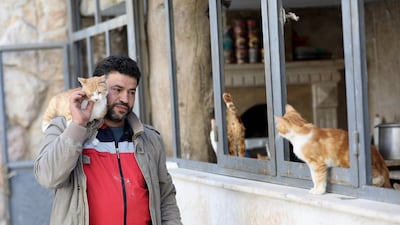
Mohammed Alaa al-Jaleel carries a cat on his shoulder at Ernesto's Cat Sanctuary that he runs in Kfar Naha, an opposition-held town in Aleppo province. AFP -
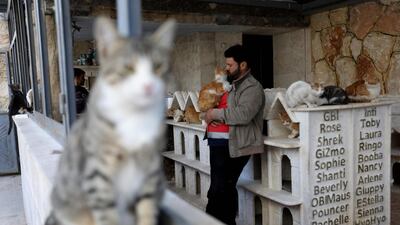
The 43-year-old grew up in Aleppo and has been mad about cats since he was a boy. AFP -
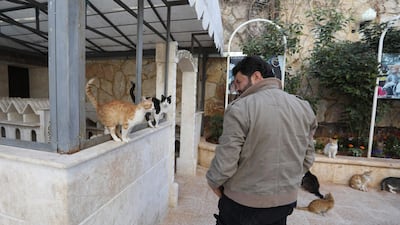
As the war raged in Syria and cat lovers fled the city, he was left with 170 cats to feed and a new nickname: the Cat Man of Aleppo. AFP -
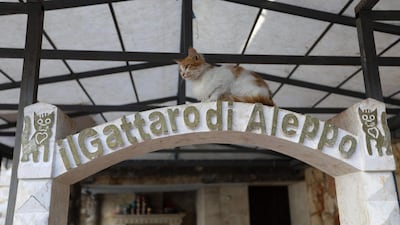
A cat sits at the entrance of the sleeping area of Ernesto's Cat Sanctuary in Kfar Naha. AFP -
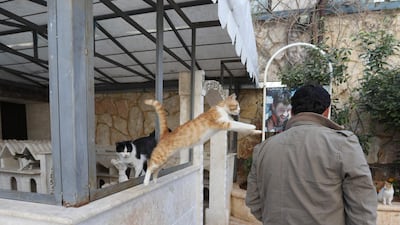
A cat jumps on Mohammed Alaa al-Jaleel's shoulder at Ernesto's Cat Sanctuary. AFP -
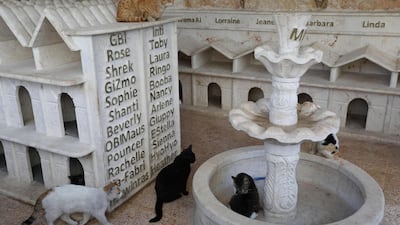
Cats walk around a marble fountain and cubes used as houses at Ernesto's Cat Sanctuary. AFP -
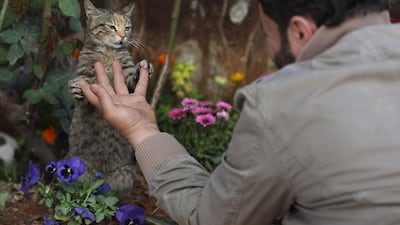
Mohammed Alaa al-Jaleel plays with a cat at Ernesto's Cat Sanctuary. AFP -
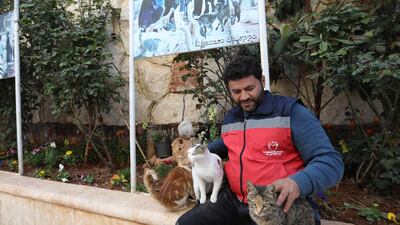
"If you want to show mercy to people, start by showing mercy to everything else," says Jaleel. AFP -
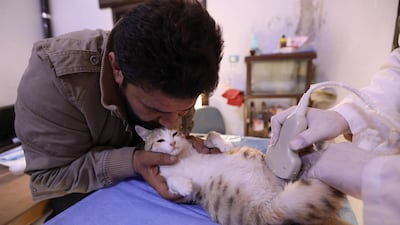
Mohammed Alaa al-Jaleel comforts a feline patient on her back as an ultrasound probe is rolled across her pregnant belly at Ernesto's Cat Sanctuary. AFP -
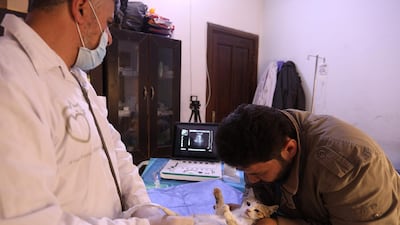
Mohammed Alaa al-Jaleel helps hold a feline patient on her back as an ultrasound probe is rolled across her pregnant belly at Ernesto's Cat Sanctuary. AFP -
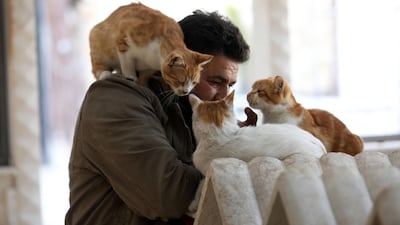
Mohammed Alaa al-Jaleel pets cats near marble cubes used as houses at Ernesto's Cat Sanctuary that he runs in Kfar Naha. AFP -
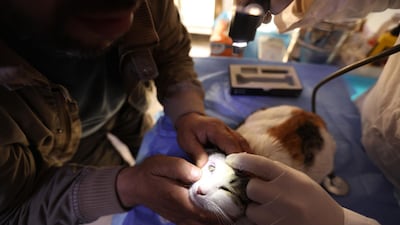
A feline patient as it gets its eyes checked at Ernesto's Cat Sanctuary. AFP -
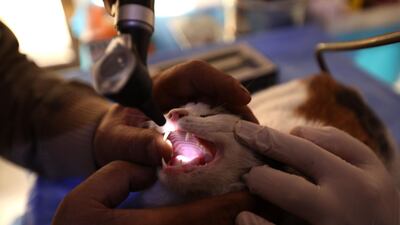
It also gets its teeth checked at Ernesto's Cat Sanctuary. AFP -
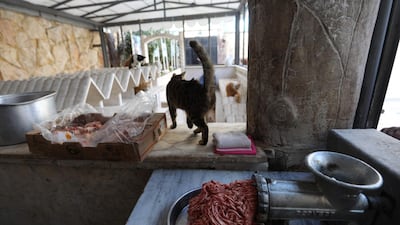
A grinder churns out streams of mincemeat to feed cats at Ernesto's Cat Sanctuary run by Mohammed Alaa al-Jaleel in Kfar Naha. AFP -
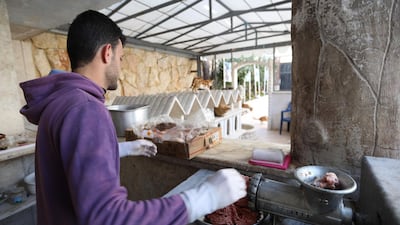
A volunteer grinds mincemeat to feed cats at Ernesto's Cat Sanctuary. AFP -
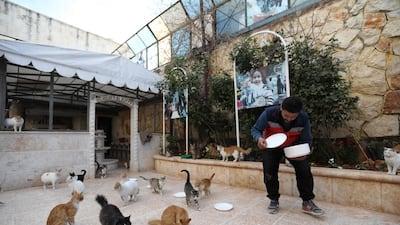
Mohammed Alaa al-Jaleel spreads plates on the ground to feed cats at lunchtime. AFP -
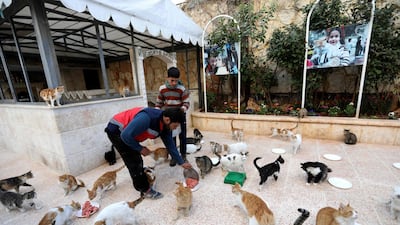
Mohammed Alaa al-Jaleel scoopes out mincemeat onto plates to feed cats at lunchtime. AFP -
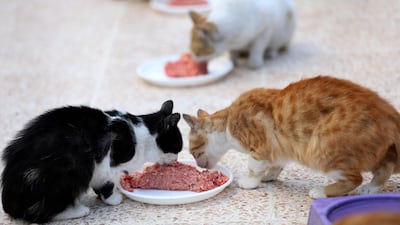
Cats feed on mincemeat at lunchtime at Ernesto's Cat Sanctuary. AFP -
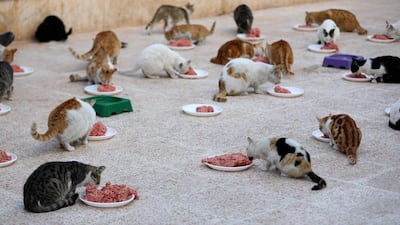
Cats feed on mincemeat at lunchtime. AFP -
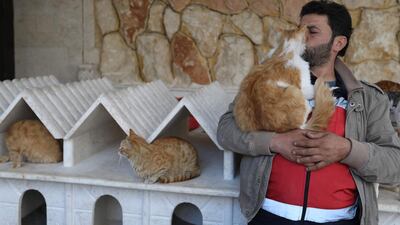
Mohammed Alaa al-Jaleel holds a feline near marble cubes used as houses at Ernesto's Cat Sanctuary. AFP


Having witnessed unspeakable horrors and exploitation of people during the war, Aljaleel's sharpest contempt is saved for the fighters.
He notes tragically the enormous civilian cost of the war in terms of the lives, businesses and homes lost. "Aleppo was a great city," he says. "It took thousands of years to build up through the work of hundreds of generations. It survived Mongol invasions, famines, droughts and earthquakes. But one generation has brought it down in just four years."
But it is Aljaleel's indefatigable commitment to the cats of Aleppo that brings his compatriots – most of whom regard his concern for animals as ridiculous and preposterous – and admirers from around the world together to create a shared understanding and respect. And it is this understanding which has in turn brought desperately needed support – and hope.
"It's our mission to show people how these animals have brought good luck for everyone," he says. "Through caring for animals I've been able to convey to people abroad the image of how people inside Syria are suffering. People in the West know there are children and adults who need help via us, and we're expanding our activities day by day through our projects, which are designed to help both humans and animals. Thank God I have found a way to be a bridge between the people in the West and people here who need our help."

There is one other element of serendipity in this story. While it is largely Aljaleel's narrated story, it is penned by British writer Diana Darke, who was enlisted to piece his story together because of her ties with, and knowledge of, Syria.
Initially, Darke had to reluctantly turn down the commission due to other commitments. But then friends of hers, Raeda and Ammar – a Syrian couple displaced in Beirut and awaiting the chance to start a new life in Italy – had their plans put on hold after Ammar's visa was delayed due to a case of mistaken identity.
"They were absolutely desperate, stuck in Beirut with no income," says Darke. "They had wound down all the translation work they'd been doing, and I just thought: if they're stuck there and if I can get them to do the bulk of the time-consuming work – contacting Aljaleel, gathering all of the material from him and building the relationship with him, which is really going to take the time, then that will actually work really well for them, providing financial support, and it will enable me to take it on."
The schedule for the project was extremely tight and difficult for everyone to coordinate their efforts, but in the end it all fell into place. "It's a wonderful testimony to how the team of us have managed it and, as a result, Aljaleel himself has got a really good relationship with Raeda and Ammar [who is also from Aleppo], and therefore with me," says Darke. "Everyone has helped each other, which is what's lovely about it."
While she and Aljaleel have yet to meet in person – they recently had a long conversation by phone while Darke was visiting Raeda and Ammar in Lebanon – they hope to do so before long, she says. "I feel as though I know him even though we hadn't had this direct conversation until last week. We have formed a bond."
The Last Sanctuary in Aleppo is published by Headline and is available now from Amazon and other online retailers

