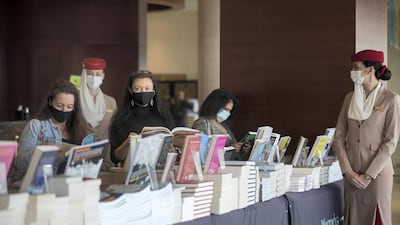
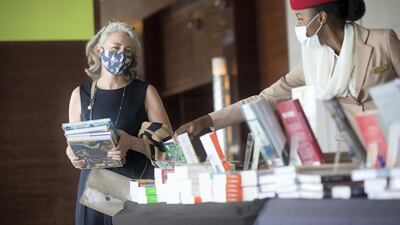
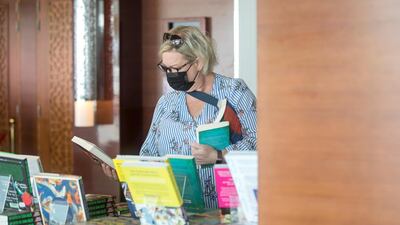
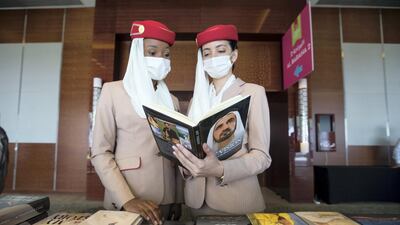
Nimble planning is what helped the team behind the Emirates Airline Festival of Literature persevere through one of its most difficult years.
Not only did this attention to detail help them pull off a successful event mid-pandemic, but it also sparked several ideas that may be used in future iterations of the festival. Organisers say these changes could inspire more literary heavyweights to take part in the event and boost global participation like never before.
'Literature is a basic human right'
At first, the challenges and uncertainties brought on by Covid-19 seemed insurmountable. It wasn’t even clear if the festival would be able to take place, and whether it could be held safely in a physical setting or had to go completely virtual. Travel restrictions and social distancing guidelines changed on a daily basis. What if scheduled authors were unable to come? What if another lockdown was declared?
Despite all of these challenges, festival director Ahlam Bolooki says they were determined to see the event happen. The festival could provide a hint of much-needed normalcy for many, but it could also provide a platform for people to deliberate on issues made even more pressing in light of the pandemic.
“Literature is a basic human right,” she says. “We really believe in the importance of what we do and, no matter what challenges we faced, we wanted to keep going on.”
As we now know, the festival did eventually take place. It was held across three weekends and in three different venues. It began on January 29 at the Jameel Arts Centre, before moving on to its traditional home at the InterContinental Dubai Festival City, followed by its conclusion on February 13 at Alserkal Avenue.
Bolooki says the decision to hold the festival across different locations was a way of opening it up to the local community. “Spreading out is definitely something we thought worked really well this year and are open to considering more of in the future,” she says.
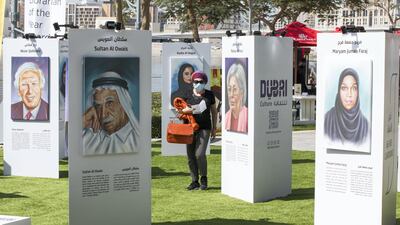
As a way of ensuring social distancing measures and the safety of attendees, a large portion of the festival was also held outdoors. At InterContinental Dubai Festival City, a number of pavilions were set up on the grassy fields by the hotel, where panel discussions, as well as online author talks, took place.
“We made those changes within the last two weeks,” Bolooki explains. “We had to take decisions that would enable us to hold the festival safely.”
Of course, we missed the book signings this year, but otherwise it was as good as it could've been
This decision might have a long-lasting impact, however. "That was one of my favourite things this year," Bolooki says. "Especially at the InterContinental Hotel, sitting in the pavilions outside, watching a session with the Dubai Creek and the Mohammed Bin Rashid Library on my right. It felt like a dream. It was really beautiful. Holding the festival outdoors is something that I'd love to keep for next year."
In a way, the pandemic also showed organisers what was possible from a technological standpoint. “We made sure we had the big LED screens during the virtual talks,” Bolooki says. “No matter where you were sitting, it felt like you were right there in the front row.”
High-profile figures such as Malala Yousafzai and Elif Shafak gave talks this way, appearing via screen and answering questions from the audience.
“Of course, we missed the book signings this year, but otherwise it was as good as it could’ve been,” Bolooki adds.
The online author talks also helped audiences from all over the world participate in the festival. Bolooki says the organising team is currently working on compiling streaming statistics, which will be released soon.
“One important outcome of the festival is that it showed us what’s possible. So many times, we’ve lost the opportunity to host big-name authors because of their clashing schedules. Now, through the technology, they could be up close and personal even if they can’t fly in.”
While virtual appearances are viable, Bolooki says she would still prefer if authors can physically attend the festival.
“Hopefully, we’ll be at a place next year where enough of us are vaccinated and we can have more authors attend in person,” she says.
The 2021 event may have brought unforeseen challenges, but it also presented “a huge learning experience that we will certainly carry forward in future years”, she adds.

Six things you need to know about UAE Women’s Special Olympics football team
Several girls started playing football at age four
They describe sport as their passion
The girls don’t dwell on their condition
They just say they may need to work a little harder than others
When not in training, they play football with their brothers and sisters
The girls want to inspire others to join the UAE Special Olympics teams
More on Quran memorisation:
Islamic%20Architecture%3A%20A%20World%20History
%3Cp%3E%3Cstrong%3EAuthor%3A%3C%2Fstrong%3E%20Eric%20Broug%3Cbr%3E%3Cstrong%3EPublisher%3A%3C%2Fstrong%3E%20Thames%20%26amp%3B%20Hudson%3Cbr%3E%3Cstrong%3EPages%3A%3C%2Fstrong%3E%20336%3Cbr%3E%3Cstrong%3EAvailable%3A%3C%2Fstrong%3E%20September%3C%2Fp%3E%0A
Mohammed bin Zayed Majlis
The burning issue
The internal combustion engine is facing a watershed moment – major manufacturer Volvo is to stop producing petroleum-powered vehicles by 2021 and countries in Europe, including the UK, have vowed to ban their sale before 2040. The National takes a look at the story of one of the most successful technologies of the last 100 years and how it has impacted life in the UAE.
Read part four: an affection for classic cars lives on
Read part three: the age of the electric vehicle begins
Read part one: how cars came to the UAE
Zayed Sustainability Prize
More on Quran memorisation:
Gulf Under 19s final
Dubai College A 50-12 Dubai College B
Pox that threatens the Middle East's native species
Camelpox
Caused by a virus related to the one that causes human smallpox, camelpox typically causes fever, swelling of lymph nodes and skin lesions in camels aged over three, but the animal usually recovers after a month or so. Younger animals may develop a more acute form that causes internal lesions and diarrhoea, and is often fatal, especially when secondary infections result. It is found across the Middle East as well as in parts of Asia, Africa, Russia and India.
Falconpox
Falconpox can cause a variety of types of lesions, which can affect, for example, the eyelids, feet and the areas above and below the beak. It is a problem among captive falcons and is one of many types of avian pox or avipox diseases that together affect dozens of bird species across the world. Among the other forms are pigeonpox, turkeypox, starlingpox and canarypox. Avipox viruses are spread by mosquitoes and direct bird-to-bird contact.
Houbarapox
Houbarapox is, like falconpox, one of the many forms of avipox diseases. It exists in various forms, with a type that causes skin lesions being least likely to result in death. Other forms cause more severe lesions, including internal lesions, and are more likely to kill the bird, often because secondary infections develop. This summer the CVRL reported an outbreak of pox in houbaras after rains in spring led to an increase in mosquito numbers.
The years Ramadan fell in May
More from Neighbourhood Watch:
Mercer, the investment consulting arm of US services company Marsh & McLennan, expects its wealth division to at least double its assets under management (AUM) in the Middle East as wealth in the region continues to grow despite economic headwinds, a company official said.
Mercer Wealth, which globally has $160 billion in AUM, plans to boost its AUM in the region to $2-$3bn in the next 2-3 years from the present $1bn, said Yasir AbuShaban, a Dubai-based principal with Mercer Wealth.
“Within the next two to three years, we are looking at reaching $2 to $3 billion as a conservative estimate and we do see an opportunity to do so,” said Mr AbuShaban.
Mercer does not directly make investments, but allocates clients’ money they have discretion to, to professional asset managers. They also provide advice to clients.
“We have buying power. We can negotiate on their (client’s) behalf with asset managers to provide them lower fees than they otherwise would have to get on their own,” he added.
Mercer Wealth’s clients include sovereign wealth funds, family offices, and insurance companies among others.
From its office in Dubai, Mercer also looks after Africa, India and Turkey, where they also see opportunity for growth.
Wealth creation in Middle East and Africa (MEA) grew 8.5 per cent to $8.1 trillion last year from $7.5tn in 2015, higher than last year’s global average of 6 per cent and the second-highest growth in a region after Asia-Pacific which grew 9.9 per cent, according to consultancy Boston Consulting Group (BCG). In the region, where wealth grew just 1.9 per cent in 2015 compared with 2014, a pickup in oil prices has helped in wealth generation.
BCG is forecasting MEA wealth will rise to $12tn by 2021, growing at an annual average of 8 per cent.
Drivers of wealth generation in the region will be split evenly between new wealth creation and growth of performance of existing assets, according to BCG.
Another general trend in the region is clients’ looking for a comprehensive approach to investing, according to Mr AbuShaban.
“Institutional investors or some of the families are seeing a slowdown in the available capital they have to invest and in that sense they are looking at optimizing the way they manage their portfolios and making sure they are not investing haphazardly and different parts of their investment are working together,” said Mr AbuShaban.
Some clients also have a higher appetite for risk, given the low interest-rate environment that does not provide enough yield for some institutional investors. These clients are keen to invest in illiquid assets, such as private equity and infrastructure.
“What we have seen is a desire for higher returns in what has been a low-return environment specifically in various fixed income or bonds,” he said.
“In this environment, we have seen a de facto increase in the risk that clients are taking in things like illiquid investments, private equity investments, infrastructure and private debt, those kind of investments were higher illiquidity results in incrementally higher returns.”
The Abu Dhabi Investment Authority, one of the largest sovereign wealth funds, said in its 2016 report that has gradually increased its exposure in direct private equity and private credit transactions, mainly in Asian markets and especially in China and India. The authority’s private equity department focused on structured equities owing to “their defensive characteristics.”
The President's Cake
Director: Hasan Hadi
Starring: Baneen Ahmad Nayyef, Waheed Thabet Khreibat, Sajad Mohamad Qasem
Rating: 4/5
More from Neighbourhood Watch:
Zayed Sustainability Prize