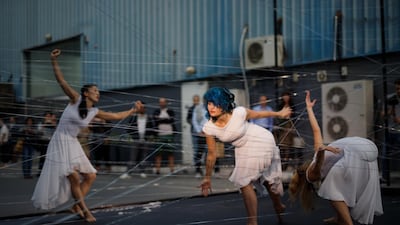
A performance at Quoz Arts Fest 2019 at Dubai's Alserkal Avenue. Courtesy Alserkal Avenue

UAE’s women art collectors to discuss what’s ahead for Middle East art


Alexandra Chaves
  • English
  • Arabic

In the past decade, the Middle East's art scene has evolved to include more museums, events and institutions. It is this growth, as well as what comes next, that a new series of talks by The Art Circle wants to examine.

Founded in 2018 by Barbara Farahnick-Mathonet, who also serves as director, The Art Circle is a non-profit organisation and network of women art collectors in the UAE. The members-only club stages activities throughout the art season, from studio visits to private tours of exhibitions and art collections.

Tac is bringing together four female directors from the UAE's major art organisations for its new series, titled "The New Dynamic of the Middle East Art Scene". Taking part will be Manal Ataya, director-general of Sharjah Museums Authority, Vilma Jurkute, executive director of Alserkal Avenue, Dyala Nusseibeh, director of Abu Dhabi Art, and Maya Allison, chief curator of New York University Abu Dhabi and founding executive director of NYUAD Art Gallery.

Ms Allison is also the curator of the National Pavilion UAE at the Venice Biennale in 2022.

Maya Allison, executive director of NYUAD Art Gallery and chief curator of NYUAD

The talk series will first cover the UAE, with future events dedicated to Egypt and Saudi Arabia.

Held in partnership with Menart Fair in Paris, the UAE-focused premiere takes place online on Tuesday, at 8pm UAE time.

During the talk, the directors will discuss their roles and how their institutions and organisations have helped shape the UAE's arts and culture landscape. In the case of Ms Ataya, for example, the Sharjah Museums Authority currently runs 16 museums, which focus on various areas, including modern and contemporary Arab art, Islamic art and history, UAE heritage and maritime history, science, children's learning and archaeology.

"It is not unique to the UAE that there is great attention and investment globally in cultural districts and projects," Ms Ataya tells The National, highlighting the mushrooming of several cultural players in the country.

“However, in the UAE, our arts ecosystem is growing much more rapidly in comparison with others, reaching a level of maturity now with a layering effect, which is needed for sustainable growth.

"In Sharjah, we see a great example of, over decades of work, establishing small and large institutions with government support and consistency with public programmes for all audiences to enjoy cultural life," she says.

Sharjah's recent major exhibitions include a retrospective on Algerian artist Baya Mahieddine, an important figure in modern Arab art.

Ms Jurkute, who has been part of the Alserkal organisation since 2012, oversaw the launch of major architectural project Concrete, an Office for Metropolitan Architecture-designed cultural space.

In the UAE, our arts ecosystem is growing much more rapidly in comparison with others, reaching a level of maturity now with a layering effect which is needed for sustainable growth

Over the years, Alserkal Avenue, an arts neighbourhood with contemporary art galleries and spaces in Al Quoz, has transformed into a cultural destination. But it has also become an arts institution, with the creation of the Alserkal Arts Foundation in 2019, which includes artist residencies and commissions programmes.

Bringing an academic and curatorial perspective, Ms Allison has made crucial contributions to UAE art history, particularly in the publication of the book But We Cannot See Them: Tracing a UAE Art Community, 1998-2008, which she edited. In it, she brings together essays and research material that chronicle the development of contemporary art in the UAE, focusing on pioneering artists such as Hassan Sharif, Mohamed Ahmed Ibrahim, Mohammed Kazem, Vivek Vilasini, Ebtisam Abdulaziz and more.

Currently, Ms Allison is curating the UAE's pavilion for the Venice Biennale – a solo presentation by Ibrahim, with whom she has worked closely over the years.

Ms Nusseibeh's insights will encompass her time as the director of Abu Dhabi Art, which she has run since 2016. Under Ms Nusseibeh, the fair expanded to more than simply a market event, but also a platform for cultural programming in the UAE.

These changes included "Beyond: Emerging Artists", which focuses on commissioning young practitioners in the UAE to showcase their work during the fair, plus "Beyond: Artists Commissions", which invites international and regional artists to install ambitious projects that respond to the history and landscape of heritage sites in Al Ain.

Under Ms Nusseibeh's guidance, Abu Dhabi Art has also staged year-round exhibitions in the UAE and abroad, including a new show set to open at London's Cromwell Place in June, featuring Emirati artists Hind Mezaina, Afra Al Dhaheri and Afra Al Suwaidi. The works were originally presented at Manarat Al Saadiyat as part of Abu Dhabi Art 2020.

'The New Dynamic of the Middle East Art Scene' takes place on Tuesday, at 8pm GST. More information on how to register is at theartcircle.ae


Ten tax points to be aware of in 2026

1. Domestic VAT refund amendments: request your refund within five years

If a business does not apply for the refund on time, they lose their credit.

2. E-invoicing in the UAE

Businesses should continue preparing for the implementation of e-invoicing in the UAE, with 2026 a preparation and transition period ahead of phased mandatory adoption. 

3. More tax audits

Tax authorities are increasingly using data already available across multiple filings to identify audit risks. 

4. More beneficial VAT and excise tax penalty regime

Tax disputes are expected to become more frequent and more structured, with clearer administrative objection and appeal processes. The UAE has adopted a new penalty regime for VAT and excise disputes, which now mirrors the penalty regime for corporate tax.

5. Greater emphasis on statutory audit

There is a greater need for the accuracy of financial statements. The International Financial Reporting Standards standards need to be strictly adhered to and, as a result, the quality of the audits will need to increase.

6. Further transfer pricing enforcement

Transfer pricing enforcement, which refers to the practice of establishing prices for internal transactions between related entities, is expected to broaden in scope. The UAE will shortly open the possibility to negotiate advance pricing agreements, or essentially rulings for transfer pricing purposes. 

7. Limited time periods for audits

Recent amendments also introduce a default five-year limitation period for tax audits and assessments, subject to specific statutory exceptions. While the standard audit and assessment period is five years, this may be extended to up to 15 years in cases involving fraud or tax evasion. 

8. Pillar 2 implementation 

Many multinational groups will begin to feel the practical effect of the Domestic Minimum Top-Up Tax (DMTT), the UAE's implementation of the OECD’s global minimum tax under Pillar 2. While the rules apply for financial years starting on or after January 1, 2025, it is 2026 that marks the transition to an operational phase.

9. Reduced compliance obligations for imported goods and services

Businesses that apply the reverse-charge mechanism for VAT purposes in the UAE may benefit from reduced compliance obligations. 

10. Substance and CbC reporting focus

Tax authorities are expected to continue strengthening the enforcement of economic substance and Country-by-Country (CbC) reporting frameworks. In the UAE, these regimes are increasingly being used as risk-assessment tools, providing tax authorities with a comprehensive view of multinational groups’ global footprints and enabling them to assess whether profits are aligned with real economic activity. 

Contributed by Thomas Vanhee and Hend Rashwan, Aurifer

%20Ramez%20Gab%20Min%20El%20Akher
%3Cp%3E%3Cstrong%3ECreator%3A%3C%2Fstrong%3E%20Ramez%20Galal%3C%2Fp%3E%0A%3Cp%3E%3Cstrong%3EStarring%3A%3C%2Fstrong%3E%20Ramez%20Galal%3C%2Fp%3E%0A%3Cp%3E%3Cstrong%3EStreaming%20on%3A%20%3C%2Fstrong%3EMBC%20Shahid%3C%2Fp%3E%0A%3Cp%3E%3Cstrong%3ERating%3A%20%3C%2Fstrong%3E2.5%2F5%3C%2Fp%3E%0A
UAE rugby in numbers

5 - Year sponsorship deal between Hesco and Jebel Ali Dragons

700 - Dubai Hurricanes had more than 700 playing members last season between their mini and youth, men's and women's teams

Dh600,000 - Dubai Exiles' budget for pitch and court hire next season, for their rugby, netball and cricket teams

Dh1.8m - Dubai Hurricanes' overall budget for next season

Dh2.8m - Dubai Exiles’ overall budget for next season

Biog:

Age: 34

Favourite superhero: Batman

Favourite sport: anything extreme

Favourite person: Muhammad Ali 

Who's who in Yemen conflict

Houthis: Iran-backed rebels who occupy Sanaa and run unrecognised government

Yemeni government: Exiled government in Aden led by eight-member Presidential Leadership Council

Southern Transitional Council: Faction in Yemeni government that seeks autonomy for the south

Habrish 'rebels': Tribal-backed forces feuding with STC over control of oil in government territory

In numbers

- Number of children under five will fall from 681 million in 2017 to 401m in 2100

- Over-80s will rise from 141m in 2017 to 866m in 2100

- Nigeria will become the world’s second most populous country with 791m by 2100, behind India

- China will fall dramatically from a peak of 2.4 billion in 2024 to 732 million by 2100

- an average of 2.1 children per woman is required to sustain population growth

Result

2.15pm: Maiden Dh75,000 1,950m; Winner: Majestic Thunder, Tadhg O’Shea (jockey), Satish Seemar (trainer).

2.45pm: Handicap Dh80,000 1,800m; Winner: Tailor’s Row, Royston Ffrench, Salem bin Ghadayer.

3.15pm: Handicap Dh85,000 1,600m; Winner: Native Appeal, Adam McLean, Doug Watson.

3.45pm: Handicap Dh115,000 1,950m; Winner: Conclusion, Antonio Fresu, Musabah Al Muhairi.

4.15pm: Handicap Dh100,000 1,400m; Winner: Pilgrim’s Treasure, Tadhg O’Shea, Satish Seemar.

4.45pm: Maiden Dh75,000 1,400m; Winner: Sanad Libya, Richard Mullen, Satish Seemar.

5.15pm: Handicap Dh90,000 1,000m; Winner: Midlander, Richard Mullen, Satish Seemar

Our family matters legal consultant

Name: Hassan Mohsen Elhais

Position: legal consultant with Al Rowaad Advocates and Legal Consultants.