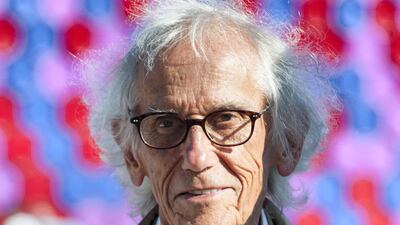
• Christo Vladimirov Jaacheff at the unveiling of 'Dunescape', an installation by Anna Kurkova, at NYUAD in Abu Dhabi in 2017. Delores Johnson / The National
    Christo Vladimirov Jaacheff at the unveiling of 'Dunescape', an installation by Anna Kurkova, at NYUAD in Abu Dhabi in 2017. Delores Johnson / The National
  • Maram Kassab, Christo, Huda Kanoo, WHO, and Mariam Ayoub in front of the 2018 Christo and Jeanne-Claude Award-winning pavilion
    Maram Kassab, Christo, Huda Kanoo, WHO, and Mariam Ayoub in front of the 2018 Christo and Jeanne-Claude Award-winning pavilion
  • Christo visits the UAE in 1979 to explain the preliminary engineering concept for The Mastaba to officials of the Ministry of Construction.
    Christo visits the UAE in 1979 to explain the preliminary engineering concept for The Mastaba to officials of the Ministry of Construction.
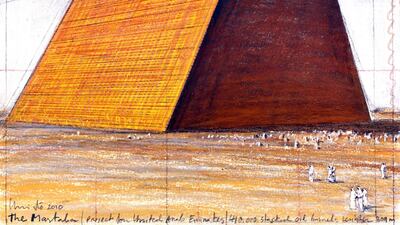
  • A 2009 drawing showing the concept for Christo's 'The Mastaba' project in the UAE. Photo by Wolfgang Volz
    A 2009 drawing showing the concept for Christo's 'The Mastaba' project in the UAE. Photo by Wolfgang Volz
  • Christo and Jeanne-Claude scout for locations for the site of 'The Mastaba' in October 2007. Photo by Wolfgang Volz
    Christo and Jeanne-Claude scout for locations for the site of 'The Mastaba' in October 2007. Photo by Wolfgang Volz
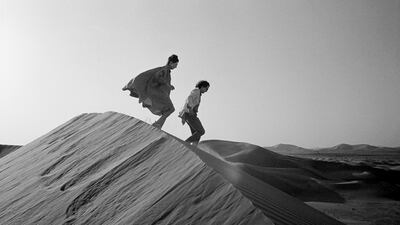
  • Christo and Jeanne-Claude looking for a possible site for 'The Mastaba' in February 1982. Photo by Wolfgang Volz
    Christo and Jeanne-Claude looking for a possible site for 'The Mastaba' in February 1982. Photo by Wolfgang Volz
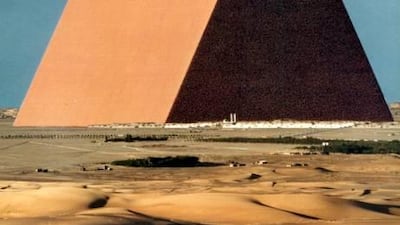
  • A collage, from 1979, showing how 'The Mastaba' would appear in the Liwa desert. Photo by Wolfgang Volz
    A collage, from 1979, showing how 'The Mastaba' would appear in the Liwa desert. Photo by Wolfgang Volz
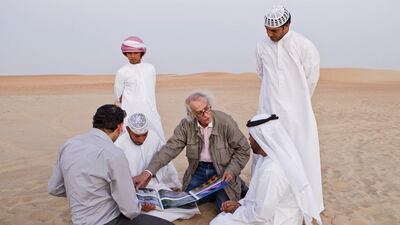
  • Christo meets with Liwa residents Khalfan Al Qubasi, left, Saeed Al Falahi, right, and Obaid Al Mazrouei, front right, in October 2012, to discuss his plans to construct 'The Mastaba', a pyramid of 410,000 barrels. Antonie Robertson / The National
    Christo meets with Liwa residents Khalfan Al Qubasi, left, Saeed Al Falahi, right, and Obaid Al Mazrouei, front right, in October 2012, to discuss his plans to construct 'The Mastaba', a pyramid of 410,000 barrels. Antonie Robertson / The National
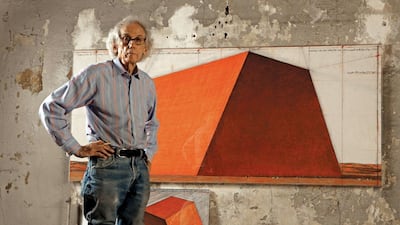
  • Christo in his studio with a preparatory drawing for 'The Mastaba' Courtesy Christo and the Maeght Foundation
    Christo in his studio with a preparatory drawing for 'The Mastaba' Courtesy Christo and the Maeght Foundation
  • Christo with Mohammed bin Azzan Al Mazrouei, the director general of the Western Region Development Council. Delores Johnson / The National
    Christo with Mohammed bin Azzan Al Mazrouei, the director general of the Western Region Development Council. Delores Johnson / The National
  • Christo Yavacheff (centre), meets with Liwa residents Khalfan Al Qubasi (L) and Saeed Al Falahi (R) to discuss his plans to construct in Liwa a pyramid of 415,000 oil drums that will be bigger than the main pyramid of giza. Antonie Robertson / The National
    Christo Yavacheff (centre), meets with Liwa residents Khalfan Al Qubasi (L) and Saeed Al Falahi (R) to discuss his plans to construct in Liwa a pyramid of 415,000 oil drums that will be bigger than the main pyramid of giza. Antonie Robertson / The National
  • Christo Yavacheff sketches out his plans to construct in Liwa a pyramid of 415,000 oil drums that will be bigger than the main pyramid of giza. Antonie Robertson / The National
    Christo Yavacheff sketches out his plans to construct in Liwa a pyramid of 415,000 oil drums that will be bigger than the main pyramid of giza. Antonie Robertson / The National
  • Christo with Khalfan Al Qubasi, left, Saeed Al Falahi, right, and Obaid Al Mazrouei, front right, in Liwa. Antonie Robertson / The National
    Christo with Khalfan Al Qubasi, left, Saeed Al Falahi, right, and Obaid Al Mazrouei, front right, in Liwa. Antonie Robertson / The National
  • Christo meets with Liwa residents Khalfan Al Qubasi, left, and Saeed Al Falahi, right. Antonie Robertson / The National
    Christo meets with Liwa residents Khalfan Al Qubasi, left, and Saeed Al Falahi, right. Antonie Robertson / The National
  • Christo Yavacheff (centre), meets with Liwa residents Khalfan Al Qubasi (L) to discuss his plans to construct in Liwa a pyramid of 415,000 oil drums that will be bigger than the main pyramid of giza. Antonie Robertson / The National
    Christo Yavacheff (centre), meets with Liwa residents Khalfan Al Qubasi (L) to discuss his plans to construct in Liwa a pyramid of 415,000 oil drums that will be bigger than the main pyramid of giza. Antonie Robertson / The National

'Christo loved the UAE and the Emirates loved him back': Zaki Nusseibeh on the artist's desert legacy


Razmig Bedirian
  • English
  • Arabic

“His genius was clear to all those who met him,” says Zaki Nusseibeh of Christo.

"He was full of ideas, full of energy," the UAE's Minister of State tells The National.

The pioneering Bulgarian-born artist had dreams of building the world's largest sculpture in the UAE. He died, aged 84 on Sunday, May 31 at his home in New York City.

Christo was as enthusiastic about the mastaba project in his later years as he was when he first came to the UAE with his wife and collaborator, Jeanne-Claude, in 1979.

The project was envisioned as a 150-metre-high and 330-metre-wide pyramid structure, crafted out of 410,000 oil barrels painted in different shades of okra yellow. With an estimated cost of $350 million, the project was planned to be built out in the Liwa desert and become one of the most recognisable landmarks in the country.

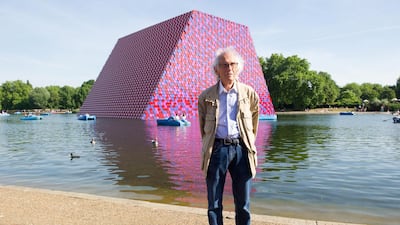
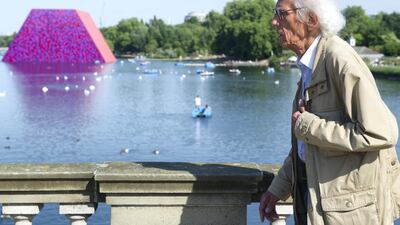
  • Christo with his new Mastaba installation at the Serpentine Gallery in London's Hyde Park. Gustavo Valiente / The National
    Christo with his new Mastaba installation at the Serpentine Gallery in London's Hyde Park. Gustavo Valiente / The National
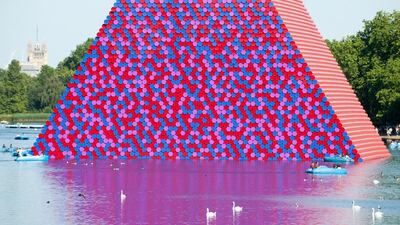
  • The London mastaba is made out of 7,506 barrels - the proposed one for Abu Dhabi would be crafted from 410,000 barrels. Gustavo Valiente / The National
    The London mastaba is made out of 7,506 barrels - the proposed one for Abu Dhabi would be crafted from 410,000 barrels. Gustavo Valiente / The National
  • A collage, 1979, showing how The Mastaba would appear in the Liwa Desert. Wolfgang Volz
    A collage, 1979, showing how The Mastaba would appear in the Liwa Desert. Wolfgang Volz
  • The artist Christo, centre, meets with Liwa residents Khalfan Al Qubasi, left, Saeed Al Falahi, right, and Obaid Al Mazrouei, front right, in October 2012, to discuss his plans to construct The Mastaba, a pyramid of 410,000 barrels. Antonie Robertson / The National
    The artist Christo, centre, meets with Liwa residents Khalfan Al Qubasi, left, Saeed Al Falahi, right, and Obaid Al Mazrouei, front right, in October 2012, to discuss his plans to construct The Mastaba, a pyramid of 410,000 barrels. Antonie Robertson / The National
  • A close-up look at the red, blue and pink floating structure in London. Gustavo Valiente / The National
    A close-up look at the red, blue and pink floating structure in London. Gustavo Valiente / The National
  • A drawing of The Mastaba from 2010 by Christo. Andre Grossman
    A drawing of The Mastaba from 2010 by Christo. Andre Grossman
  • Christo, in the white suit, explaining the preliminary engineering concept for The Mastaba to officials of the Ministry of Construction. Wolfgang Volz
    Christo, in the white suit, explaining the preliminary engineering concept for The Mastaba to officials of the Ministry of Construction. Wolfgang Volz
  • Christo in his studio with a preparatory drawing for The Mastaba. Christo and the Maeght Foundation
    Christo in his studio with a preparatory drawing for The Mastaba. Christo and the Maeght Foundation
  • Artist Christo, 83, with his new installation at the Serpentine Gallery in London on Sunday June 24. He is thought to be one of the world's richest living artists. Gustavo Valiente / The National
    Artist Christo, 83, with his new installation at the Serpentine Gallery in London on Sunday June 24. He is thought to be one of the world's richest living artists. Gustavo Valiente / The National
  • Christo and Jeanne-Claude looking for a possible site for The Mastaba in 1982. Wolfgang Volz
    Christo and Jeanne-Claude looking for a possible site for The Mastaba in 1982. Wolfgang Volz
  • Artist Christo with his new installation at the Serpentine Gallery in London. The word mastaba means 'mud bench' in Arabic, a place for sitting and conversation originating from the historical region of Mesopotamia. Gustavo Valiente / The National
    Artist Christo with his new installation at the Serpentine Gallery in London. The word mastaba means 'mud bench' in Arabic, a place for sitting and conversation originating from the historical region of Mesopotamia. Gustavo Valiente / The National

“Abu Dhabi was a small community in the 1970s, so we met Christo regularly during his first visit,” Nusseibeh says.

"Christo spoke about the project even then. But it wasn’t embraced or appreciated at the time, mainly because Abu Dhabi was still concerned with building infrastructure and wasn’t yet ready to invest such sums on an art installation.”

Nusseibeh says a number of factors prevented the project from coming to fruition. “It was an ambitious large-scale project. Christo knew how to raise funds for his works and the UAE government was ready to give him a plot of land to construct the mastaba. However, due to a number of reasons, it never came to be.”

Nusseibeh and Christo stayed in touch over the decades, with Nusseibeh regularly keeping up with the late artist’s works in Germany, France and the United States.

“He started coming back regularly in the last ten years. We met regularly at my home and at my office,” Nusseibeh says, adding that Christo was still eager to see the mastaba project come to fruition.

Christo often spoke of how he wanted to complete the project in honour of his wife Jean Claude, who died in 2009.

Zaki Nusseibeh, Minister of State. Chris Whiteoak / The National

“Christo was serious about the project. He would go out to the western parts of the country, to Dhafrah and Madinat Zayed, researching the area and conducting art workshops there,” Nusseibeh says.

Nusseibeh says Christo produced various iterations of his mastaba concept, including sketches and drawings, as well as a smaller-scale version (made of 7,506 barrels) that was showcased on the Serpentine lake in London’s Hyde Park.

A photo from April 2009 shows artists Christo (L) and Jeanne-Claude in Austria. EPA

“Pyramids, to him, were a symbol of man’s use of the natural resources to build civilizations. And, as this was where the story of oil was, he was keen to have the monumental version of the mastaba built here in the UAE.

"It was supposed to be a permanent fixture, unlike Christo’s other structures, which were transitory.”

Christo still left a mark on the local cultural scene, even if his monumental structure did not get built to loom over the Liwa desert in his lifetime.

The Christo and Jeanne Claude Award – presented by New York University Abu Dhabi and in partnership with the Abu Dhabi Music & Arts Foundation (ADMAF) – was established in 2012 with the aim of nurturing artistic talent in the UAE.

Nusseibeh, who was previously a member of the judging committee, says that the award is a faithful reflection of Christo’s contribution to the local cultural community.

“He was keen on supporting up-and-coming artists. He regularly held workshops with students from NYU and Zayed University.”

Nusseibeh, who last saw Christo during the artist’s retrospective exhibition in Brussels in 2017, says that the artist will be sorely missed by the UAE’s cultural community.

“We know Christo loved the UAE and we in the Emirates loved him back.”