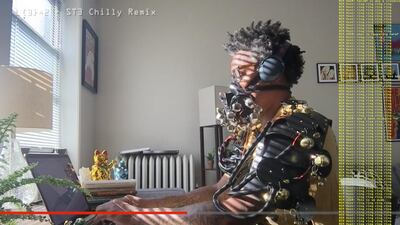
Lee Blalock, 'Ev3ryd4y Cyb0rg (Season 1, Episode 3: L0:F1 loop)', 2019. Video, motion graphics, sound. Duration: 1 minute 24 seconds loop. Courtesy of the artist

'Born digital': New UAE exhibition features artworks made specifically for the smartphone


Alexandra Chaves
  • English
  • Arabic

Despite the weariness around Zoom meetings and virtual events that has developed this year, our smartphones remain portals to distraction and entertainment.

“The smartphone persists as a site of diversion, escape and the meaningful pleasure of discovery,” curator Maya Allison points out.

Allison is the executive director of the New York University Abu Dhabi (NYUAD) Art Gallery and the university's chief curator. Alongside artist and NYUAD assistant professor Heather Dewey-Hagborg, she has put together the gallery's first virtual exhibition, tailored entirely for the smartphone screen.

The exhibit – not in, of, along, or relating to a line – opens on Wednesday, January 20 and features nine artists who primarily deal with technology in their works: Cao Fei, Sophia Al Maria, Zach Blas, Addie Wagenknecht, Eva and Franco Mattes, Lee Blalock, Maryam Al Hamra, Micha Cardenas, and the trio of Ramin Haerizadeh, Rokni Haerizadeh and Hesam Rahmanian.

From the Instagram of Cao Fei. Courtesy the artist

All the works in the show are “born digital”, as the gallery puts it, a concept explained by Dewey-Hagborg as “always originally making use of digital technology as a medium".

“This distinguishes it from work that accidentally ends up online as documentation, for example," she says. "We think this makes for a particularly strong online exhibit because it isn’t trying to force work that is meant to be viewed in person, like sculpture, on to a digital distribution platform. Rather, the online platform amplifies the already digital nature of the work.”

As the title suggests, the exhibition takes no direct path. Visitors can weave from one artwork to another, designed to “embody the branching and decentralised paths originally envisioned as the internet", Dewey-Hagborg says.

“We told the artists we were designing an exhibition that was natively online and, even further, meant to be viewed from a mobile phone, held in the palm of your hand."

NYUAD visiting assistant professor, transdisciplinary artist and exhibition co-curator, Heather Dewey-Hagborg. Ana Brigada

Thematically, not in, of, along, or relating to a line is built around Dewey-Hagborg’s discussions about digital technology’s effect on our sense of identity, and how the pandemic has brought about its own impact on our sense of self and the artists’ practices.

It casts neither censure nor commendations on tech, but rather a “deep ambivalence” towards it, as Dewey-Hagborg describes. “These artists are on one level enamoured with technology … but on another level they are often deeply troubled by the power structures it embodies and the political impact it continues to have in our daily lives,” she says.

Works in the exhibition include American artist Wagenknecht's Opsec and Beauty series. Modelled after popular "beauty hacks" on YouTube, the cosmetic tutorials are cybersecurity lessons in disguise – a 2018 video, for example, is named "korean sheet masks and password management for pore refining wins".

“By teaching methods of cybersecurity in an accessible and quite humorous way, Wagenknecht dismantles the patriarchal and alienating status quo in information security,” Dewey-Hagborg explains. Wagenknecht has created a new work of contemporary still lifes for NYUAD Art Gallery.

Addie Wagenknecht and Aiala Hernando, 'Alive Still No. 2', 2020. Courtesy of the artists

Arab artist Al Maria will premiere a generative poem developed by an AI bot that was trained on her own writing, while Blalock has crafted a narrative around a cyborg, giving it a home life where it performs mundane chores.

To take a typically public event such as an art exhibition and modify it specifically to live on the smartphone screen proffers a kind of intimacy between the viewer and the artwork.

After all, is there any object more intimate and more private to us than our smartphones? These pocket-sized computers contain our contacts, photographs and messages, as well as the apps that allow us to connect to the world and to run our daily lives.

Amid the dozens of streams and feeds powered by algorithms which seem to know us all too well, is there space for art? Allison thinks so. “The art world may or may not have algorithms … but art has a 73,000-year track record, with mark-making and human expression through images, symbols and storytelling,” she says.

Maya Allison is the executive director of the NYUAD Art Gallery and the university's chief curator. NYUAD

With this virtual show, Allison claims the gallery is setting its own test on the appeal of art on the screen. “So much digitally created art lives more comfortably on your phone than in a gallery,” she says.

Allison highlights the work of artists Haerizadeh, Haerizadeh and Rahmanian titled From March to April... 2020, an almost video diary made during lockdown documenting overhead shots of their table that was crowded with paint, drawings, food and newspapers.

The artists had sent the work out to their contacts, Allison included. “For the first time in the pandemic, I had what felt like a genuine encounter with an artwork,” she recalls. “It was clear to me when I saw that video that this was not social media. This was not an algorithm. This was genuine, a unique and specific expression.”

She describes it as a light bulb moment, recognising that art in the digital sphere can be as stirring as that in the physical realm. In the present day, when the art world’s commercial survival and relevance seems to hinge on its virtual presence, perhaps online art is the way forward, picking up where net art left off in the 1990s.

“Phones are already extensions of our bodies into the virtual world, and they are still a place we turn to for warmth and cheer, for discovery and meaning,” says Allison.

“Those are the same words I would use for what the best museums and galleries can be: places where we can enter a different frame of mind, to connect with our humanity, and to view the world around us – or in our hand – differently.”

The exhibition not in, of, along, or relating to a line opens on Wednesday, January 20. For more details, visit nyuad-artgallery.org

The%20specs
%3Cp%3E%3Cstrong%3EPowertrain%3A%20%3C%2Fstrong%3ESingle%20electric%20motor%0D%3Cbr%3E%3Cstrong%3EPower%3A%20%3C%2Fstrong%3E201hp%0D%3Cbr%3E%3Cstrong%3ETorque%3A%20%3C%2Fstrong%3E310Nm%0D%3Cbr%3E%3Cstrong%3ETransmission%3A%20%3C%2Fstrong%3ESingle-speed%20auto%0D%3Cbr%3E%3Cstrong%3EBattery%3A%20%3C%2Fstrong%3E53kWh%20lithium-ion%20battery%20pack%20(GS%20base%20model)%3B%2070kWh%20battery%20pack%20(GF)%0D%3Cbr%3E%3Cstrong%3ETouring%20range%3A%20%3C%2Fstrong%3E350km%20(GS)%3B%20480km%20(GF)%0D%3Cbr%3E%3Cstrong%3EPrice%3A%20%3C%2Fstrong%3EFrom%20Dh129%2C900%20(GS)%3B%20Dh149%2C000%20(GF)%0D%3Cbr%3E%3Cstrong%3EOn%20sale%3A%3C%2Fstrong%3E%20Now%3C%2Fp%3E%0A
Other workplace saving schemes
  • The UAE government announced a retirement savings plan for private and free zone sector employees in 2023.
  • Dubai’s savings retirement scheme for foreign employees working in the emirate’s government and public sector came into effect in 2022.
  • National Bonds unveiled a Golden Pension Scheme in 2022 to help private-sector foreign employees with their financial planning.
  • In April 2021, Hayah Insurance unveiled a workplace savings plan to help UAE employees save for their retirement.
  • Lunate, an Abu Dhabi-based investment manager, has launched a fund that will allow UAE private companies to offer employees investment returns on end-of-service benefits.
The specs: 2018 Opel Mokka X

Price, as tested: Dh84,000

Engine: 1.4L, four-cylinder turbo

Transmission: Six-speed auto

Power: 142hp at 4,900rpm

Torque: 200Nm at 1,850rpm

Fuel economy, combined: 6.5L / 100km

if you go

The flights

Emirates have direct flights from Dubai to Glasgow from Dh3,115. Alternatively, if you want to see a bit of Edinburgh first, then you can fly there direct with Etihad from Abu Dhabi.

The hotel

Located in the heart of Mackintosh's Glasgow, the Dakota Deluxe is perhaps the most refined hotel anywhere in the city. Doubles from Dh850

 Events and tours

There are various Mackintosh specific events throughout 2018 – for more details and to see a map of his surviving designs see glasgowmackintosh.com

For walking tours focussing on the Glasgow Style, see the website of the Glasgow School of Art. 

More information

For ideas on planning a trip to Scotland, visit www.visitscotland.com

Turning%20waste%20into%20fuel
%3Cp%3EAverage%20amount%20of%20biofuel%20produced%20at%20DIC%20factory%20every%20month%3A%20%3Cstrong%3EApproximately%20106%2C000%20litres%3C%2Fstrong%3E%3C%2Fp%3E%0A%3Cp%3EAmount%20of%20biofuel%20produced%20from%201%20litre%20of%20used%20cooking%20oil%3A%20%3Cstrong%3E920ml%20(92%25)%3C%2Fstrong%3E%3C%2Fp%3E%0A%3Cp%3ETime%20required%20for%20one%20full%20cycle%20of%20production%20from%20used%20cooking%20oil%20to%20biofuel%3A%20%3Cstrong%3EOne%20day%3C%2Fstrong%3E%3C%2Fp%3E%0A%3Cp%3EEnergy%20requirements%20for%20one%20cycle%20of%20production%20from%201%2C000%20litres%20of%20used%20cooking%20oil%3A%3Cbr%3E%3Cstrong%3E%E2%96%AA%20Electricity%20-%201.1904%20units%3Cbr%3E%E2%96%AA%20Water-%2031%20litres%3Cbr%3E%E2%96%AA%20Diesel%20%E2%80%93%2026.275%20litres%3C%2Fstrong%3E%3C%2Fp%3E%0A
Top investing tips for UAE residents in 2021

Build an emergency fund: Make sure you have enough cash to cover six months of expenses as a buffer against unexpected problems before you begin investing, advises Steve Cronin, the founder of DeadSimpleSaving.com.

Think long-term: When you invest, you need to have a long-term mindset, so don’t worry about momentary ups and downs in the stock market.

Invest worldwide: Diversify your investments globally, ideally by way of a global stock index fund.

Is your money tied up: Avoid anything where you cannot get your money back in full within a month at any time without any penalty.

Skip past the promises: “If an investment product is offering more than 10 per cent return per year, it is either extremely risky or a scam,” Mr Cronin says.

Choose plans with low fees: Make sure that any funds you buy do not charge more than 1 per cent in fees, Mr Cronin says. “If you invest by yourself, you can easily stay below this figure.” Managed funds and commissionable investments often come with higher fees.

Be sceptical about recommendations: If someone suggests an investment to you, ask if they stand to gain, advises Mr Cronin. “If they are receiving commission, they are unlikely to recommend an investment that’s best for you.”

Get financially independent: Mr Cronin advises UAE residents to pursue financial independence. Start with a Google search and improve your knowledge via expat investing websites or Facebook groups such as SimplyFI. 

Ten tax points to be aware of in 2026

1. Domestic VAT refund amendments: request your refund within five years

If a business does not apply for the refund on time, they lose their credit.

2. E-invoicing in the UAE

Businesses should continue preparing for the implementation of e-invoicing in the UAE, with 2026 a preparation and transition period ahead of phased mandatory adoption. 

3. More tax audits

Tax authorities are increasingly using data already available across multiple filings to identify audit risks. 

4. More beneficial VAT and excise tax penalty regime

Tax disputes are expected to become more frequent and more structured, with clearer administrative objection and appeal processes. The UAE has adopted a new penalty regime for VAT and excise disputes, which now mirrors the penalty regime for corporate tax.

5. Greater emphasis on statutory audit

There is a greater need for the accuracy of financial statements. The International Financial Reporting Standards standards need to be strictly adhered to and, as a result, the quality of the audits will need to increase.

6. Further transfer pricing enforcement

Transfer pricing enforcement, which refers to the practice of establishing prices for internal transactions between related entities, is expected to broaden in scope. The UAE will shortly open the possibility to negotiate advance pricing agreements, or essentially rulings for transfer pricing purposes. 

7. Limited time periods for audits

Recent amendments also introduce a default five-year limitation period for tax audits and assessments, subject to specific statutory exceptions. While the standard audit and assessment period is five years, this may be extended to up to 15 years in cases involving fraud or tax evasion. 

8. Pillar 2 implementation 

Many multinational groups will begin to feel the practical effect of the Domestic Minimum Top-Up Tax (DMTT), the UAE's implementation of the OECD’s global minimum tax under Pillar 2. While the rules apply for financial years starting on or after January 1, 2025, it is 2026 that marks the transition to an operational phase.

9. Reduced compliance obligations for imported goods and services

Businesses that apply the reverse-charge mechanism for VAT purposes in the UAE may benefit from reduced compliance obligations. 

10. Substance and CbC reporting focus

Tax authorities are expected to continue strengthening the enforcement of economic substance and Country-by-Country (CbC) reporting frameworks. In the UAE, these regimes are increasingly being used as risk-assessment tools, providing tax authorities with a comprehensive view of multinational groups’ global footprints and enabling them to assess whether profits are aligned with real economic activity. 

Contributed by Thomas Vanhee and Hend Rashwan, Aurifer
