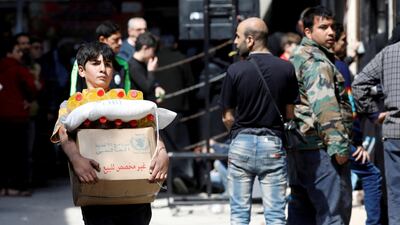
Millions of people in north-west Syria depend on aid deliveries for survival. Reuters

Russia and China veto UN resolution to extend Syrian aid


Joyce Karam
  • English
  • Arabic

Russia and China on Friday vetoed a last-ditch attempt by western members of the UN Security Council to extend for six months the delivery of humanitarian aid to Syria across its border with Turkey.

The two vetoes blocked the German-Belgian resolution despite the support of the 13 other members who all voted in favour.

This is the second veto this week by Russia and China on the resolution, and the six-year-long UN mandate for aid deliveries is set to expire on Friday.

The UN says the aid deliveries from Turkey are a "lifeline" to millions of Syrian civilians living in the country's rebel-held north-west.

Russia and China, allies of the Assad regime, want to cut the number of border crossings to one, arguing those areas can be reached with humanitarian help from within Syria.

Later on Friday the council voted on a Russian draft text to approve aid deliveries for one Turkish crossing for one year, but it failed after only garnering four votes in favour.

Diplomats said work would continue to see if a compromise could be reached among council members.

Trucks carrying aid cross into Syria at the border crossing at Bab Al Hawa. Russia and China want to reduce the number of crossing points on the Turkey- Syria border. EPA

The Security Council first authorised the cross-border aid operation into Syria in 2014, which also included access from Jordan and Iraq. Those crossings were cut in January due to opposition by Russia and China.

Before the vote, US Ambassador to the UN Kelly Craft told The National that her country wanted to stop Russia and China from politicising humanitarian assistance.

"We have been working all hours, day and night, to make certain that the members of the council understand the importance of not allowing Russia and China to politicise the humanitarian assistance in order to prop up the Assad regime," Ms Craft told The National during a media briefing on Thursday. "We are going to be fighting for as to save as many lives as possible, and that means that we will be fighting for the two borders for a six-month time."

With the veto and the mandate expiring on Friday, the Security Council was due to discuss more amendments as a last resort to find a way forward.

Humanitarian organisations have warned of an aggravated humanitarian catastrophe for the large numbers of displaced people living in Syria's Idlib province if the resolution is not extended.

Amnesty International called the failure to pass a resolution and the successive vetoes “despicable”.

Friday’s veto was Russia’s 16th on Syria since the conflict started in 2011.

Experts are calling the Security Council's paralysis on the issue deeply worrying.

"With the cross-border mechanism expiring tonight, today's veto is deeply worrying. All week, UNSC members have been trying to find a way forward to extend the cross-border aid operation," said Emma Beals, an independent researcher and editor at Syria in Context.

On Thursday, the north-western Idlib province reported its first Covid-19 case, sparking fears that an outbreak of the virus could wreak havoc on an already poverty-stricken and economically deprived part of the country.

US Ambassador to the United Nations Kelly Craft. AFP

Russia wants aid deliveries to go through its ally, Damascus, but that aim is seen as unacceptable by other Security Council members given the regime's behaviour in politicising aid deliveries.

“The resolution was only ever needed because of the Syrian regime’s policy of weaponising aid and starving its opponents into submission,” Ms Beals said.

The last ditch hope now would be for “UNSC members to reach a workable agreement in the coming hours and days,” the expert said.  But, she added, given the politics, “any compromise will be less than the mandate that is required to serve Syria’s north-west and north-east”.


Women & Power: A Manifesto

Mary Beard

Profile Books and London Review of Books 

How to get there

Emirates (www.emirates.com) flies directly to Hanoi, Vietnam, with fares starting from around Dh2,725 return, while Etihad (www.etihad.com) fares cost about Dh2,213 return with a stop. Chuong is 25 kilometres south of Hanoi.
 

11 cabbie-recommended restaurants and dishes to try in Abu Dhabi

Iqbal Restaurant behind Wendy’s on Hamdan Street for the chicken karahi (Dh14)

Pathemari in Navy Gate for prawn biryani (from Dh12 to Dh35)

Abu Al Nasar near Abu Dhabi Mall, for biryani (from Dh12 to Dh20)

Bonna Annee at Navy Gate for Ethiopian food (the Bonna Annee special costs Dh42 and comes with a mix of six house stews – key wet, minchet abesh, kekel, meser be sega, tibs fir fir and shiro).

Al Habasha in Tanker Mai for Ethiopian food (tibs, a hearty stew with meat, is a popular dish; here it costs Dh36.75 for lamb and beef versions)

Himalayan Restaurant in Mussaffa for Nepalese (the momos and chowmein noodles are best-selling items, and go for between Dh14 and Dh20)

Makalu in Mussaffa for Nepalese (get the chicken curry or chicken fry for Dh11)

Al Shaheen Cafeteria near Guardian Towers for a quick morning bite, especially the egg sandwich in paratha (Dh3.50)

Pinky Food Restaurant in Tanker Mai for tilapia

Tasty Zone for Nepalese-style noodles (Dh15)

Ibrahimi for Pakistani food (a quarter chicken tikka with roti costs Dh16)

The specs

Engine: 8.0-litre, quad-turbo 16-cylinder

Transmission: 7-speed auto

0-100kmh 2.3 seconds

0-200kmh 5.5 seconds

0-300kmh 11.6 seconds

Power: 1500hp

Torque: 1600Nm

Price: Dh13,400,000

On sale: now

What the law says

Micro-retirement is not a recognised concept or employment status under Federal Decree Law No. 33 of 2021 on the Regulation of Labour Relations (as amended) (UAE Labour Law). As such, it reflects a voluntary work-life balance practice, rather than a recognised legal employment category, according to Dilini Loku, senior associate for law firm Gateley Middle East.

“Some companies may offer formal sabbatical policies or career break programmes; however, beyond such arrangements, there is no automatic right or statutory entitlement to extended breaks,” she explains.

“Any leave taken beyond statutory entitlements, such as annual leave, is typically regarded as unpaid leave in accordance with Article 33 of the UAE Labour Law. While employees may legally take unpaid leave, such requests are subject to the employer’s discretion and require approval.”

If an employee resigns to pursue micro-retirement, the employment contract is terminated, and the employer is under no legal obligation to rehire the employee in the future unless specific contractual agreements are in place (such as return-to-work arrangements), which are generally uncommon, Ms Loku adds.

Other workplace saving schemes
  • The UAE government announced a retirement savings plan for private and free zone sector employees in 2023.
  • Dubai’s savings retirement scheme for foreign employees working in the emirate’s government and public sector came into effect in 2022.
  • National Bonds unveiled a Golden Pension Scheme in 2022 to help private-sector foreign employees with their financial planning.
  • In April 2021, Hayah Insurance unveiled a workplace savings plan to help UAE employees save for their retirement.
  • Lunate, an Abu Dhabi-based investment manager, has launched a fund that will allow UAE private companies to offer employees investment returns on end-of-service benefits.