

France is planning to ban the far-right Generation Identity group as part of a wider attempt to tackle radicalism.
President Emmanuel Macron is worried about the influence of the far-right, as well as the high-profile attacks carried out by Islamic extremists.
Interior Minister Gerald Darmanin raised the possibility of proscribing GI after it carried out a series of anti-immigration protests.
The rallies included one in January at the border with Spain where banners reading "Defend Europe" were waved from cars.
Mr Darmanin said that GI appeared to have broken a French law against “incitement to discriminate against a person or group because of their origin”.
Earlier this week, politicians in France's lower house backed the government's controversial bill that Mr Macron said was designed to rid the country of extremism and protect French values.
-

People gather on Place de la Republique in Paris in homage to history teacher Samuel Paty two days after he was beheaded by an attacker who was shot dead by policemen. AFP -
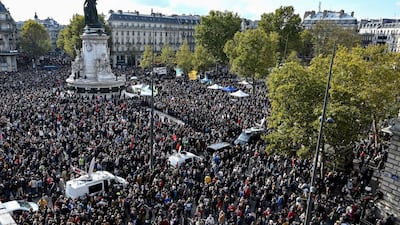
The murder has shocked France and politicians of all stripes attended the Paris rally. AFP -

In Bordeaux, people gather on Place de la Bourse. AFP -
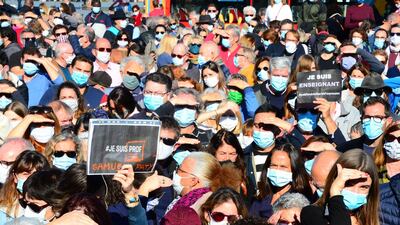
A person holds a placard reading 'I am a teacher' as people gather on Place de la Bourse. AFP -

Flags at city hall are at half-mast as people gather in Place du Capitole in Toulouse. AFP -
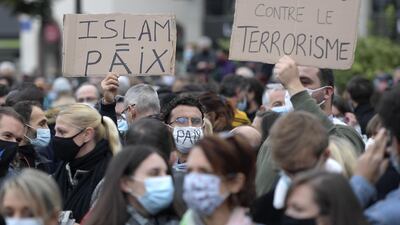
People hold placards reading 'Islam = peace' and 'Muslims against terrorism' as they gather in Strasbourg. AFP -
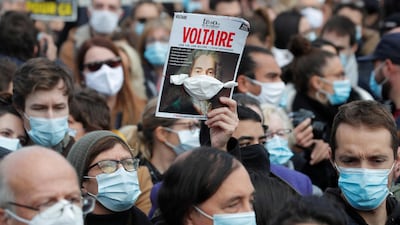
Samuel Paty, was killed in the Paris suburb of Conflans-Sainte-Honorine. Reuters -
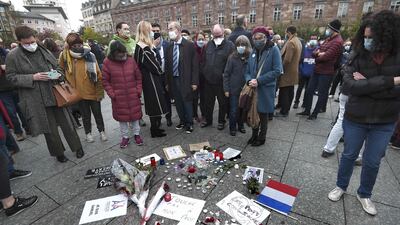
People stand near flowers and placards reading 'I am Samuel' and 'Don't touch my teacher' at a rally in Strasbourg. AFP -
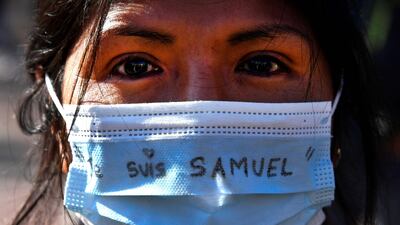
A person wears a prtotective face mask with an inscription reading 'I am Samuel'. AFP -
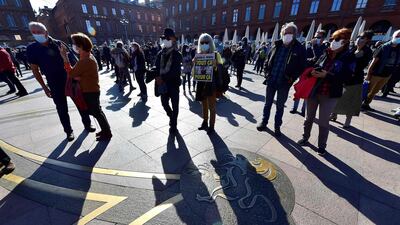
History teacher Samuel Paty was killed on Friday. AFP -

People gather at the Place de la Republique in Paris. Reuters -
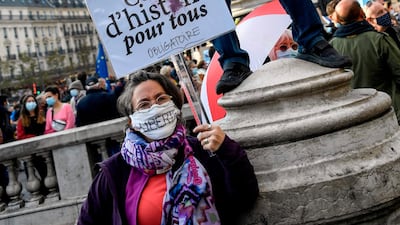
A woman holds a placard reading 'History course for eveyone' and a man holds a French flag on Place de la Republique in Paris. AFP


For the past 10 years GI has orchestrated a series of headline-grabbing protests, including the occupation of a mosque and the setting up of fake border control points on the French-Italian frontier.
French political expert Jean-Yves Camus said that the group has only about 800 members, while Stephane Francois, an expert on the far-right in France, said that GI believes that being French is down to European ethnic and cultural identity.
The state's approach is that all its citizens are French regardless of their origin.
Mr Macron's anti-separatism bill was fast-tracked after the beheading of schoolteacher Samuel Paty on the outskirts of Paris last year.
Mr Paty provoked anger in the local Muslim community for showing cartoons of the Prophet Mohammed to pupils in his classroom.
The 51-article act bans virginity certificates and provides measures against polygamy and forced marriage.
Other elements include ensuring that children attend regular school from the age of 3 in a move to deter home schooling where ideology is taught, while all public employees will be trained in secularism under the new legislation.

