


Global health chiefs renamed coronavirus variants in an effort to remove any stigma associated with the countries they are associated with.
Under the new system devised by the World Health Organisation, variants are no longer identified by the area or country of their discovery, such as the Indian, South African or Kent strains.
Greek letters have instead been assigned to the strains in the order they were designated variants of concern, starting at Alpha, for the strain first detected in the UK last year.
The scientific names used for the variants were also ruled out for regular use as they could be deemed too complicated to remember.
Viruses have often been named after the place where they emerged, like Ebola, which was named after a river in the Democratic Republic of the Congo.
But that has been damaging to the countries’ reputations, WHO said.
It lists 10 Covid-19 strains, four of which are described as variants of concern and six variants of interest.
Here we explain the new names and what you need to know about the strains.
Variants of concern:
Delta - Indian variant/B1617.2
This was first detected in October in India, where it led to a second wave that has receded.
The strain includes mutations which make it more transmissible and help it evade the body’s immune response.
The UK recently said it was estimated to be 40 per cent more transmissible than the Alpha variant, which itself was also more transmissible than the original strain.

And vaccines appear to be less effective against it.
Research from the UK, where the strain has recently become dominant, suggests people who have received the Pfizer vaccine generate fewer antibodies against it compared to other variants.
The study, published in The Lancet medical journal, found that people fully vaccinated with Pfizer-BioNTech are likely to have more than five times lower levels of neutralising antibodies against it.
-
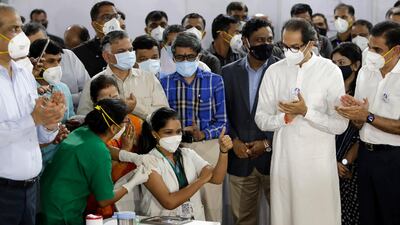
Madhura Patil, a health worker, gestures as she receives the Covid-19 vaccine in the presence of Maharashtra chief minister Uddhav Thackeray, standing beside her, in Mumbai, India. AP Photo -
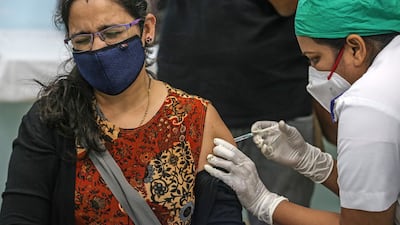
A woman is vaccinated against Covid-19 at Rajawadi Hospital in Mumbai, India. EPA -
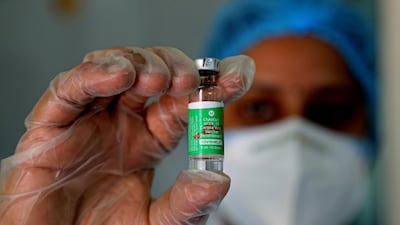
An Indian health worker holds up the Covishield Covid-19 vaccine, developed by Oxford University and Astra-Zeneca and manufactured by the Serum Institute of India, at the Government General Hospital in Jayanagar, Bangalore. EPA -
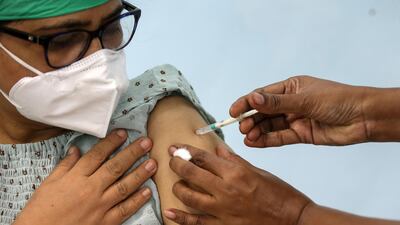
A beneficiary gets the first dose of a Covid-19 vaccine shot manufactured by Serum Institute of India at Rajawadi Hospital in Mumbai, India. EPA -
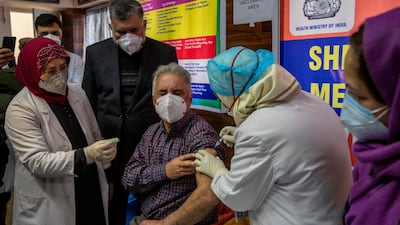
A Kashmiri doctor receives a Covid-19 vaccine at a government hospital in Srinagar, Kashmir. AP Photo -
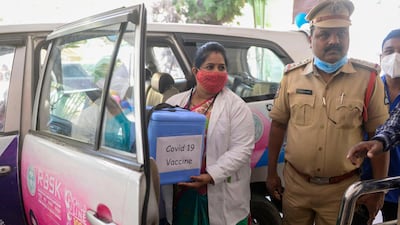
A doctor carries a freezer box with Covid-19 vaccine at the King Koti hospital in Hyderabad. AFP -
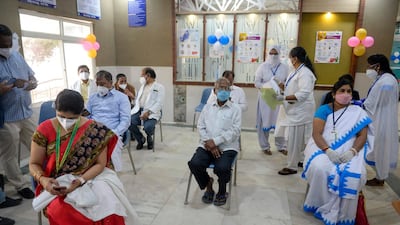
Medical workers wait to be inoculated with a Covid-19 vaccine at the King Koti hospital in Hyderabad. AFP -

Sanitation worker Manish Kumar, who according to the officials is the first person in India to be vaccinated against Covid-19, receives a dose of Bharat Biotech's Covaxin vaccines at the All India Institute of Medical Sciences (AIIMS) hospital in New Delhi. Reuters -
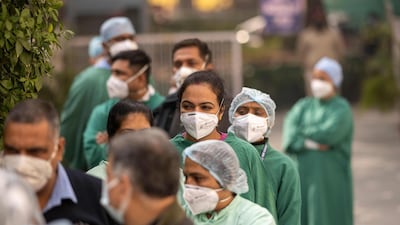
Medical workers wait to be inoculated against Covid-19 at a hospital in New Delhi. AFP -

A security guard keeps watch at a Covid-19 vaccination centre New Delhi. AFP -
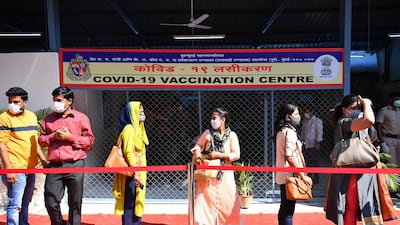
Health workers queue to receive the Covid-19 vaccine in Mumbai. AFP -

A medical worker prepares to inoculate a doctor with a Covid-19 vaccine at the Urban Primary Health Centre in Kolkata. AFP -
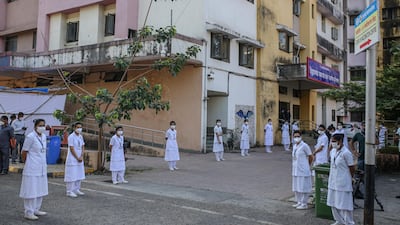
Employees wearing protective masks wait to welcome health workers at the Dr R N Cooper Municipal General Hospital in Mumbai, India. Bloomberg


According to Public Health England (PHE), three weeks after the first dose of either Pfizer or AstraZeneca-Oxford, both vaccines were around 33 per cent effective against symptomatic disease, versus 50 per cent against Alpha.
Its latest risk assessment said there is a “high level of uncertainty” about AstraZeneca’s effectiveness against the strain after two doses.
A report by PHE also said people infected by the strain are also twice as likely to end up in hospital than with Alpha. It has been linked to cases of “unprecedented damage” to the pancreas in otherwise healthy people in India.
For these reasons, scientists say the strain is the worst seen to date.
Gamma - Brazil variant/P1
This strain is believed to have emerged in mid-November in Brazil in the Amazonian city of Manaus, which was hit by two waves of the virus.
Mutations make it more transmissible and give it the ability to escape previous immunity.
Data collected in Manaus suggested the variant may be twice as transmissible as previous strains, and could evade up to half of immune defences from previous infections.
People who had the virus before have around 54 to 79 per cent protection against P1.
That explains why the variant led to a deadlier second wave, overwhelming hospitals again, even after studies suggested more than three quarters of the population had already had the virus.
Vaccines also appear to be weaker against it.
In lab tests, antibodies produced by Pfizer’s vaccine could not attach as well compared to the original virus.
Beta - South Africa variant/B1351
This strain was first detected in South Africa in early October, but not publicly announced until December, when authorities said it appeared to affect younger people more than previous variants.
It has since been found in more than 80 countries.
It carries a mutation called E484K, which helps the virus elude a person’s immune system.
And the vaccines do not work as well against it, in particular AstraZeneca, which offers only 10 per cent protection against mild to moderate illness caused by the strain.
-
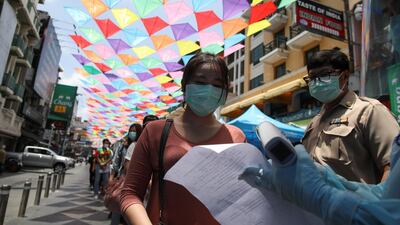
Residents queue for a coronavirus nasal swab test, in Bangkok, Thailand. Reuters -
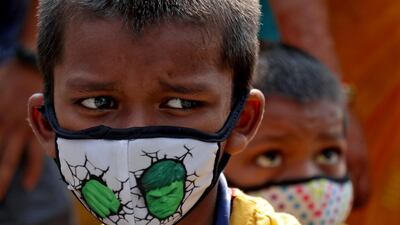
Children wearing protective masks wait to enter the Lokmanya Tilak Terminus railway station in Mumbai, India. Reuters -
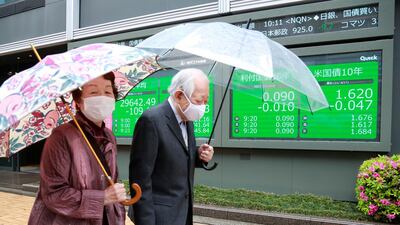
A couple pass an electronic stock board of a securities company in Tokyo. Asian stock markets rose on Wednesday after Wall Street hit a high following an uptick in US inflation and an order by regulators to suspend use of Johnson & Johnson's coronavirus vaccine. AP Photo -

An activist in a coronavirus mask bearing the colours of the Lebanese flag and the UN resolution numbers calling for the disarmament of all Lebanese and non-Lebanese militias. She was at a sit-in in Beirut, Lebanon, to mark the 47th anniversary of the 1975-1990 civil war, in which more than 150,000 people were killed. AP Photo -
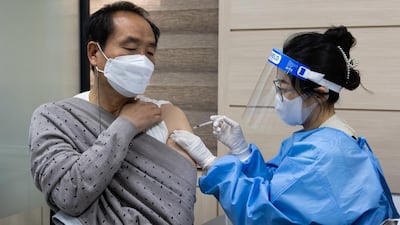
A nurse administers a dose of the AstraZeneca Covid-19 vaccine at the Nowon District public health centre in Seoul, South Korea. The country resumed inoculations with the AstraZeneca shot this week after a suspension, but will limit use to those between 30 and 60 years old. Bloomberg -
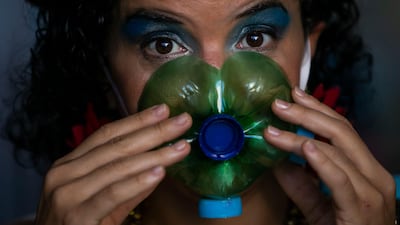
Actress Thais Bezerra puts on a mask made from a plastic bottle as she gets dressed in her costume to perform in a video recording of 'Giant Dreamers' outside the Museum of Modern Art during the Covid-19 pandemic in Rio de Janeiro, Brazil. AP Photo -
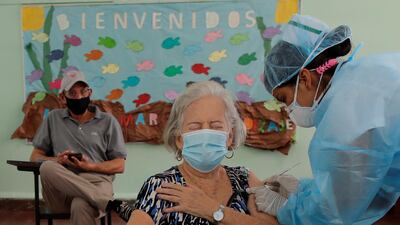
A woman receives the second dose of the Pfizer vaccine at the Belisario Porras School, in Panama City, Panama. The president of Panama, Laurentino Cortizo, announced that another batch of Pfizer vaccines will arrive, assuring that the country has enough doses. EPA -
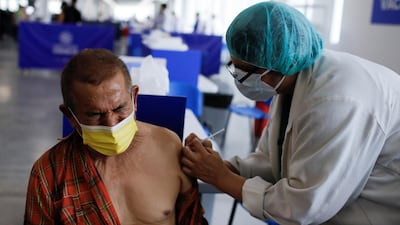
A health worker administers a dose of Sinovac's CoronaVac vaccine at an inoculation centre in San Salvador, El Salvador. Reuters -
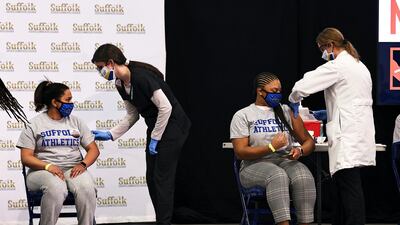
Students from Suffolk County Community College prepare to get vaccinated during a news conference at the school in Brentwood, New York. Several colleges in the state announced the cancellation of vaccination clinics using the Johnson & Johnson vaccine. AP Photo -
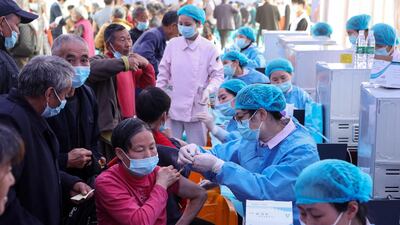
People receive the China National Biotec Group Covid-19 vaccine in Chongqing municipality in south-west China. AFP


Research in Qatar found people who received the Pfizer vaccine were 75 per cent less likely to develop Covid-19.
Alpha - Kent variant/B117
Tests showed the variant first emerged in the UK in Kent in late September.
At the end of October the strain accounted for only 3 per cent of cases in England.
But by the start of February the share had soared to 96 per cent, causing a third wave across the country.
It also became dominant in the US.
That was because the strain is significantly more transmissible than the original virus which emerged in Wuhan.
And because more people become sick, more people are put in hospital if they catch it.
Data suggested the strain is 30 to 70 per cent more lethal than the original strain.
But it does not escape antibodies from natural infection or vaccines.
A trial from the UK found the AstraZeneca-Oxford vaccine was 70.4 per cent effective against symptomatic Covid-19 caused by the variant.
Pfizer is 89.5 per cent effective against the strain, at least 14 days after the second dose.
Variants of interest:
Epsilon - B.1.427/B.1.429
It was first designated a variant of interest on March 5 and is common in California. It is believed to be about 20 per cent more infectious, and carries the L452R mutation, which is believed to increase immune evasion and binding to cells.
Zeta - P2
Identified as a a variant of interest later in March, it was discovered in Brazil in April, 2020. It includes the E484 mutation in the spike. There is limited information on whether monoclonal antibody therapies and antibodies generated post-vaccination are affected by it.
Eta - B.1.525
Eta was first detected in Nigeria but has since been found in other countries. It was designated a variant of interest at the same time as Zeta.
It includes the E484K mutation, which is believed to help the virus avoid the immune system, and possibly vaccine-induced antibodies.
Theta - P.3
Theta was identified in the Philippines in January before being designated a variant of interest in March. It also includes the E484K mutation.
Iota - B.1.526
The strain was detected in New York and identified as a variant of interest in late March.
There are two forms of the variant, one of which includes the E484K mutation, while the other includes the S477N mutation, which is believed to help the virus bind more tightly to cells.
Kappa - B.1.617
Detected in India in October, it was classified as a variant of interest in April. It split into two lineages, one of which, B.1.617.2, has since become a variant of concern.
WHO has said has demonstrated increased transmissibility in some areas, but appears to be declining. It carries two mutations believed to be of concern, L452R and E484Q, termed as an escape mutation as it helps the virus slip past the body's immune system.

