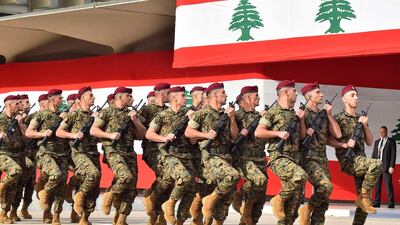
The Lebanese military needs aid to help its soldiers survive the financial crisis, an army source said on Wednesday before a UN-backed donor conference.
Unlike earlier conferences to provide training, weapons or equipment for Lebanon's armed forces, the online meeting hosted by France on Thursday hopes to give the type of humanitarian assistance usually reserved for countries dealing with war or natural disasters.
"We are in need of food parcels, healthcare assistance" and other support, a military source told AFP.
"The devaluation of the Lebanese pound is affecting soldiers and they are in need of support. Their salaries are not enough any more."
Lebanon's economic crisis, which the World Bank has called one of the world's worst since the 1850s, has led the local currency to lose more than 90 per cent of its value on the black market.
The crisis has eroded the value of soldiers' salaries and cut the military's budget for maintenance and equipment, further threatening the country's stability.
A regular soldier earns about 1.2 million Lebanese pounds a month, which is $800 at the official exchange rate but only about $80 on the black market.
Towards the middle of last year, the army said it had scrapped meat from the meals offered to on-duty soldiers, because of rising food prices.
"We are doing the impossible to ease the suffering and the economic woes of our soldiers," army chief Gen Joseph Aoun said on Tuesday.
"We are forced to turn to allied states to secure aid and I am ready to go to the end of the world to procure assistance so that the army can stay on its feet."
About 20 countries, including the US, several EU member states, Gulf countries, Russia and China have been invited to take part in the conference.
Gen Aoun last month visited Paris, where he said the army could face even darker days without emergency support.
"The Lebanese army is going through a major crisis, which could get worse due to the deteriorating economic and social situation in Lebanon, which may worsen when subsidies are lifted," he said.
Gen Aoun was referring to a government plan to scrap subsidies on essential goods such as fuel and flour to support dwindling foreign currency reserves.
A source close to French Defence Minister Florence Parly on Wednesday said the crisis was alarming because the Lebanese military was the "key institution" maintaining security.
The army has highlighted "very specific needs" for milk, flour, medicine, fuel and spare parts for maintenance, the source said.
Aram Nerguizian, of the Centre for Strategic and International Studies and the Carnegie Middle East Centre, said the military had already lost more than 3,000 members since 2019, with 80,874 personnel at the start of this year.
"Morale is low, officers are increasingly demoralised," Mr Nerguizian said.
He said donors could provide "in-kind assistance that helps LAF personnel gain access to staple goods they would otherwise spend their now severely diminished salaries on", such as food, fuel and medicine.
But aid that supports salaries is "more difficult".
"For most of the LAF's western partners, there are laws and mechanisms in place specifically not to have aid used in that way," Mr Nerguizian said.
"Those systems are in place to prevent corruption, nepotism and a twisted form of dependence on foreign aid for the current portion of national defence spending."
The US remains the biggest financial backer of the Lebanese military, and increased funding for the army by $15m for this year to $120m.
France, Egypt, the UAE and Turkey are among the army's main food donors, while Iraq and Spain have offered medical assistance.

COMPANY PROFILE
Founders: Alhaan Ahmed, Alyina Ahmed and Maximo Tettamanzi
Total funding: Self funded
The Vile
Starring: Bdoor Mohammad, Jasem Alkharraz, Iman Tarik, Sarah Taibah
Director: Majid Al Ansari
Rating: 4/5
Electric scooters: some rules to remember
- Riders must be 14-years-old or over
- Wear a protective helmet
- Park the electric scooter in designated parking lots (if any)
- Do not leave electric scooter in locations that obstruct traffic or pedestrians
- Solo riders only, no passengers allowed
- Do not drive outside designated lanes
Scoreline
Saudi Arabia 1-0 Japan
Saudi Arabia Al Muwallad 63’
Ten tax points to be aware of in 2026
1. Domestic VAT refund amendments: request your refund within five years
If a business does not apply for the refund on time, they lose their credit.
2. E-invoicing in the UAE
Businesses should continue preparing for the implementation of e-invoicing in the UAE, with 2026 a preparation and transition period ahead of phased mandatory adoption.
3. More tax audits
Tax authorities are increasingly using data already available across multiple filings to identify audit risks.
4. More beneficial VAT and excise tax penalty regime
Tax disputes are expected to become more frequent and more structured, with clearer administrative objection and appeal processes. The UAE has adopted a new penalty regime for VAT and excise disputes, which now mirrors the penalty regime for corporate tax.
5. Greater emphasis on statutory audit
There is a greater need for the accuracy of financial statements. The International Financial Reporting Standards standards need to be strictly adhered to and, as a result, the quality of the audits will need to increase.
6. Further transfer pricing enforcement
Transfer pricing enforcement, which refers to the practice of establishing prices for internal transactions between related entities, is expected to broaden in scope. The UAE will shortly open the possibility to negotiate advance pricing agreements, or essentially rulings for transfer pricing purposes.
7. Limited time periods for audits
Recent amendments also introduce a default five-year limitation period for tax audits and assessments, subject to specific statutory exceptions. While the standard audit and assessment period is five years, this may be extended to up to 15 years in cases involving fraud or tax evasion.
8. Pillar 2 implementation
Many multinational groups will begin to feel the practical effect of the Domestic Minimum Top-Up Tax (DMTT), the UAE's implementation of the OECD’s global minimum tax under Pillar 2. While the rules apply for financial years starting on or after January 1, 2025, it is 2026 that marks the transition to an operational phase.
9. Reduced compliance obligations for imported goods and services
Businesses that apply the reverse-charge mechanism for VAT purposes in the UAE may benefit from reduced compliance obligations.
10. Substance and CbC reporting focus
Tax authorities are expected to continue strengthening the enforcement of economic substance and Country-by-Country (CbC) reporting frameworks. In the UAE, these regimes are increasingly being used as risk-assessment tools, providing tax authorities with a comprehensive view of multinational groups’ global footprints and enabling them to assess whether profits are aligned with real economic activity.
Contributed by Thomas Vanhee and Hend Rashwan, Aurifer
'The Woman in the House Across the Street from the Girl in the Window'
Director:Michael Lehmann
Stars:Kristen Bell
Rating: 1/5
Dengue%20fever%20symptoms
%3Cp%3EHigh%20fever%20(40%C2%B0C%2F104%C2%B0F)%3Cbr%3ESevere%20headache%3Cbr%3EPain%20behind%20the%20eyes%3Cbr%3EMuscle%20and%20joint%20pains%3Cbr%3ENausea%3Cbr%3EVomiting%3Cbr%3ESwollen%20glands%3Cbr%3ERash%26nbsp%3B%3C%2Fp%3E%0A
