
Often news stories about Bahrain will be accompanied by photographs of gleaming towers in Manama and Juffair, or – if the reporters want to go down another route – the traditional narrow streets and wind towers of Muharraq. Harvard-trained architect Ali Karimi wants to look beyond this simplistic binary and, in partnership with the Sheikh Ebrahim bin Mohammed Al Khalifa Centre for Culture and Research, designed a set of tours to show the true variety of Bahrain's architectural heritage.
The excursions, which began in 2019, are ever-changing events, so participants can expect something different every time. A location is chosen for one weekend a month and, weather permitting, small groups head out on Fridays and Saturdays to learn more about a particular neighbourhood.
Previous tours have included a walk around old Juffair’s colonial, mid-20th century buildings – an eye-opener for those who’ve grown to see the area as a beacon of brash modernity and little America – as well as a trip around Manama’s waterfront.

Karimi prefers to visit somewhere new each time in order to show people as much of what the island has to offer as possible, but also to satisfy his own curiosity.
"It's not about seeing the buildings that form the 'bread-and-butter' Bahraini narrative," he says. "It's about exploring the architecture that contests that narrative.
"I also see it as an invitation to be part of a discussion for a few hours; a tour where people can ask what buildings actually do and what they mean to us." The group spends two hours strolling around a chosen area, as Karimi explains how the architecture has evolved. He believes this boots-on-the-ground approach can help people understand how Bahrain's different communities lived and intertwined in the past, as well as illustrating the stories of transformation and growth in each locality. "We can use the buildings to talk about how Bahrain has changed, and what role they've had in that evolution."
Karimi’s interest in architecture stems from his childhood spent in Muharraq. He describes the ever-changing nature of the island as inspiring a “hopeless nostalgia” among Bahrainis; the island’s development means that every generation has grown up with different surroundings.
"Studying the environment I grew up in gave me a sense of agency," he says. "Architecture began to appear in my mind's eye as something that sat at the intersection of a few different conversations. It allowed me to understand what was going on in terms of public space and buildings, but also do something about it. It seems to me a very necessary, but also empowering profession."

Karimi has studied, worked and lived in places as diverse as New York, Brussels and Santiago, and his achievements include being co-curator of the Kuwait Pavilion at the 2016 Venice Biennale and exhibiting recently at the Sharjah Architecture Triennial.
He now wants to pass on this knowledge to others, and often brings architecture students along on his tours. “I wanted to help build literacy about buildings in Bahrain as a communal project rather than just as a research exercise in an office or library.”
His tours also serve to bring attention to buildings of significance that might otherwise be lost to development. “Of course, I want to highlight buildings that don’t fall under the realm of protection. I make suggestions about those that could be included on the protected list.”
Karimi is aware that not every building can be saved, though. “Some will go – that’s just the nature of architecture,” he says. “We can’t preserve the city in aspic, but we can examine what is gained and lost in that process. It can help combat the sense of helplessness people sometimes feel when buildings are demolished. “If we photograph and document buildings properly, they’re not really gone. They become part of a cultural memory.”

Karimi often discovers something new about the island on his tours, too. "When exploring old schools in Manama, we found out that the first girls', boys' and institutional schools in the area were all originally hosted out of the same private houses," he says. "Essentially, they were all hosted in merchant houses at the start, and that's why they're so close together. If I hadn't physically been leading a tour around there, I don't think I'd have ever made the connection, since I would have focused on schools as a category and not as a part of a neighbourhood fabric."
Karimi has big plans for the future of this project. In the short term, he wants to take groups to the oil company town of Awali, as well as visit Gudaibiya, and go on another tour of Manama, this time focusing on the old churches and health centres. Another ambition of his is to head farther afield, to the UAE and Kuwait, looking at early modern buildings there, too.
In the longer term, Karimi wants to use the material he gathers from these expeditions to form the basis of a book about the beginnings of modern architecture in Bahrain. "The tours started as a way to get permission to access and document modern buildings. The proposal to collaborate with the Sheikh Ebrahim Centre and the Bahrain Authority for Culture and Antiquities was that we would use the process of doing research while also building public awareness," he says.
Take a look at the buildings on Bahrain's Unesco-listed Pearling Path:
-

Al Alawi House is one site on Bahrain's Unesco World Heritage List-inscribed Pearling Path. All photos Timothy Power -
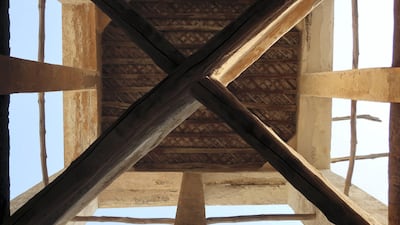
A view of the wind tower at Al Alawi House. -
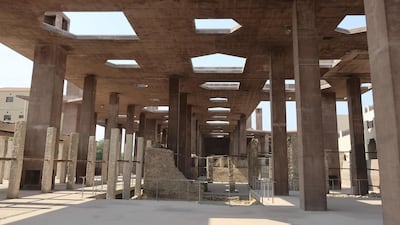
The Pearling Path's Visitor & Experience Centre in Bahrain. The site consists of 17 houses, two offshore oyster beds and Bu Mahir Fort. It was inscribed onto the Unesco list in 2012. -

Fakhro House was the luxury residence of Yousif Abdurrahman Fakhro, a successful timber and boat merchant. -
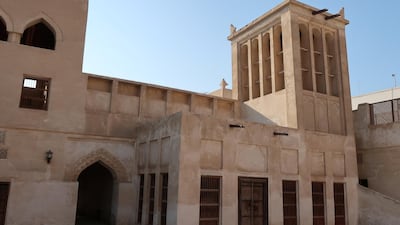
An example of an old wind tower is seen at Shaikh Isa bin Ali Al Khalifa Palace. Timothy Power -
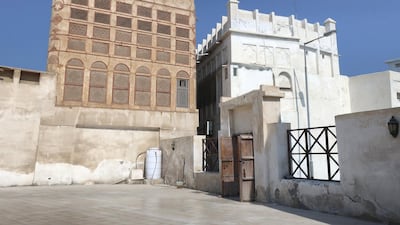
Siyadi House and majlis is part of a complex by one of Bahrain's leading grand pearl merchant families. -
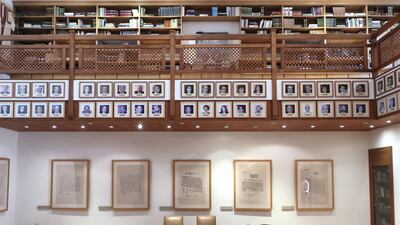
Inside the Shaikh Ebrahim bin Mohammed Al Khalifa Center for Culture & Research. -
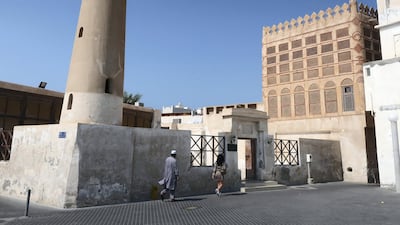
Siyadi Mosque is a single-storey courtyard mosque, the oldest preserved mosque in Muharraq. -
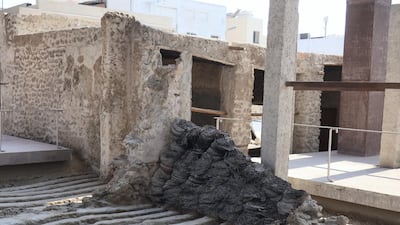
A date press at the Visitor & Experience Centre.


“I plan to write about the country’s modern, early modern and colonial buildings, which haven’t yet been fully understood. Even if buildings are lost, at least the architectural ideas they represent can remain accessible in a publication.
"I envisage it as a hybrid tour book-architecture history book covering the buildings between roughly 1919 and 1961. It'll really be looking at the beginnings of modern architecture in the Gulf, using Bahrain as the main case study."
For now, anyone can join Karimi on his tours, but as they're socially distanced and bespoke, places are limited. They cost 5 Bahraini dinars ($13) and bookings are a must.
More information is available at shaikhebrahimcenter.org

