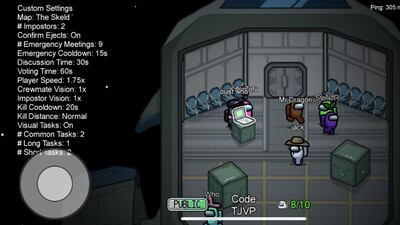
Players in the waiting room of a game in 'Among Us'

'Among Us': what to know about the online survival game that's all about deceit


Evelyn Lau
  • English
  • Arabic

Who doesn’t love a good murder mystery? And these days, while we’re all socially distancing, what better way to stay connected to friends and family than by betraying them in a game of survival?

At least that's the premise for InnerSloth's Among Us. The game – which can be downloaded and played on a PC or mobile – was released in 2018, but over the past few months has gained more players owing to the pandemic. It's also been streamed by popular gamers on sites such as Twitch, bringing it even more attention.

So, if you’re looking to play it, here’s what to know:

How do you play 'Among Us'?

Each game can host between four to 10 players (the more, the better) and there are three different game maps to choose from, all of which are set in space – two are aboard a spaceship and one is on a planet.

Each player is a crewmate on the spaceship, but two are imposters whose main goal is to kill everyone else before being discovered. The crew can win the game if they finish their tasks or if they figure out who the imposters are and kick them off. The imposters can win if they kill everyone on board or get other players to vote off everyone else.

During the game, crewmates will run around the ship performing tasks while imposters look for victims. After a crew member is killed, if another member stumbles upon the body, they can report it and trigger a meeting between everyone on board.

Here's when the fun (and deceit) begins, as questions about who was nearby and who saw what begin. This is probably also the part where you figure out which of your friends and family are good at lying. Communication is done through in-game chat.

After the meeting, teams can choose to vote off a player or skip voting for that round and everyone returns to the ship to finish their tasks (or to kill off other crew members) and it continues. A player can also call an “emergency meeting” if they suspect they know who the imposter is.

What to keep in mind while playing

Among Us is played online so you will need either internet access or a data plan. Players can download the game for free on their mobile or pay $5 (Dh18.3) to download it from Stream to play on a PC. Gamers can host their own private games with friends or join online games with strangers.

It should be noted that if a game has the maximum 10 players, the game can also be customised to have as many as three imposters on the ship – which makes finding out who they are quickly even more vital.

Other things to look out for: imposters are the only players able to 'vent' (basically quickly travel through vents) around the game. That’s why knowing the ship’s map is important. If you are an imposter, after you kill a crew member, you can jump into a vent and quickly shift to another part of the ship. However, if other players witness this, they’ll also know that you’re an imposter.

Imposters are also given fake tasks so they look as though they’re a crewmate and also have the ability to sabotage a ship (such as cutting off the oxygen or turning out the lights). This means that crewmates will suddenly need to run to a specific area in order to fix it (which can sometimes be a set-up for being killed).

For a major sabotage, such as cutting off oxygen, there’s a time limit and if players cannot fix it in time, everyone dies and the imposter wins.

After a player dies or gets voted off, they become ghosts on the ship where they can see everyone and go through walls. But ghosts can also still continue their tasks and should do so because it helps their team win the game if it’s completed. Also, once dead, they cannot communicate with anyone still alive in the game, but can chat with other deceased players.

Why is it so popular?

Since the game allows a maximum of 10 players, rounds only last about 10 to 15 minutes. Perhaps even better, the game is also easy to understand and doesn't require much skill to play.

As mentioned, Among Us has found sudden attention thanks to gamers who stream it while playing live together. Watching the reactions of people trying to guess who the imposter is (and sometimes getting it very wrong) or lying terribly about not being the imposter is all quite entertaining.

The game has also gained traction on social media, with users praising the game's mechanics and small player count. It's very similar to playing an old-fashioned murder mystery board game but online.

The game has become so popular that InnerSloth had originally announced plans for Among Us 2. However, that's since been cancelled as the developers say they will put more focus on improving the first one.


Why your domicile status is important

Your UK residence status is assessed using the statutory residence test. While your residence status – ie where you live - is assessed every year, your domicile status is assessed over your lifetime.

Your domicile of origin generally comes from your parents and if your parents were not married, then it is decided by your father. Your domicile is generally the country your father considered his permanent home when you were born. 

UK residents who have their permanent home ("domicile") outside the UK may not have to pay UK tax on foreign income. For example, they do not pay tax on foreign income or gains if they are less than £2,000 in the tax year and do not transfer that gain to a UK bank account.

A UK-domiciled person, however, is liable for UK tax on their worldwide income and gains when they are resident in the UK.

UAE currency: the story behind the money in your pockets

Mercer, the investment consulting arm of US services company Marsh & McLennan, expects its wealth division to at least double its assets under management (AUM) in the Middle East as wealth in the region continues to grow despite economic headwinds, a company official said.

Mercer Wealth, which globally has $160 billion in AUM, plans to boost its AUM in the region to $2-$3bn in the next 2-3 years from the present $1bn, said Yasir AbuShaban, a Dubai-based principal with Mercer Wealth.

Within the next two to three years, we are looking at reaching $2 to $3 billion as a conservative estimate and we do see an opportunity to do so,” said Mr AbuShaban.

Mercer does not directly make investments, but allocates clients’ money they have discretion to, to professional asset managers. They also provide advice to clients.

“We have buying power. We can negotiate on their (client’s) behalf with asset managers to provide them lower fees than they otherwise would have to get on their own,” he added.

Mercer Wealth’s clients include sovereign wealth funds, family offices, and insurance companies among others.

From its office in Dubai, Mercer also looks after Africa, India and Turkey, where they also see opportunity for growth.

Wealth creation in Middle East and Africa (MEA) grew 8.5 per cent to $8.1 trillion last year from $7.5tn in 2015, higher than last year’s global average of 6 per cent and the second-highest growth in a region after Asia-Pacific which grew 9.9 per cent, according to consultancy Boston Consulting Group (BCG). In the region, where wealth grew just 1.9 per cent in 2015 compared with 2014, a pickup in oil prices has helped in wealth generation.

BCG is forecasting MEA wealth will rise to $12tn by 2021, growing at an annual average of 8 per cent.

Drivers of wealth generation in the region will be split evenly between new wealth creation and growth of performance of existing assets, according to BCG.

Another general trend in the region is clients’ looking for a comprehensive approach to investing, according to Mr AbuShaban.

“Institutional investors or some of the families are seeing a slowdown in the available capital they have to invest and in that sense they are looking at optimizing the way they manage their portfolios and making sure they are not investing haphazardly and different parts of their investment are working together,” said Mr AbuShaban.

Some clients also have a higher appetite for risk, given the low interest-rate environment that does not provide enough yield for some institutional investors. These clients are keen to invest in illiquid assets, such as private equity and infrastructure.

“What we have seen is a desire for higher returns in what has been a low-return environment specifically in various fixed income or bonds,” he said.

“In this environment, we have seen a de facto increase in the risk that clients are taking in things like illiquid investments, private equity investments, infrastructure and private debt, those kind of investments were higher illiquidity results in incrementally higher returns.”

The Abu Dhabi Investment Authority, one of the largest sovereign wealth funds, said in its 2016 report that has gradually increased its exposure in direct private equity and private credit transactions, mainly in Asian markets and especially in China and India. The authority’s private equity department focused on structured equities owing to “their defensive characteristics.”

Infobox

Western Region Asia Cup Qualifier, Al Amerat, Oman

The two finalists advance to the next stage of qualifying, in Malaysia in August

Results

UAE beat Iran by 10 wickets

Kuwait beat Saudi Arabia by eight wickets

Oman beat Bahrain by nine wickets

Qatar beat Maldives by 106 runs

Monday fixtures

UAE v Kuwait, Iran v Saudi Arabia, Oman v Qatar, Maldives v Bahrain

UAE currency: the story behind the money in your pockets
TOURNAMENT INFO

Women’s World Twenty20 Qualifier

Jul 3- 14, in the Netherlands
The top two teams will qualify to play at the World T20 in the West Indies in November

UAE squad
Humaira Tasneem (captain), Chamani Seneviratne, Subha Srinivasan, Neha Sharma, Kavisha Kumari, Judit Cleetus, Chaya Mughal, Roopa Nagraj, Heena Hotchandani, Namita D’Souza, Ishani Senevirathne, Esha Oza, Nisha Ali, Udeni Kuruppuarachchi

England's lowest Test innings

- 45 v Australia in Sydney, January 28, 1887

- 46 v West Indies in Port of Spain, March 25, 1994

- 51 v West Indies in Kingston, February 4, 2009

- 52 v Australia at The Oval, August 14, 1948

- 53 v Australia at Lord's, July 16, 1888

- 58 v New Zealand in Auckland, March 22, 2018