

A comet that has not entered the inner solar system for 50,000 years is set to fly past Earth later this month and will be visible from the UAE.
Comet C/2022 E3 (ZTF) is getting brighter as it moves closer to Earth and could be visible to the naked eye in Northern Hemisphere countries.
Nasa said that the comet will appear in late January and early February, lighting up the skies with a greenish glow and its striking dust tail.
“In late January and early February 2023, the comet C/2022 E3 (ZTF) should be visible in the morning sky with binoculars and might become bright enough to see with the naked eye, especially from a dark area with clear skies,” the space agency said.
A comet is a celestial object made up of ice and dust. They are leftovers from when the solar system was formed billions of years ago.
This comet was discovered by astronomers in March last year. At its closest approach in February, the comet will pass 42.5m kilometres from Earth.
“How bright a comet appears depends both on things we can predict — how close it is to the Earth and how close it is to the Sun, and on what we cannot predict — how much gas and dust it is giving off,” said Nasa.
The comet’s visibility will depend upon the weather, including if there will be interference from the Moon or clouds.
It should be observable at the end of January and on February 1 and 2.
The Dubai Astronomy Group will host an observation event on February 4 at the Al Qudra desert in Dubai, from 6.30pm to 9.30pm.
The event will include comet, Moon, Mars, Jupiter and deep sky objects telescope observation, an astrophotography session and sky mapping. Entrance fees range from Dh70 to Dh120.
Stargazers will also be able to watch the passing of the comet on YouTube.
Comet Leonard that was seen in December - in pictures
-

Abu Dhabi astronomer Aldrin Gabuya captured the bright and glowing Comet Leonard over the UAE capital on December 18. Photo: Aldrin Gabuya / Al Sadeem Observatory -
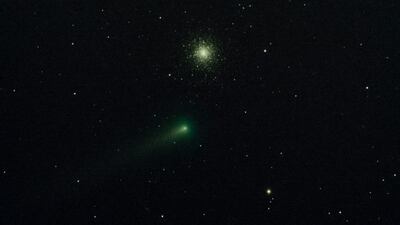
The bright green comet was photographed from the UAE as it made a rare approach towards Earth. Photo: Aldrin Gabuya / Al Sadeem Observatory -

An image of Venus and Comet Leonard. Photo: Aldrin Gabuya / Al Sadeem Observatory -
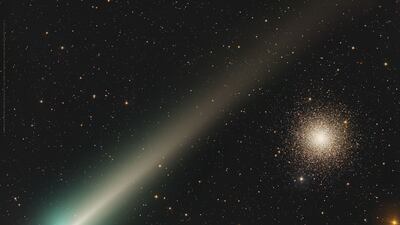
Comet Leonard appears before the M3 cluster of stars. Photo: Dan Bartlett / Nasa -
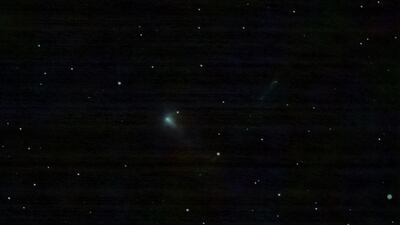
Leonard has been called the ‘Christmas comet’ because it is visiting during the month of December and reached its brightest point just days before December 25. Photo: Aldrin Gabuya / Al Sadeem Observatory



