• The Heart of Arabia team travels across the Saudi desert on camels. All photos unless stated: Ana-Maria Pavalache / Heart of Arabia expedition
    The Heart of Arabia team travels across the Saudi desert on camels. All photos unless stated: Ana-Maria Pavalache / Heart of Arabia expedition
  • The team - Alan Morrissey, Reem Philby, Mark Evans and Ana-Maria Pavalache. Photo: Osama Farhan / British Embassy Riyadh
    The team - Alan Morrissey, Reem Philby, Mark Evans and Ana-Maria Pavalache. Photo: Osama Farhan / British Embassy Riyadh
  • The team at the starting point of their expedition in Uqair, on the shores of the Gulf
    The team at the starting point of their expedition in Uqair, on the shores of the Gulf
  • The Heart of Arabia team at the historical fort in Uqair
    The Heart of Arabia team at the historical fort in Uqair
  • The team are greeted with hospitality in Uqair, at the beginning of the trip
    The team are greeted with hospitality in Uqair, at the beginning of the trip
  • Alan Morrissey, Mark Evans and Reem Philby walk across the sand
    Alan Morrissey, Mark Evans and Reem Philby walk across the sand
  • A comparison of the Ibrahim Pasha Mosque in Hofuf, now and in 1917, taken by Harry St John Philby in 1917
    A comparison of the Ibrahim Pasha Mosque in Hofuf, now and in 1917, taken by Harry St John Philby in 1917
  • The team read by torch-light at night
    The team read by torch-light at night
  • Harry St John Philby on his 1917 trek across the Arabian Peninsula, which he recorded in his 1922 book 'Heart of Arabia'
    Harry St John Philby on his 1917 trek across the Arabian Peninsula, which he recorded in his 1922 book 'Heart of Arabia'
  • Mark Evans and Reem Philby ride camels on the Heart of Arabia expedition
    Mark Evans and Reem Philby ride camels on the Heart of Arabia expedition
  • Alan Morrissey, Mark Evans, and Reem Philby with one of the support vehicles for the trip, nicknamed "the beast" by Mr Morrissey
    Alan Morrissey, Mark Evans, and Reem Philby with one of the support vehicles for the trip, nicknamed "the beast" by Mr Morrissey
  • The team with the three support vehicles that took them south into the Empty Quarter
    The team with the three support vehicles that took them south into the Empty Quarter
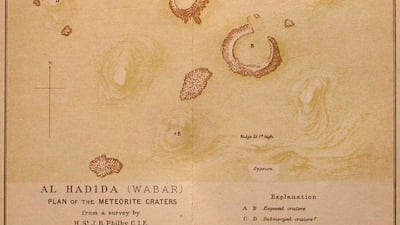
  • The map of the Wabar craters, known as Al Hadida or “the place of iron” to local Bedouin. Philby was the first European to visit the site during his expedition across the Empty Quarter in 1932
    The map of the Wabar craters, known as Al Hadida or “the place of iron” to local Bedouin. Philby was the first European to visit the site during his expedition across the Empty Quarter in 1932
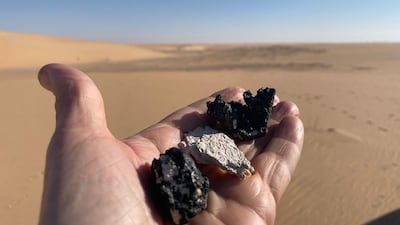
  • Volcanic rock at the Al Wabar craters in the Empty Quarter desert
    Volcanic rock at the Al Wabar craters in the Empty Quarter desert
  • The Heart of Arabia team with the flag of the Explorers Club of New York
    The Heart of Arabia team with the flag of the Explorers Club of New York
  • The vast deserts of Saudi Arabia captured by drone
    The vast deserts of Saudi Arabia captured by drone
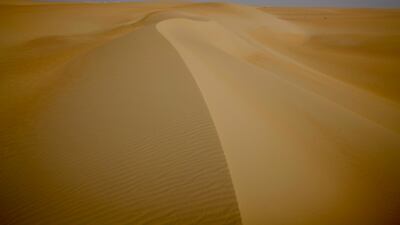
  • A sand dune in the Empty Quarter
    A sand dune in the Empty Quarter
  • A drone captures the team travelling in the Empty Quarter desert
    A drone captures the team travelling in the Empty Quarter desert
  • The Saudi desert in Hawaya, in a photo taken by Philby from his 1932 expedition. Getty
    The Saudi desert in Hawaya, in a photo taken by Philby from his 1932 expedition. Getty
  • The Heart of Arabia team from above in the deserts of Saudi Arabia
    The Heart of Arabia team from above in the deserts of Saudi Arabia
  • Camels ready for the final journey towards Riyadh
    Camels ready for the final journey towards Riyadh
  • Outward Bound Oman founder and expedition leader Mark Evans with a camel in the Saudi desert
    Outward Bound Oman founder and expedition leader Mark Evans with a camel in the Saudi desert
  • A comparison of Harry St John Philby's photo of "The ravine and wells of Abu Jifan", included in his book the Heart of Arabia, with the site today as seen by the expedition of the same name
    A comparison of Harry St John Philby's photo of "The ravine and wells of Abu Jifan", included in his book the Heart of Arabia, with the site today as seen by the expedition of the same name
  • Harry St John Philby and his companions at Wadi Al Shajara, where they stopped for a prayer on his 1917 trip to Riyadh. He included the photo in his 1922 book, The Heart of Arabia
    Harry St John Philby and his companions at Wadi Al Shajara, where they stopped for a prayer on his 1917 trip to Riyadh. He included the photo in his 1922 book, The Heart of Arabia
  • The Heart of Arabia team at the spot under a tree in Wadi Al Shajara, where Philby stopped for a prayer in 1917
    The Heart of Arabia team at the spot under a tree in Wadi Al Shajara, where Philby stopped for a prayer in 1917
  • The expedition team with locals in the Saudi desert on their trip
    The expedition team with locals in the Saudi desert on their trip
  • The Heart of Arabia expedition team in front of the Maskmak Fort Museum in Riyadh, the destination of the first leg of their trip
    The Heart of Arabia expedition team in front of the Maskmak Fort Museum in Riyadh, the destination of the first leg of their trip

Heart of Arabia expedition arrives in Riyadh after two weeks in the desert


Tommy Hilton
  • English
  • Arabic

Latest: Heart of Arabia expedition sets off across the desert towards Jeddah

The Heart of Arabia expedition has reached Riyadh after two weeks in the desert retracing the route taken by British explorer Harry St John Philby in 1917.

Oman-based explorer Mark Evans, photographer Ana-Maria Pavalache, logistics lead Alan Morrissey, and Saudi explorer Reem Philby — the granddaughter of the man who made the trek 105 years ago — set off from Al Uqair in eastern Saudi Arabia on November 14.

They travelled by foot, camel and car to sites including the Al Ahsa Oasis, Hofuf, and the Al Wabar craters.

“Our 14 amazing days in the desert came to an end today,” said Reem Philby.

“It was a journey of discovery of sites, history, difficulties, challenges, beauty, peace, hospitality and of a great man that walked this land and made it his home and who is still remembered and recognised for the work and discoveries he started over a century ago.”

Following in Philby’s footsteps

The team has mainly followed the route taken by Philby, using his 1922 book The Heart of Arabia and a series of photographs of him as a guide.

Philby was sent on a diplomatic mission to Arabia in November 1917 on behalf of Britain to Ibn Saud, who then ruled central and eastern Arabia from his capital Riyadh.

Along the way, Philby made meticulous notes on the people and places he saw that shaped British maps of the area and earned him the Founders Medal from the Royal Geographical Society.

Following in his footsteps, the Heart of Arabia team visited locations described by Philby while gathering scientific data for three projects, including using a “bat locator” to monitor the distribution of fruit bats, which play a crucial role in the cross-pollination of dates.

They began their trek from the exact location that Philby did, in the fishing village of Uqair.

The team then travelled to the Al Ahsa Oasis, a Unesco world heritage site home to more than 2.25 million palm trees. Philby described the vast oasis as a “scene of wondrous loveliness — a broad black band of palms backed by the setting sun”.

His granddaughter Reem said she was overwhelmed by the generosity of the local people in Al Ahsa, and that she felt a deep connection to her grandfather as she followed in his footsteps.

“Just being there and sensing his presence was truly special,” she said on the Heart of Arabia expedition’s daily podcast.

The team also followed Philby’s route into Hofuf, which he estimated was a town of 30,000 people in 1917 — the largest town in Ibn Saud’s realm at the time.

While Hofuf is now a major city, the 16th century Turkish-built Ibrahim Palace still stands, and the team believe they were able to find the spot where Philby took a photo in front of the palace mosque’s iconic dome.

A comparison of the Ibrahim Pasha Mosque in Hofuf. The original image was taken by Harry St John Philby in 1917 and published in his Heart of Arabia book. The backdrop shows the mosque under restoration in 2022.

The lost city of Ubar

After a week, the team took a detour from Philby’s original route and travelled in two support vehicles south to visit the remote Al Wabar craters, known as Al Hadida or “the place of iron” to local Bedouin.

Philby visited the craters on a separate trip across the Empty Quarter in 1932 in search of the lost desert city of Ubar.

Local Bedouin believe the Wabar craters to be the site of the city, which is mentioned as “Iram” in the Quran.

Philby was the first European to visit the site but quickly observed that it was more likely a volcanic meteorite crater, which is the consensus today.

“A volcano in the midst of the Rub' al Khali! And below me, as I stood on that hilltop transfixed, lay the twin craters, whose black walls stood up gauntly above the encroaching sand like the battlements and bastions of some great castle,” he wrote.

The team spent a day at the site and used drones to capture the scope of the craters from above.

  • The map of the Wabar craters, known as Al Hadida or “the place of iron” to local Bedouin. All photos: Ana-Maria Pavalache / Heart of Arabia expedition
    The map of the Wabar craters, known as Al Hadida or “the place of iron” to local Bedouin. All photos: Ana-Maria Pavalache / Heart of Arabia expedition
  • Volcanic rock at the Al Wabar craters. Philby visited the craters on a separate trip across the Empty Quarter in 1932 in search of the lost desert city of Ubar
    Volcanic rock at the Al Wabar craters. Philby visited the craters on a separate trip across the Empty Quarter in 1932 in search of the lost desert city of Ubar
  • The vast deserts of Saudi Arabia captured by drone
    The vast deserts of Saudi Arabia captured by drone
  • A drone captures the team travelling in the Empty Quarter desert from above
    A drone captures the team travelling in the Empty Quarter desert from above
  • A sand dune in the Empty Quarter
    A sand dune in the Empty Quarter

Riyadh and onwards

From Al Wabar, the team returned to Philby’s route and travelled the final days to Riyadh on camels provided by Saudi Arabia’s Camel Club.

This included a visit to the Abu Jifan Fort, where Philby camped by a waterhole on his trip.

On arrival in Riyadh, they visited the Al Masmak Fort, where Philby met Ibn Saud in 1917.

The fort is now a museum that tells the story of Ibn Saud's dramatic recapture of the city in 1902 and includes a quote from Philby.

Philby, who later converted to Islam and took the name Abdullah, returned to Arabia and became a lifelong friend and adviser to Ibn Saud.

The team will embark on the second leg of the trip on January 15, which will take them across the desert to Jeddah on Saudi Arabia’s western coast.

Speaking from Riyadh, Mr Evans said he was looking forward to a shower after an action-packed two weeks.

“We are exhausted, exhilarated, proud, filthy dirty, covered in dust and looking forward to getting into a hot shower — the first for two weeks — once the vehicles have been unloaded and all the equipment is cleaned and ready for leg two!”

“What an extraordinary place Saudi Arabia is,” he said.

The Heart of Arabia expedition team in front of the Maskmak Fort Museum in Riyadh, the destination of the first leg of their trip. Left to right: Ana-Maria Pavalache, Mark Evans, Reem Philby and Alan Morrissey.
Updated: January 18, 2023, 10:06 AM