

So many people died from disease, war and enslavement during the European conquest of the Americas that Amazonian forests grew back, reducing atmospheric carbon dioxide and perhaps contributing to the “Little Ice Age” of the 17th century.
Today, forests provide a more positive hope of limiting global heating. But the current approach is failing.
The idea of biological-based carbon credits is that an emitter of carbon dioxide – say, an airline – can fund a project that protects trees, plants new ones, or conserves other carbon-containing ecosystems such as peat bogs – wetlands with partially decayed vegetation – or mangroves. These projects are accredited under approved methodologies by major registries such as Verra and Gold Standard.
In the ideal case, such offsets balance out carbon dioxide emissions, protect a fragile ecosystem, bring some benefits to local communities, and have other positive impacts such as anchoring soils and limiting flooding.
But in recent months, it has become abundantly clear that bio-based offsets have significant problems that render them useless or are even counterproductive and environmentally harmful.
One of the most dramatic developments came in Zimbabwe last month. Kariba, a forest protection project covering an area almost twice that of the emirate of Dubai, saw its main partner South Pole withdraw. The project sold 23 million tonnes worth of credits, for almost $100 million, but its climate benefits appear to have been overstated by a factor of five, while money went to the developers rather than the local communities tasked with actually reducing deforestation.
This should perhaps have been obvious from the cheapness of such offsets: $1 to $2 per tonne of carbon dioxide for “low-quality” credits and up to $10 to $20 for high-quality ones. If it were that cheap to stop global warming, we would have done it already. For comparison, carbon prices in the world’s leading trading system, that of the EU, currently range around $90 per tonne and are likely to go much higher.
Companies may skimp on reducing their emissions, instead buying credits to claim to be “carbon neutral”, or falsely convince consumers that unsustainable activities can be cheaply offset.
Some problems are practical. Proper measurement and verification is tricky and expensive, especially if done well, although new satellite methods offer improvements.
Carbon runs between trunks and leaves, roots, dead wood, charcoal and carbon in soils, and when disturbed, some may be released.
Trees don’t soak up much carbon dioxide immediately when planted, but only as they grow to maturity over several decades. That is problematic when we are facing rapid warming today. Once mature, trees absorb little extra carbon, yet they have to be kept alive or replaced with new growth in perpetuity.
A hotter planet sparks stronger wildfires. California, Canada, Australia and the Mediterranean have been hit by vast conflagrations in recent years. This can wipe out millions of tonnes of offsets in hours, eliminating the reserve that issuers hold back. Drought and pests can also damage forests.
-

A woman is helped out of a house by neighbours in Anon de Moncayo, north-eastern Spain, where a large wildfire grew rapidly overnight and was burning out of control. AP -
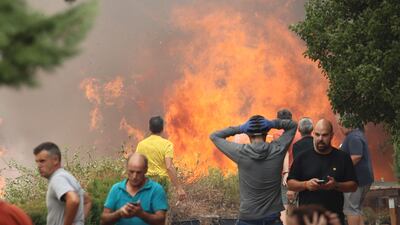
People stand near the forest fire in Anon de Moncayo, Spain. The fire has already forced the evacuation of eight villages and 1,500 people in Zaragoza province. AP -
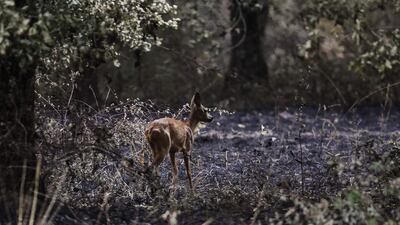
A doe walks in a burnt forest following a fire in South Gironde, near Belin-Beliet, south-western France on Saturday. AFP -
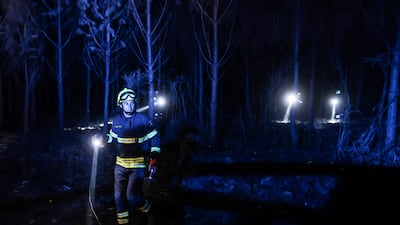
Austrian firefighters help to extinguish a fire in a forest of South Gironde, near Belin-Beliet, in south-western France. AFP -
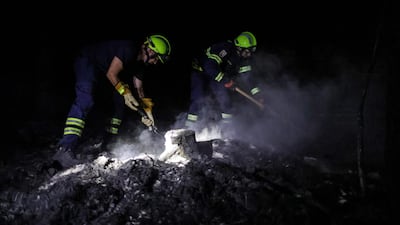
Austrian firefighters help to extinguish a fire in a forest of South Gironde, near Belin-Beliet, in south-western France. AFP -
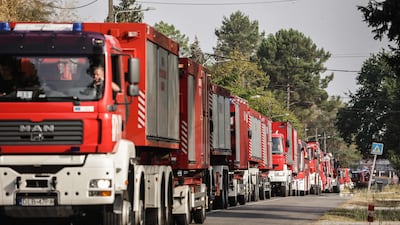
Polish firefighters arrive at the Hostens fire department to help in tackling the wildfire in south-western France. AFP -
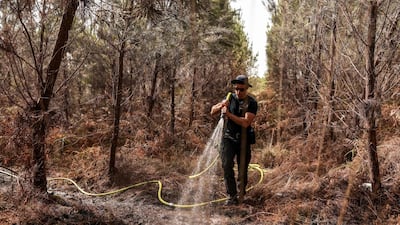
A German firefighter sprays water to put out lingering hot spots left by the wildfire near Belin-Beliet in France on Saturday. AFP -
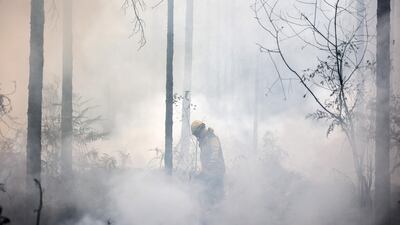
A French tactical firefighter lights a controlled fire to slow the advance of a wildfire near Belin-Belitet, south-western France. AFP -
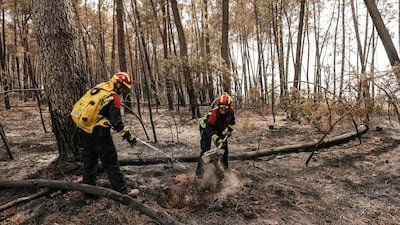
German firefighters spray water to put out lingering hot spots left by the wildfire near Belin-Belitet, south-western France. AFP -
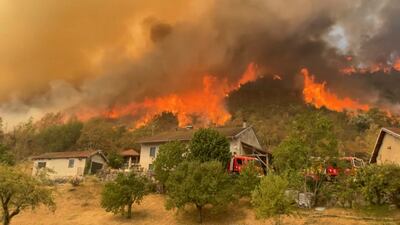
A wildfire burning in the Jura department in the Bourgogne-Franche-Comte region, France, in this still image taken from a social media video. Reuters -
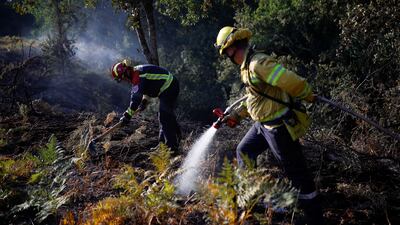
German firefighters work to contain a fire in Hostens, as wildfires continue to spread in the Gironde region of south-western France. Reuters -

Trees and vegetation burnt by a major fire in Hostens, as wildfires continue to spread in the Gironde region of south-western France. Reuters -
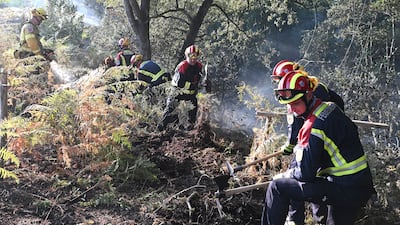
German firefighters fighting a forest fire as part of the European Civil Protection co-operation in Hostens, in the Gironde region of south-western France. EPA -
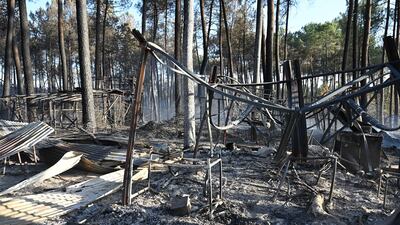
A cabin burnt by forest fires in Hostens, in the Gironde region of south-western France. EPA -
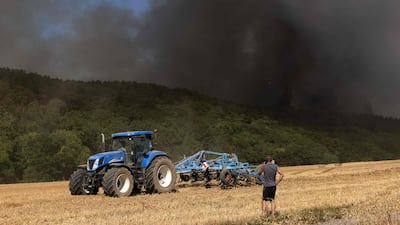
A farmer stands in a field as farmers arrive with their tractors to help firefighters to fight a nearby forest fire in Thierville, in Normandy, north-western France. AFP -
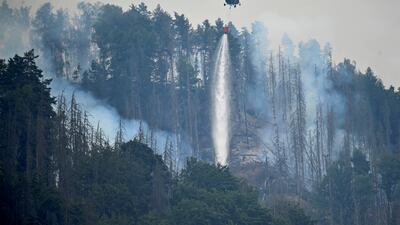
A Czech military helicopter helps to extinguish a fire close to the German-Czech border near Schmilka, Germany. Reuters -
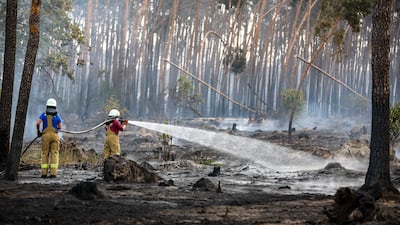
Firefighters extinguish pockets of embers near Falkenberg, south-eastern Germany. AP -
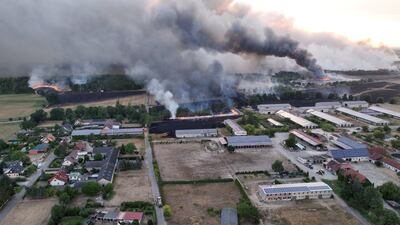
Smoke rises as firefighters try to extinguish a wildfire in Kolsa, Germany. Reuters -

A helicopter loads water from the sea in Falkenberg, Germany, to dump on wildfires. AP -
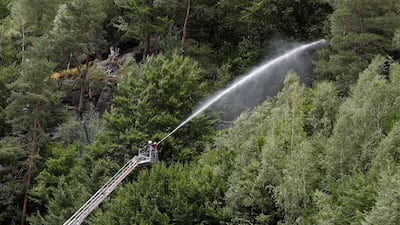
A firefighter works to contain a wildfire in a forest near the town of Hrensko, Czech Republic. Reuters -
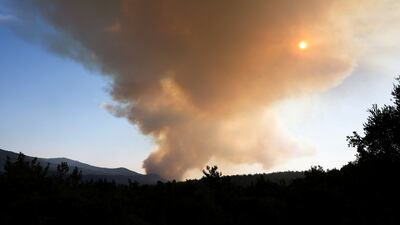
A wildfire burns in Dadia National Park, Greece. Reuters -
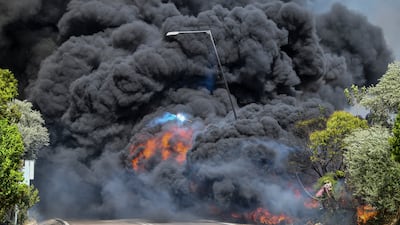
A power cable sparks as a fire burns near the village of Krestena, south of Ancient Olympia, while authorities evacuate five villages in the area, in Greece. AP -

A firefighting helicopter drops water near the village of Krestena in Greece. AP -
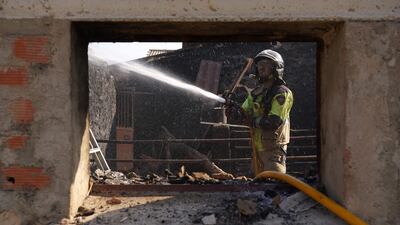
A firefighter douses rubble in a burnt house after a wildfire in Santibanez del Val near Burgos, Spain. AFP -
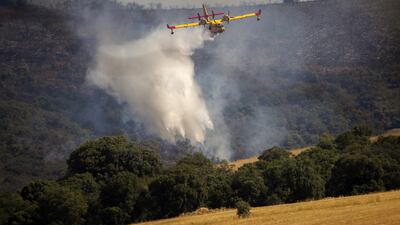
A firefighting aircraft drops water on a forest fire in Malagon, Spain. EPA


Preserving existing forests is conceptually hard to assess. Were trees ever really in danger of being destroyed? Project proponents have the temptation to exaggerate. Some studies suggest that as much as 90 per cent of rainforest protection credits are worthless.
Reforestation might seem more tangible. But the cheapest approach is monoculture: setting up vast plantations of identical fast-growing species. These, though, are disastrous for biodiversity, probably offering fewer habitats for wildlife than the grasslands they replace. This applies particularly to trees planted for biofuels, such as oil palms. However, only planting seeds can be ineffective when trees are not tended and are at risk of dying from drought.
Preserving or reforesting specific locations without addressing the root causes of deforestation – rising demand for meat, animal feed and biofuels – is likely to displace farming and ranching activity elsewhere. Locals may be excluded from areas they had relied on for food and firewood and see little of the payments made.
Yet, it is good to pay to protect vulnerable forests and other ecosystems. It is good to keep carbon out of the atmosphere or draw it into plants and soils. It is good to bring another source of income to impoverished rural communities. And it is essential to find affordable ways to counteract residual, unavoidable emissions. So how do we make the offset system work?
Accounting, methodological fixes, more scrutiny and reviews are only tinkering around the edges.
Financial reporting and dealing with real dollars recorded in bank accounts is prone enough to fraud and scandals – think how long Enron was able to fool investors and regulators.
Much harder is measuring levels of soil and trees and then assessing the counterfactual of how much carbon would have been emitted in the absence of offset projects.
A real fix would have three key components. First, bio-offsets are a temporary form of carbon storage. They should only be issued in alignment with the actual growth of a forest and its carbon storage.
The credits should endure for a defined period, like a bond, that has to be repaid – either with a new issuance or with a permanent form of carbon removal such as storing carbon dioxide underground or turning it into solid minerals. If a project is logged or destroyed by pests or wildfires, credits should have to be replaced immediately.
Second, the amount of the offset should be discounted to represent the displacement of some deforestation to another location.
Third, the social and biodiversity effects should be separated from carbon storage and valued individually. Companies that contribute to deforestation – such as logging, agribusinesses and biofuels makers – could offset that part with contributions from governments.
At Cop28, which starts at the end of this month in Dubai, topics of debate include carbon offsets and trading, compensating lower-income countries for losses and damage due to climate change, bringing finance to developing countries, and the role of carbon capture and storage.
Proper use of bio-based offsets has the potential to tie all of these challenges together. But cosmetic fixes are not enough. The system can only be saved by a root-and-branch rethink.
Robin M. Mills is chief executive of Qamar Energy, and author of The Myth of the Oil Crisis

