

On September 11, 2001, United Airlines Flight 93 crashed into a Pennsylvania field after passengers prevented the Al Qaeda hijackers from reaching their intended target: the US Capitol.
Two decades later, a mob of Americans successfully attacked the very same building as part of an attempted insurrection.
The failed overthrow of a presidential election on January 6 highlights the perilous low that US democracy has fallen to since 9/11. Even today, most Republican voters still don't believe Donald Trump lost, and the country's hyper-partisan divide has only deepened since Joe Biden took office.
While the cleaving of modern America pre-dates 9/11 and worsened in 2000 when the US Supreme Court cleared the way for George W. Bush to win that year's contested presidential election, the September 11 fallout has sickened the fabric of US society in ways that perhaps even Osama bin Laden could barely have imagined.
“September 11 really came at the worst time because it was right after the contested election of 2000,” Nickie Michaud-Wild, a sociologist at Upper Iowa University who specialises in American reactions to 9/11, told The National.
“That’s something that we could have turned a corner on if it were not for 9/11. I think it was a perfect set-up for that divide to become exacerbated greatly.”
Over the course of four administrations, seemingly unending and unwinnable foreign wars and the rapid expansion and centralisation of vast government surveillance powers have eroded public trust in the federal government, American politicians and the mainstream media.
Although the Iraq invasion briefly fuelled anti-war protests, a Gallup poll from 2003 found that 72 per cent of Americans supported the US occupation — buoyed by the Bush administration’s efforts to give Baghdad a role to play in the new war on terror.
In justifying the war, the Bush administration falsely asserted that Saddam Hussein had ties to Al Qaeda. Most US media outlets marched in lockstep to Mr Bush's rush to war and prestigious publications such as The New York Times uncritically parroted his administration’s inaccurate claims that Iraq was actively developing weapons of mass destruction.
-
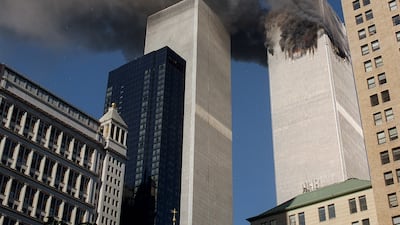
Smoke billows from the North Tower of the World Trade Centre in New York City after terrorists crashed a plane into the building on September 11, 2001. AP Photo -

The plane was thought to have hit the North Tower between floors 93 and 99 sparking a fierce fire on those storeys from which people desperately tried to escape. Reuters -
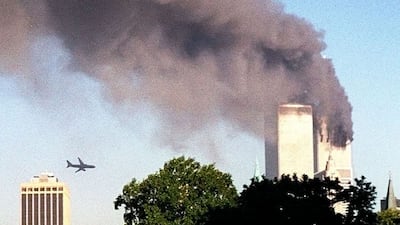
American Airlines flight 175 closes in on the south face of the South Tower of the World Trade Centre as the North Tower burns. Shutterstock -
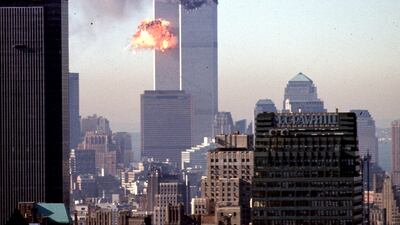
The moment of impact. AFP -
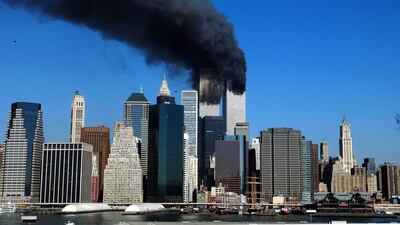
With both towers ablaze, pandemonium ensues in Manhattan in the building and on the ground. AFP -
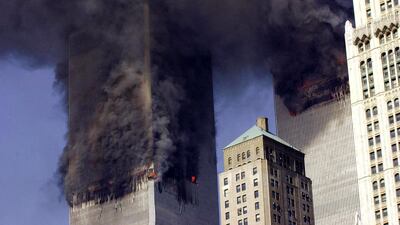
The cloudless, blue sky gave little portent of the dark, history-changing day that was to come but would remain etched on the memory of those involved and beyond. AFP -
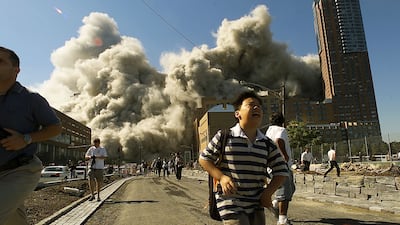
People run for their lives as the North Tower of World Trade Centre collapses. The South Tower had come down 29 minutes earlier. Getty Images -

Emergency personnel tend to injured people in Liberty Park, New Jersey, as the enormity of the day's events slowly begin to hit home. Reuters -
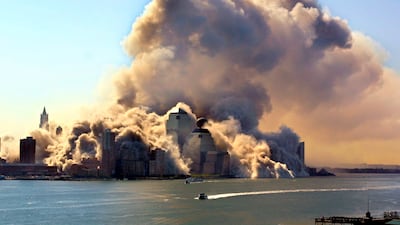
The World Trade Centre disappears in a thick cloud of smoke as the second tower implodes. AP Photo -
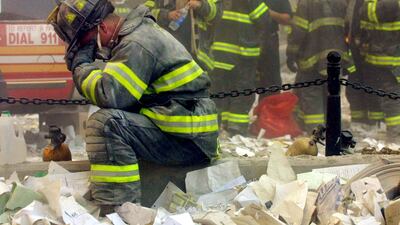
Firefighter Gerard McGibbon, of Engine 283 in Brownsville, Brooklyn, prays after the buildings collapse. Getty Images -

Smoke pours from the site and drifts across the New York sky. Reuters


A Pew Research Centre poll in 2007 found that the American public’s trust in both the military and the press to provide accurate information about Iraq severely eroded in the first four years of the war.
By that year, only 46 per cent of Americans trusted the military and 38 per cent trusted the press to provide accurate information on Iraq -- a drop from 80 percent for both institutions in 2003.
“The anti-war view was not being represented very well in the mainstream media, so even people who were progressives felt that hugely damaged their trust in the culture, institutions, everything else,” Ms Michaud-Wild said.
Although Mr Bush at first enjoyed broad Republican support for the Iraq war, former president Donald Trump would eventually appeal to those same voters in 2016, criticising his opponents from both parties who supported the conflict and repeatedly referencing the US media’s failure to critically report on it.
After Mr Trump and former president Barack Obama, Joe Biden became the third president to try to capitalise on the American public’s fatigue after two decades of war, officially withdrawing from Afghanistan at the end of August.
-
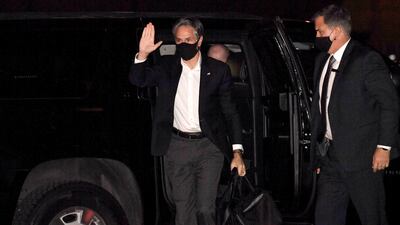
US Secretary of State Antony Blinken arrives to board an aircraft from Joint Base Andrews, Maryland for travel to Doha, Qatar and Ramstein, Germany. AP -
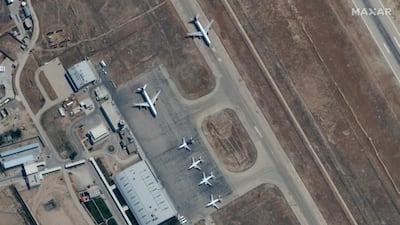
A satellite image shows grounded aircraft at the Mazar-i-Sharif airport in northern Afghanistan. Maxar Technologies via AFP -
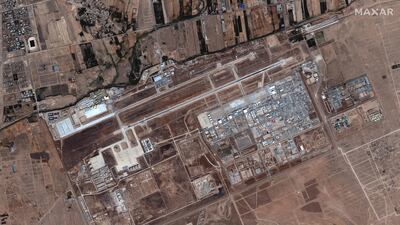
The Mazar-i-Sharif airport in northern Afghanistan. Maxar Technologies via AFP -
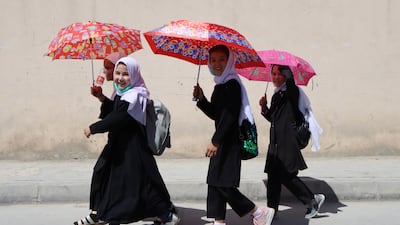
Schoolgirls on their way home in Kabul. EPA -

People sell petrol on a roadside in Kabul. EPA -
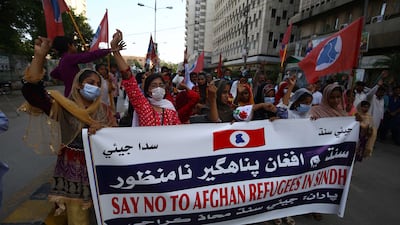
Members of Jiye Sindh Mahaz party protest against plans to accept Afghan refugees in Karachi, Pakistan. Pakistan has shut its doors to Afghan refugees following the Taliban's takeover of the country. About 1. 4 million Afghan refugees are living in Pakistan legally, while around another million are undocumented. EPA -
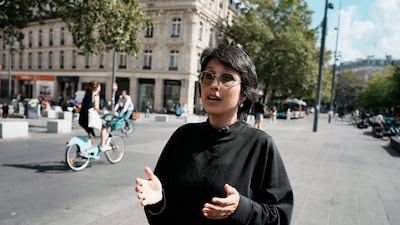
Afghan filmmaker Shahrbanoo Sadat speaks in Paris, France, before attending a gathering held to show solidarity with the women of Afghanistan. AP -
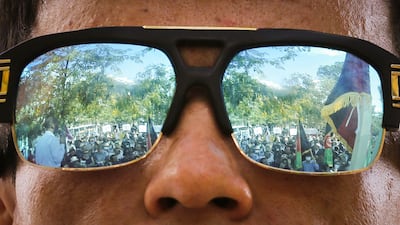
Protesters are reflected in the sunglasses worn by a demonstrator during a rally in support of Afghanistan's people, at the Place de la Republique, in Paris. AFP -
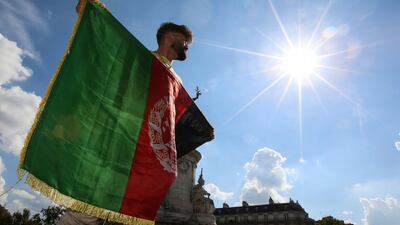
A man holds the Afghan national flag as he takes part in a rally in support of Afghanistan's people, at the Place de la Republique, in Paris. AFP -
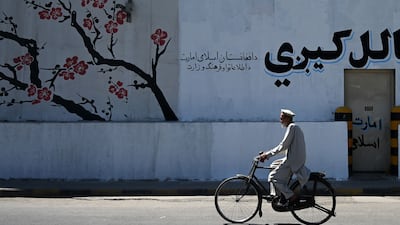
An Afghan man rides a bicycle past a barrier wall in Kabul. AFP -
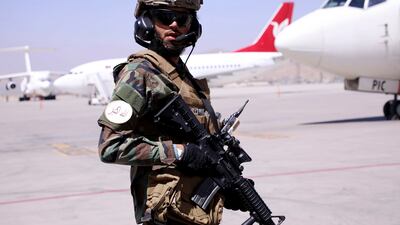
A member of the Taliban forces stands guard at Hamid Karzai International Airport in Kabul, Afghanistan. Reuters -
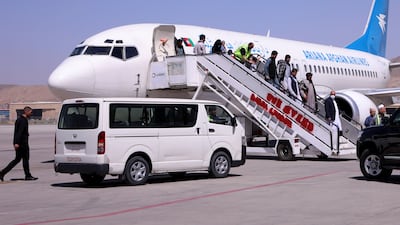
Passengers disembark on arrival from Kandahar at Hamid Karzai International Airport in Kabul, Afghanistan. Reuters -
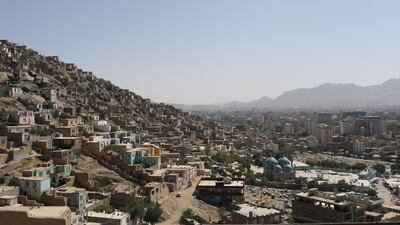
A general view of the city of Kabul, Afghanistan. Reuters -
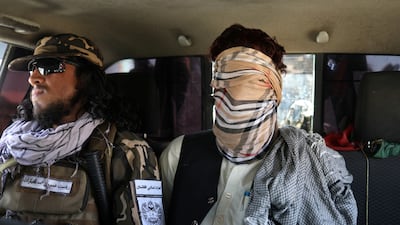
A suspected ISIS member sits blindfolded in a Taliban Special Forces car in Kabul, Afghanistan. Reuters -
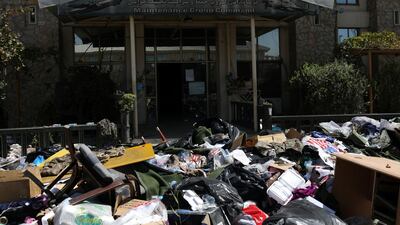
An entrance of the Maintenance Group Command at the military airfield in Kabul. Reuters -
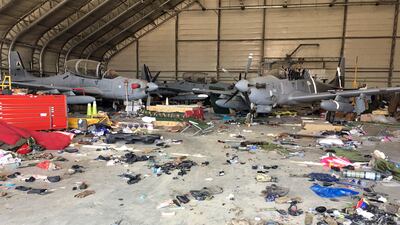
Damaged Afghan military aircraft are parked in a hangar after the Taliban's takeover of Hamid Karzai International Airport in Kabul. AP -
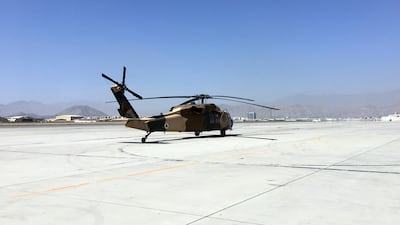
An Afghan military helicopter at the airport in Kabul. AP -
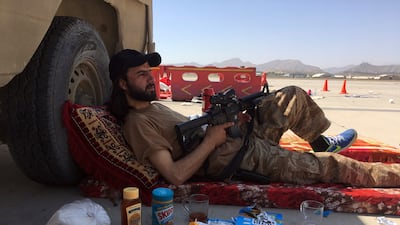
A Taliban fighter rests while on duty at the airport in Kabul, Afghanistan. AP -
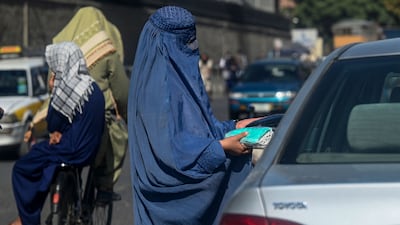
A burqa-clad woman sells face masks to commuters at a traffic intersection in Kabul. AFP -
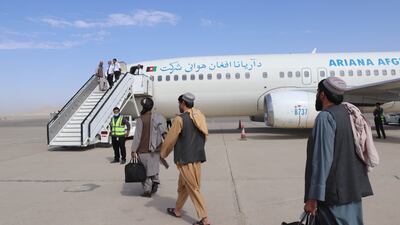
Passengers board an Ariana Afghan Airlines aircraft for a domestic flight, at the airport in Kandahar. Afghanistan's major airports reopened for domestic flights on September 4. EPA -
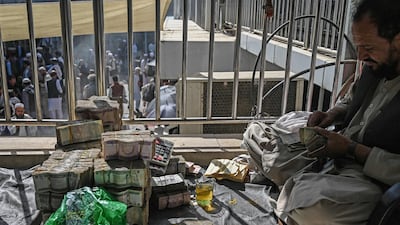
Foreign currency traders carry out their tasks after the money market and other financial services providers reopened for business in Kabul. AFP -
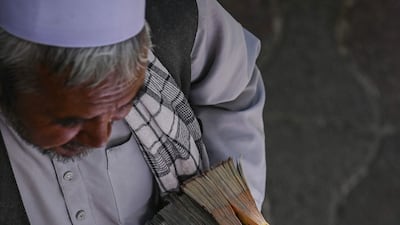
Foreign currency dealers transact in Kabul. AFP -
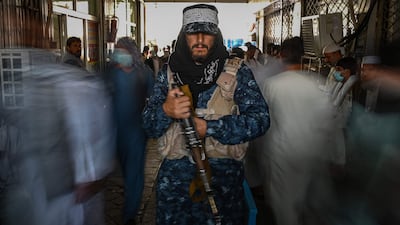
A Taliban fighter stands guard as people move past him at a market with shops dealing in foreign currency, in Kabul. AFP -
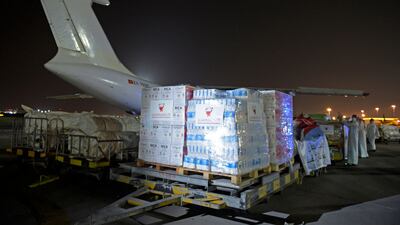
Workers and volunteers load a shipment of humanitarian aid to be sent to Afghanistan at Bahrain International Airport on Muharraq Island, near the capital Manama. AFP -
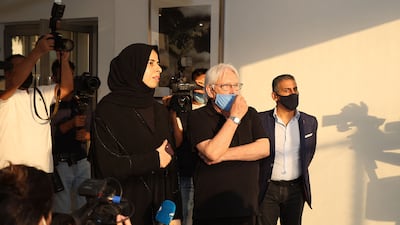
Official spokeswoman of the Supreme Committee for Crisis Management in Qatar, Lolwah Al Khater, and UN Special Envoy for Yemen Martin Griffiths visit the Park View Villas, in Doha, which is now housing Afghan refugees. AFP -

Fifa president Gianni Infantino, centre, plays football with people flown from Afghanistan at Park View Villas, Doha. Accommodation built in Qatar for the 2022 Fifa World Cup has now assumed a different role from that envisaged by the organising committee - housing Afghan refugees. AFP -

Back row, from left, Matthijs Wouter Knol, Sahraa Karimi, Sarah Mani and Mike Downey, and front row, from left, Orwa Nyrabia and Vanja Kaludjercic during the International Panel on Afghanistan and the situation of Afghan filmmakers and artists at the 78th annual Venice International Film Festival, in Italy. EPA -
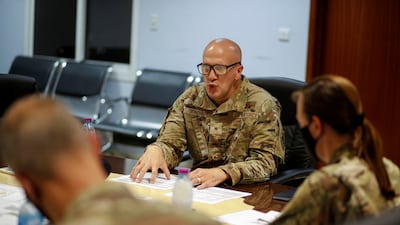
US Air Force Brigadier General Gerald Donohue speaks during a media briefing at Al Udeid airbase in Doha, Qatar. Reuters -

A vendor displays guns for sale at a market in the Panjwai district of Kandahar province. AFP -
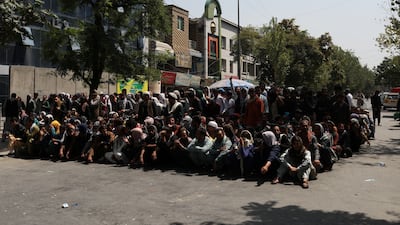
Customers wait outside a bank on a street in Kabul, Afghanistan. Reuters -
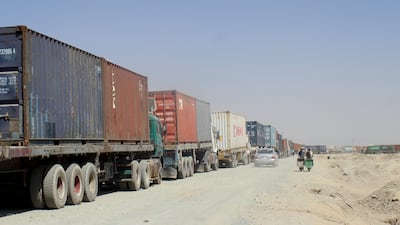
Vehicles loaded with shipping containers wait to cross into Afghanistan, at the Friendship Gate crossing point, in the border town of Chaman, Pakistan. Reuters -
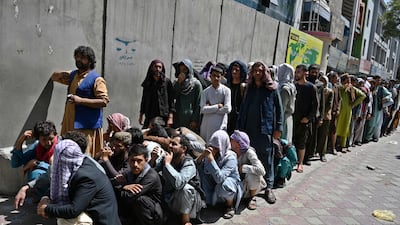
People queue outside a bank to withdraw money in the Shar-e-Naw district of Kabul. AFP


But despite the withdrawal from Afghanistan, American troops remain stationed in Iraq and Syria and the US military continues to launch drone strikes across the globe.
Data compiled by the Costs of War project at Brown University’s Watson Institute for International and Public Affairs indicate the US has launched military operations in 85 countries throughout the Middle East, Africa and Asia since September 11.
The data also show that the post-September 11 wars have killed more than 800,000 people in Afghanistan, Pakistan, Iraq, Syria and Yemen while costing US taxpayers $6.4 trillion through 2020.
“The idea that the wars are ending when we take some last number of troops out of Afghanistan is wrong,” Catherine Lutz, co-director of the Costs of War project, told The National. “It’s a global war.
“There are companies that get contracts to do this. There are generals or officers who will make their careers on continuing to be the guy who trains forces in Africa. Unless the public — or Congress, more importantly — puts the brakes on some of this, we’re going to see that for decades.”
Post-September 11 institutions have also become flash points in America's ever-worsening culture wars, such as the debate over whether to close the notorious Guantanamo Bay detention facility — a proposition that is now favoured by most Democrats and opposed by most Republicans.
The battle between conservatives and liberals over social values was a primary fault-line in American politics prior to 9/11, but the attacks intensified the debate over a significant facet of that culture war: immigration.
The series of wars that followed 9/11 contributed to the greatest global refugee crisis since the World War II, helping fuel the rise of nativist politics within the Republican Party.
The refugee crisis came at a time when violence against Muslims had skyrocketed after September 11. FBI data indicate that the rate of anti-Muslim hate crimes has remained consistently higher than it was before the attack.
The Bush administration promptly established the Department of Homeland Security and the Immigration and Customs Enforcement (ICE) agency in response to September 11.
And the culture wars over immigration have propelled backlash among the Democratic base in recent years over ICE’s harsh detainment of migrants, fuelling a movement to abolish ICE among the left.
The conservative blowback against refugees from the Middle East and Central Asia as well as Latin American migrants attempting to cross the southern border helped propel Mr Trump to the White House.
“All these things that were coming on to the scene — the white supremacist website Storm Front was one of the first websites,” said Ms Michaud-Wild.
“Historical circumstances can prime not only the divisions over immigration and loss of trust, but also the incredible proliferation of conspiracy theories and white supremacists — it’s all tied together.”
One of the earliest internet conspiracies to proliferate within the US was the September 11 “truther” movement, which falsely asserted that the attacks were an inside job carried out by the Bush administration to justify its multiple wars.

Since then, the digital age has given birth to countless conspiracy theories unrelated to September 11, including QAnon.
Mr Trump’s supporters stormed the Capitol on January 6 over lies — repeated frequently by the former president — claiming mass voter fraud in the 2020 election.
September 11 was no doubt far from the minds of the insurrectionists who stormed the Capitol.
But their actions were the product of a political and social atmosphere powered by the loss of trust in public institutions and the increasingly acrimonious culture wars that the American response to September 11 has amplified.

