
Unesco added Saudi Arabia's Al Ahsa Oasis and Oman's ancient city of Qalhat to its World Heritage List on Friday, the UN cultural organisation said.
Authorities in Riyadh and Muscat have placed tourism high on their economic agendas as Gulf states look to diversify their oil-dependent economies.
Saudi Arabia's lush Al Ahsa Oasis is dotted with yet-to-be-excavated archaeological sites, and carries traces of human occupation dating back to Neolithic times.
Al Ahsa "was a commercial centre for the Hajar territory of Bahrain", reads the Saudi submission to Unesco.
"Archaeological evidence shows that it exchanged products from southern Arabia and Persia as well as throughout the Arabian Peninsula."
Riyadh's tourism drive, backed by reformist young Crown Prince Mohammed bin Salman, has not shied from highlighting pre-Islamic heritage in the Muslim kingdom.
_______________
Read more:
Five sites hoping to make UNESCO World Heritage List
UNESCO to consider 30 entries to World Heritage List in Bahrain this week
Here are the hopefuls vying for a place on the UNESCO heritage list
_______________
Oman's Qalhat also dates back to pre-Islamic times.
The port city was once a key trade hub, with commerce including Arabian horses and Chinese porcelain, according to the Omani submission.
Unesco said: "The city developed as a major port on the east coast of Arabia between the 11th and 15th AD, during the reign of the Hormuz princes."
UAE Minister of Culture and Knowledge Development, Noura Al Kaabi, was among those to laud the Omani achievement. "Over 3,500 years ago, it was the location of a thriving port city, which played a vital role in connecting ancient trading routes throughout the Indian Ocean," she said.
The case of Qalhat also demonstrates the power women could hold in Arabian society at the time.
"In the 13th century … the governor Ayaz split his presence between Hormuz and Qalhat, which in his absence was ruled by his wife Maryam," the submission reads.
"She, Bibi Maryam, is said to have built the Great Friday Mosque and a mausoleum for her late husband. She continued ruling after her husband's death until at least 1319."
Unesco said: "The city developed as a major port on the east coast of Arabia between the 11th and 15th centuries CE, during the reign of the Hormuz princes. Today it bears unique archaeological testimony to the trade links between the east coast of Arabia, East Africa, India, China and south-east Asia."
-
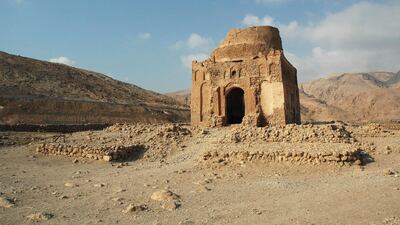
The Bibi Maryam Mausoleum in the ancient city of Qalhat, Oman. QDP / UNESCO / EPA -

The Al-Ahsa Oasis in the desert of Saudi Arabia. Francois Cristofoli / UNESCO / EPA -

The entrance to Kochieng enclosure at the Thimlich Ohinga Archaeological Site in Kenya. Ephraim Mwangi / UNESCO / EPA -
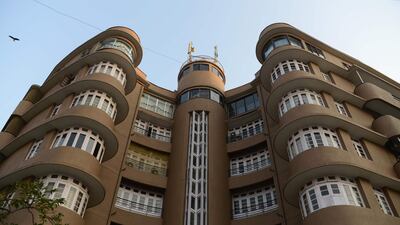
An Art Deco building in Mumbai. Punit Paranjpe / AFP -

The Qal'eh Dokhtar in the Sassanid Archaeological Landscape of Fars region, Iran. S.H. Rashedi / UNESCO / EPA -
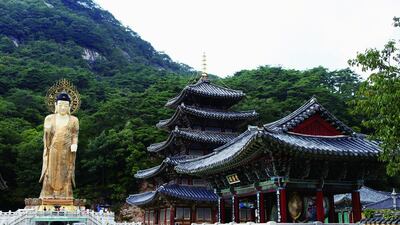
The Beopjusa Temple, Hall of Eight Pictures at the Sansa, Buddhist Mountain Monasteries, South Korea. CIBM / UNESCO / EPA -

The Oura Cathedral at Hidden Christian Sites in the Nagasaki Region, Japan. Japan Cultural Heritage Consultancy / UNESCO / EPA -
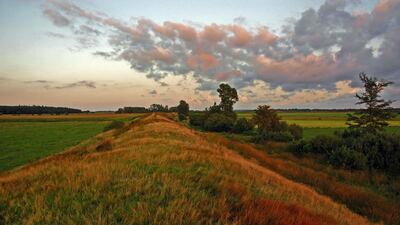
The Crooked Wall at the archaeological border complex of Danevirke, Germany. Rainer Heidenreich / EPA -
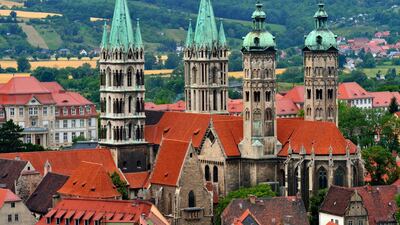
The Cathedral of Naumburg, Germany. Hendrik Schmidt / EPA -
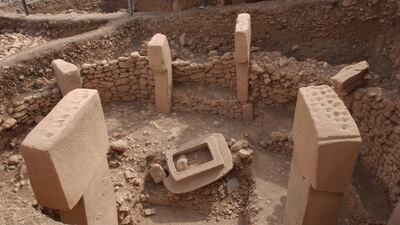
Building B of the archaeological site Goebekli Tepe in southeastern Anatolia region, Turkey. Gobekli Tepe Project / EPA -
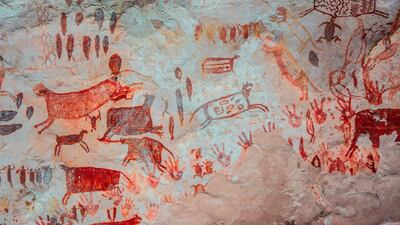
Rock art in the Chiribiquete National Park, Colombia. Jorge Mario Alvarez Arango / EPA -

The Serrania de Chiribiquete at Chiribiquete National Park, Colombia. Guillermo Legaria / AFP -

Pimachiowin Aki biosphere reserve in Canada. Pimachiowin Aki / EPA -
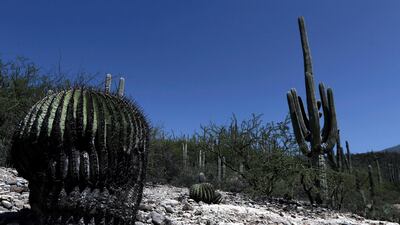
Tehuacan-Cuicatlan Valley in Mexico. Hugo Ortuno / EPA -
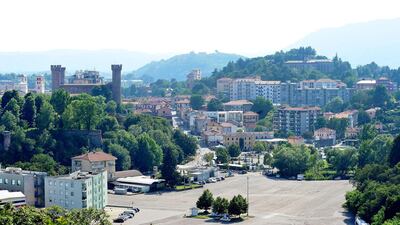
Ivrea, near Turin, Italy. Alessandro di Marco / EPA -
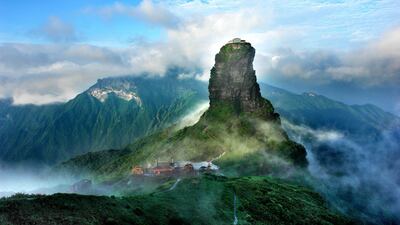
Fanjingshan in Guizhou Province of south-west China. Zhou Wenqing / UNESCO / EPA -

Caliphate City of Medina Azahara in Cordoba, Southern Spain. Salas / EPA


The World Heritage designation is a prestigious one for the Gulf states, looking to make their mark as culturally rich, safe tourist destinations.
The Unesco gathering in neighbouring Bahrain, however, comes at a sensitive time for the organisation as it scrambles for funding following Washington's withdrawal last year.
United States President Donald Trump's administration pulled out of Unesco citing its continuing "anti-Israel bias", six years after the organisation allowed the Palestinians to join.
Israel's ambassador to Unesco said on Tuesday that he was urging his government to reconsider its decision to also quit the body, saying it had halted its "anti-Israeli resolutions" over the past year.

