

At 83, two-time prime minister Sadiq Al Mahdi continues to be a powerful political figure in today’s Sudan, embracing the role of the seasoned statesman working behind the scenes to help rival forces agree on a political roadmap following the violence and tumult of revolution.
The value of that work cannot be exaggerated at a time when Sudan is struggling to move past the toxic legacy of 29 years of Islamist rule defined by wars, economic woes, widespread rights violations and corruption.
Mr Al Mahdi spoke to The National on Tuesday at his home in Omdurman, twin city of the Sudanese capital. During the hour-long, wide-ranging interview, he singled out the economy and armed conflicts in western and southern Sudan as the two most serious challenges facing Sudan after the ousting in April of long-time dictator Omar Al Bashir.
Mr Bashir brought his downfall on himself, said Mr Al Mahdi, wearing a light beige robe and a knitted cap. “That man and his regime squandered every chance to escape their grim fate. They have willingly invited their destiny.”
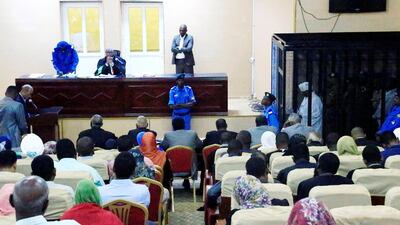
But he betrayed no glee speaking about what it meant for him to see Al Bashir, whose 1989 military coup toppled his freely elected government, appear before a criminal court on Monday charged with corruption. Photos of Sudan’s leader of 29 years inside a defendants’ cage splashed on the front page of almost every Arab newspaper on Tuesday.
Memories of the 1989 coup are still bitter for the former prime minister, however, as it was Mr Al Mahdi’s own brother-in-law – the late radical Islamist leader Hassan Al Turabi – who engineered his overthrow.
Mr Al Turabi’s National Islamic Front briefly served as a partner in a coalition government led by Mr Al Mahdi, whose second tenure was between 1986 and 1989. He first led the country aged 30 in 1966.
Of Mr Al Turabi, he said: “He harvested the bitter fruit of the seed he planted.”
-

Sudanese protesters run for cover from tear gas canisters fired by police outside the military headquarters in the capital Khartoum on April 6, 2019. AFP -
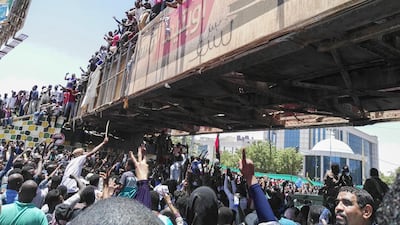
Sudanese protesters rally in front of the military headquarters in the capital Khartoum on April 8, 2019. AFP -
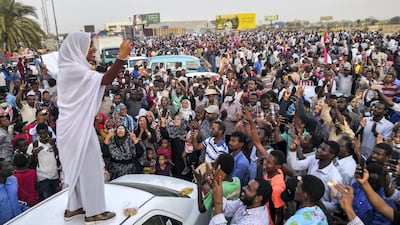
Alaa Salah, a Sudanese woman propelled to internet fame earlier this week after clips went viral of her leading powerful protest chants against President Omar Al Bashir, addresses protesters during a demonstration in front of the military headquarters in the capital Khartoum on April 10, 2019. AFP -
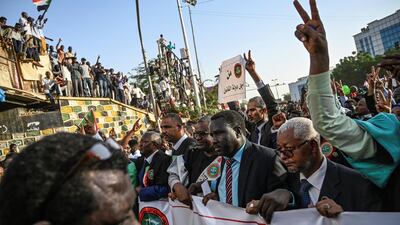
Sudanese judges, dressed in their robes, gather for a "million-strong" march outside the army headquarters in the capital Khartoum on April 25, 2019. AFP -

A Sudanese anti-regime protester kisses a soldier on the head during protests on April 11, 2019 in the area around the army headquarters in Sudan's capital Khartoum. AFP -
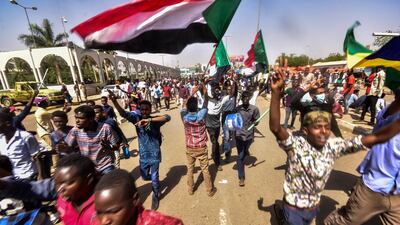
Sudanese demonstrators march with national flags as they gather during a rally demanding a civilian body to lead the transition to democracy. AFP -
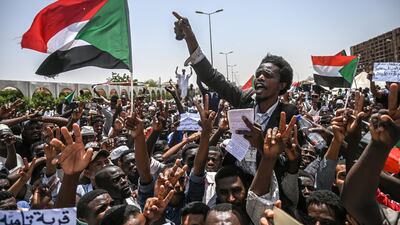
Protesters massed outside the army complex in central Khartoum on April 6, initially to demand the overthrow of longtime leader Omar Al Bashir. AFP -
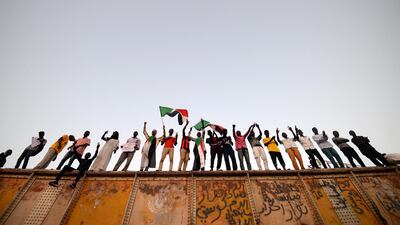
Sudanese protesters gather outside the army headquarters in Khartoum on May 6, 2019. AFP -
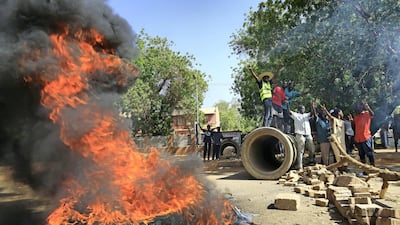
Sudanese protesters burn tyres as they block Nile Street for the second consecutive day during continuing protests in Sudan's capital Khartoum on May 13, 2019. AFP -
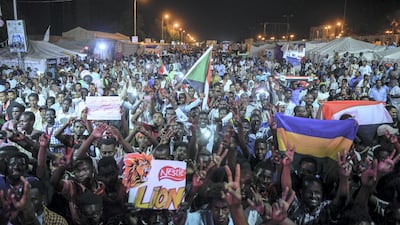
Sudanese protesters wave flags and flash victory signs as they gather for a sit-in outside the military headquarters in Khartoum on May 19, 2019. AFP -
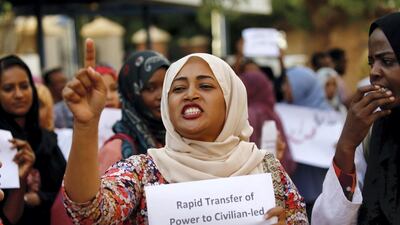
A Sudanese health worker carries a placard as scores of medics hold a rally in front of a hospital in the capital Khartoum on May 23, 2019. AFP -
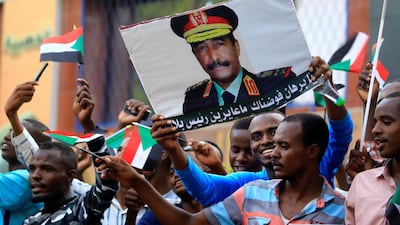
Sudanese supporters of the ruling Transitional Military Council (TMC) hold up a sign showing a portrait of its head General Abdel Fattah Al Burhan with a caption below reading in Arabic "we have delegated you Burhan, we want no president but you", during a rally in the centre of the capital Khartoum on May 31, 2019. AFP -
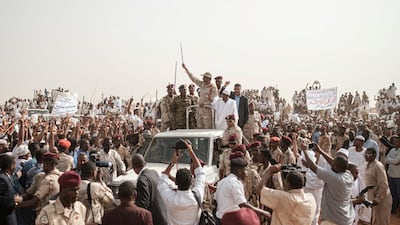
Mohamed Hamdan Dagalo, known as Himediti, deputy head of Sudan's ruling Transitional Military Council and commander of the Rapid Support Forces paramilitaries, waves a baton to supporters on a vehicle as he arrives for a rally in the village of Abraq, about 60 kilometres northwest of Khartoum, on June 22, 2019. AFP -
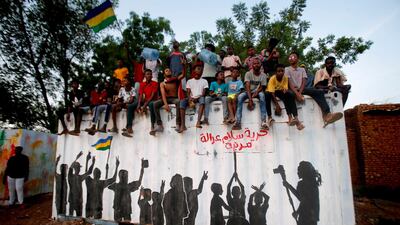
Sudanese protestors celebrate in the streets of Khartoum after ruling generals and protest leaders announced they have reached an agreement on the disputed issue of a new governing body on July 5, 2019. AFP -
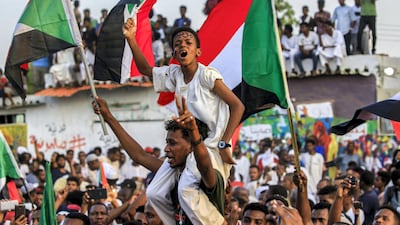
Thousands went to the streets to welcome the agreement on Saturday. AFP -
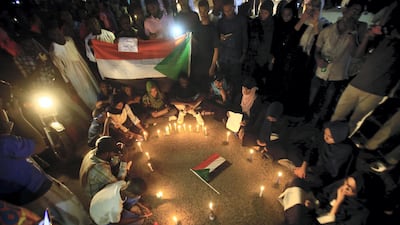
Sudanese protesters take part in a vigil in the capital Khartoum to mourn dozens of demonstrators killed last month in a raid on a Khartoum sit-in. AFP -
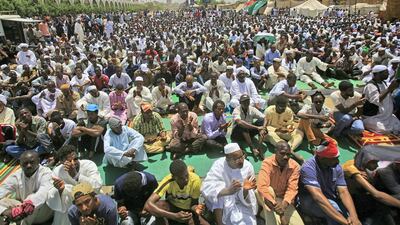
Sudanese protesters gather during Friday noon prayers outside the army headquarters in Khartoum on May 3, 2019, as they continue to protest demanding that the ruling military council hand power to a civilian administration. AFP -
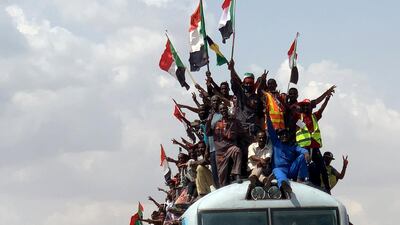
Sudanese civilians from other provinces ride on the train to join in the celebrations of the signing of Sudan's power-sharing deal. Reuters -
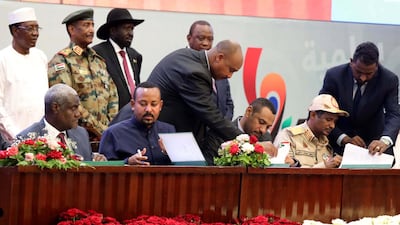
Sudan's Forces of Freedom and Change coalition leader Ahmad Rabiah (3-R) and Sudan's General and Vice President of Sudanese Transitional Military Council, Mohamed Hamdan Dagalo (2-R) sign power-sharing agreement,. EPA -
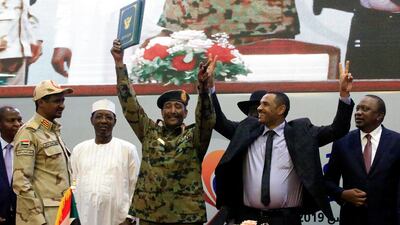
Sudan's Head of Transitional Military Council, Lieutenant General Abdel Fattah Al-Burhan, and Sudan's opposition alliance coalition's leader Ahmad Rabiah, celebrate the signing of the power-sharing deal, that paves the way for a transitional government, and eventual elections. Reuters -
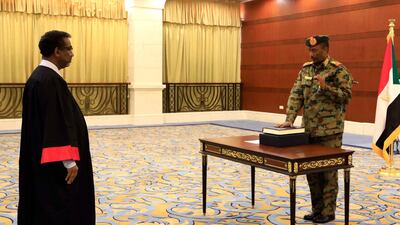
epa07783624 Leader of Sudan's transitional council, Lieutenant General Abdel Fattah Abdelrahman Burhan (R) is sworn in as the Head of the newly formed transitional Council at the presidential palace in Khartoum, Sudan, 21 August 2019. The Sudanese opposition and military council signed on 17 August a power sharing agreement. The agreement sets up a sovereign council made of five generals and six civilians, to rule the country until general elections. Protests had erupted in Sudan at the end of 2018, culminating in a long sit-in outside the army headquarters which ended with more than one hundred people being killed and others injured. Sudanese President Omar Hassan al-Bashir stepped down on 11 April 2019. EPA/STRINGER -
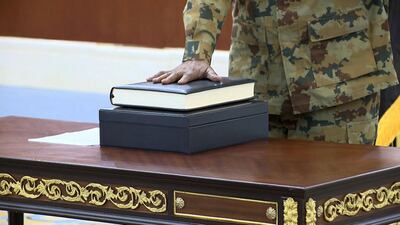
A pictured released by Sudan's Presidential Palace shows General Abdel Fattah al-Burhan, the head of Sudan's ruling military council, during a swearing in ceremony in Khartoum on August 21, 2019. Burhan was sworn today as chairman of Sudan's new sovereign council that will steer the country through a three-year transition to civilian rule. "General Abdel Fattah al-Burhan Abdel Rahman was sworn in as president of the sovereign council," the official SUNA news agency reported. / AFP / SUDAN PRESIDENTIAL PALACE / - / RESTRICTED TO EDITORIAL USE - MANDATORY CREDIT "AFP PHOTO / SUDAN PRESIDENTAIL PALACE" - NO MARKETING NO ADVERTISING CAMPAIGNS - DISTRIBUTED AS A SERVICE TO CLIENTS -
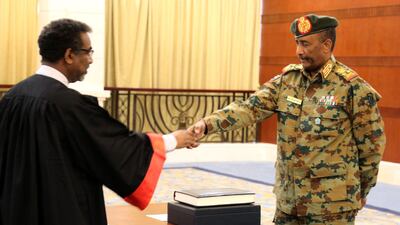
A picture released by Sudan's Presidential Palace shows General Abdel Fattah al-Burhan, the head of Sudan's ruling military council, during a swearing in ceremony in Khartoum on August 21, 2019. Burhan was sworn today as chairman of Sudan's new sovereign council that will steer the country through a three-year transition to civilian rule. "General Abdel Fattah al-Burhan Abdel Rahman was sworn in as president of the sovereign council," the official SUNA news agency reported. / AFP / SUDAN PRESIDENTIAL PALACE / - / RESTRICTED TO EDITORIAL USE - MANDATORY CREDIT "AFP PHOTO / SUDAN PRESIDENTAIL PALACE" - NO MARKETING NO ADVERTISING CAMPAIGNS - DISTRIBUTED AS A SERVICE TO CLIENTS -
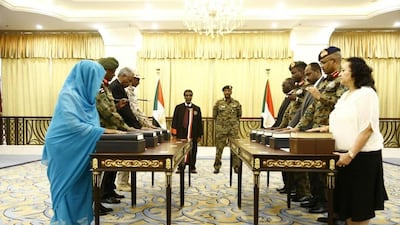
A picture released by Sudan's Presidential Palace shows General Abdel Fattah al-Burhan (C-R), the head of Sudan's ruling military council, standing during a swearing in of the new sovereign council, in Khartoum on August 21, 2019. Sudan took further steps in its transition towards civilian rule today with the swearing in of a new sovereign council, to be followed by the appointment of a prime minister. The body replaces the Transitional Military Council (TMC) that took charge after months of deadly street protests brought down longtime ruler Omar al-Bashir in April. Burhan, who already headed the TMC, was sworn in as the chairman of the new sovereign council in the morning. / AFP / SUDAN PRESIDENTIAL PALACE / - / RESTRICTED TO EDITORIAL USE - MANDATORY CREDIT "AFP PHOTO / SUDAN PRESIDENTAIL PALACE" - NO MARKETING NO ADVERTISING CAMPAIGNS - DISTRIBUTED AS A SERVICE TO CLIENTS -
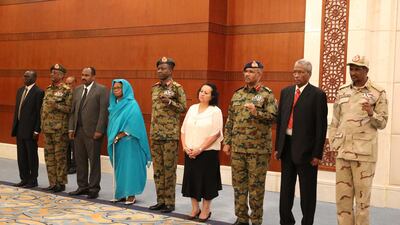
epa07784051 Members of Sudan's newly formed transitional Council (R-L) General Mohamed Hamdan Dagalo, Hassan Sheikh Idris, Genereal Ibrahim Jaber, Raja Nicola Issa Abdul-Masseh, General Shams al-Din Kabashi, Aisha Moussa, Mohamed Alfaki, General Yasser al-Atta and Sadeek Tawer look on during their sweaing-in ceremony at the presidential palace in Khartoum, Sudan, 21 August 2019. The Sudanese opposition and military council signed on 17 August a power sharing agreement. The agreement sets up a sovereign council made of five generals and six civilians, to rule the country until general elections. Protests had erupted in Sudan at the end of 2018, culminating in a long sit-in outside the army headquarters which ended with more than one hundred people being killed and others injured. Sudanese President Omar Hassan al-Bashir stepped down on 11 April 2019. EPA/MORWAN ALI -

Demonstrators march with banners and the old (L) and current (R) flags of Sudan outside a courthouse complex in the capital's twin city of Omdurman on August 21, 2019 during the trial of 40 members of Sudan's now-dissolved National Intelligence and Security Service facing charges over the death in custody of Ahmed al-Kheir, a teacher from the eastern town of Khashma el-Girba, in the early days of the wave of nationwide protests that eventually brought longtime ruler Omar al-Bashir. / AFP / Ahmed Mustafa -
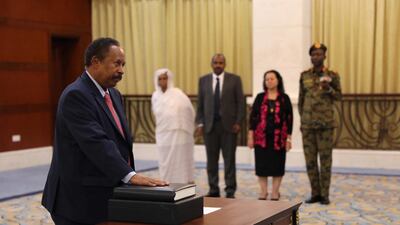
epa07784904 Sudan's new Prime Minister Abdalla Hamdok (L) swears in during a ceremony at the presidential palace in Khartoum, Sudan, 21 August 2019. The Sudanese opposition and military council signed on 17 August a power sharing agreement. The agreement sets up a sovereign council made of five generals and six civilians, to rule the country until general elections. Protests had erupted in Sudan in December 2018, culminating in a long sit-in outside the army headquarters which ended with more than one hundred people being killed and others injured. Sudanese President Omar Hassan al-Bashir stepped down on 11 April 2019. EPA/MARWAN ALI -
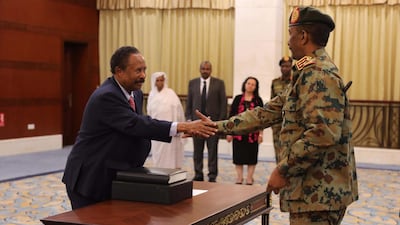
epa07784903 Sudan's new Prime Minister Abdalla Hamdok (L) shakes hands with Abdel Fattah Abdelrahman Burhan (R) after being sworn in during a ceremony at the presidential palace in Khartoum, Sudan, 21 August 2019. The Sudanese opposition and military council signed on 17 August a power sharing agreement. The agreement sets up a sovereign council made of five generals and six civilians, to rule the country until general elections. Protests had erupted in Sudan in December 2018, culminating in a long sit-in outside the army headquarters which ended with more than one hundred people being killed and others injured. Sudanese President Omar Hassan al-Bashir stepped down on 11 April 2019. EPA/MARWAN ALI -
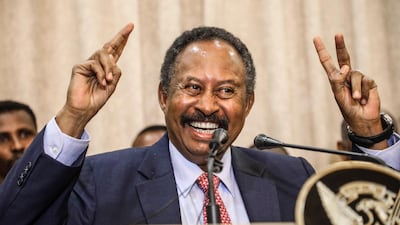
Sudan's new Prime Minister Abdalla Hamdok speaks duringa press conference in Khartoum, Sudan, Wednesday, Aug. 21, 2019. (AP Photo)


He saw the ousting of Mr Al Bashir as a chance to rectify his own overthrow in 1989. “The wrong must eventually be vanquished, the righteous state must come back.”
For months following the removal of Mr Al Bashir, Mr Al Mahdi sought to narrow the gap between the generals who removed him but wanted to hold on to power, and the young and mostly inexperienced opposition leaders who organised months of deadly street protests against the former leader.
Finally, the two sides reached a power-sharing agreement that outlined how the country would be ruled until the transitional period ends in late 2022 with the holding of elections. The document was signed on Saturday at a high-profile ceremony.
In some ways, Mr Al Mahdi’s role was a surprise to some young and overzealous opposition activists who saw him as a political relic from a bygone era and out of touch with the mood, aspirations and rebellious traits of Sudan’s contemporary youth. To them, Mr Al Mahdi is the quintessential symbol of the traditional and religious forces that dominated but achieved little during three spells of democratic rule in the 1950s, 1960s and 1980s. These forces, they argue, have been overtaken by a new strain of political activism that is mostly liberal, left-leaning and fearless in the face of the brutal force used by security forces during the uprising.
Their argument may not be entirely without merit, although Mr Al Mahdi dismisses it as untrue and argues that he and his Umma party, Sudan’s largest, were at the heart of the uprising. He is also just as dismissive of the notion held by some activists that with his impeccable English, aristocratic manners and Oxford degree, he presided over an elitist political system.

“This is nonsense. My thoughts and views keep up with change and I have authored books on a wide range of topics,” said Mr Al Mahdi, who boasted that he personally encouraged his children and grandchildren to participate in the four months of protests that paved the way for Mr Al Bashir’s removal in April. “If the Umma party was as antiquated as they say, it would have met the same fate as the Democratic Unionist party, which is now practically extinct,” he continued, alluding to his party’s one-time chief rival.
Still, Mr Al Mahdi said he had no intention of seeking executive office or assume a partisan political role.
“I am seeking a national, Arab, Islamic and international political role that is well away from partisan politics,” said Mr Mahdi, who, as is customary with him, quoted verse lines and medieval Arab philosophers in Tuesday’s interview.
-
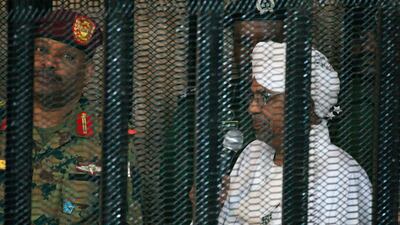
Sudan's deposed military ruler Omar al-Bashir stands in a defendant's cage during the opening of his corruption trial in Khartoum. AFP -
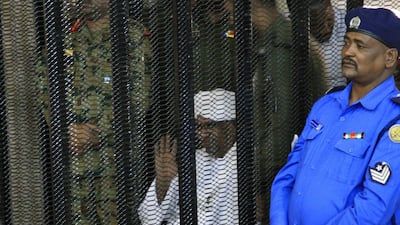
Bashir sits in a defendant's cage during the opening of his corruption trial. AFP -
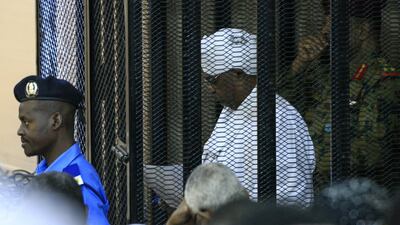
Bashir has admitted to receiving $90 million in cash from Saudi monarchs, an investigator told a Khartoum court today. AFP -
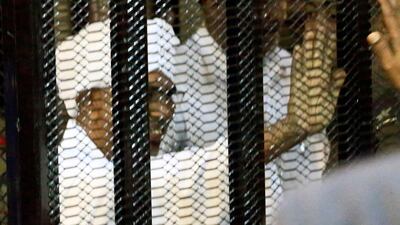
Bashir waves to relatives and supporters as he is guarded inside a cage. Reuters -
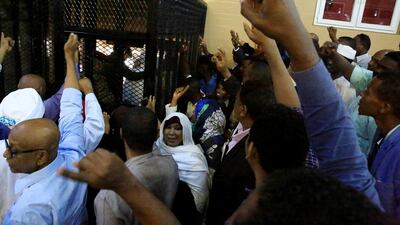
Relatives and supporters of Bashir cheer him. Reuters -
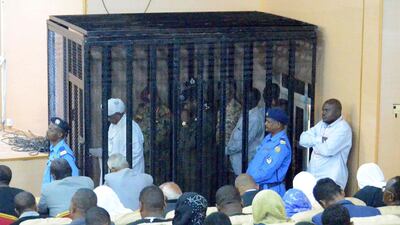
The trial resumed two days after the military council and the opposition signed a power sharing deal, hoping to end months of crisis. EPA -
Bashir stands guarded inside a cage at the courthouse where he is facing corruption charges. Reuters -
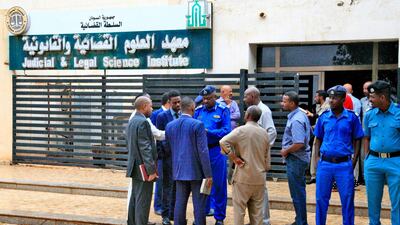
Officials gather outside the courtroom ahead of the corruption trial. AFP


Other activists, however, revere Mr Al Mahdi as a leader whose political career spanning more than a half-century had him imprisoned, in hiding, exiled abroad and vilified as corrupt or an agent of the West. Moreover, a significant part of his relevance in the “new Sudan” comes from the voting power of his supporters, something that has maintained his Umma party as a political powerhouse through the years.
Mr Al Mahdi’s lineage is another considerable asset to many Sudanese.
His great-grandfather was Mohammed Ahmed Al Mahdi, a messianic leader who led an uprising against Turko-Egyptian rule in the 19th century but whose subsequent Islamic state was defeated by an Anglo-Egyptian expedition in 1899. To this day, the power base of Mr Al Mahdi’s Umma party remains in western and central Sudan, home of the descendants of the soldiers who fought under his great-grandfather’s banner and are known as the Al Ansar.
Looking to Sudan’s future, Mr Al Mahdi predicted that early elections could shorten the 39-month transitional period if authorities were able to uproot “deep state” Islamists and Al Bashir cronies planted throughout the arms of government. Opposition leaders have maintained that holding elections before the deep state Loyal to Mr Al Bashir is dismantled could allow them to stage a political comeback.
While the ailing economy remains a pressing concern, negotiating a settlement for the long-running conflicts in the western regions of Darfur and Nuba Mountains as well as Blue Nile in the south could prove difficult before elections in 2022, he said.
“This may not be fully achieved before the forces that emerged from the revolution become political parties, compete in elections and assume executive positions,” he said, explaining that only an electoral mandate could empower leaders of the protest movement to conclude comprehensive peace deals.
Across the country, millions remain displaced by conflict, and their return home must be a priority, he said.
There is also a need to weed out elements loyal to Mr Al Bashir in the armed forces, he said. Some members of paramilitary forces established by the former leader to fight rebels should be discharged, while the rest are integrated into the military. He did not elaborate, but he was apparently referring to the Rapid Support Forces, a notorious paramilitary outfit whose genesis is in a tribal militia that fought Darfur rebels in the 2000s and is accused of large-scale abuses against civilians there.
The force’s commander is Gen Mohamed Dagalo, the deputy chairman of the Transitional Military Council that replaced Mr Al Bashir. His well-armed men are deployed across Khartoum, something that many in Sudan see as evidence that the general has become the strongman of post-Al Bashir Sudan. The power-sharing agreement signed on Saturday stipulates that his force comes under the leadership of the supreme commander of the armed forces, a proposition that may prove tough to enforce.
“In pursuit of his own security, Al Bashir tore apart the armed forces using every way possible,” said Mr Al Mahdi, whose supporters refer to him as simply the Imam, the Muslim title bestowed on his great-grandfather by loyalists. “But everyone in the armed forces is determined to uproot Al Bashir’s negative legacy.”

