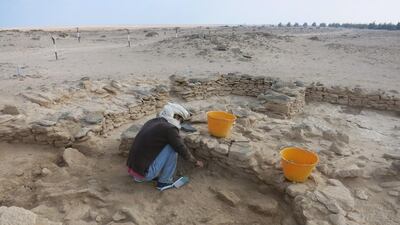
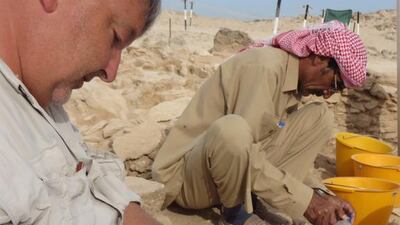
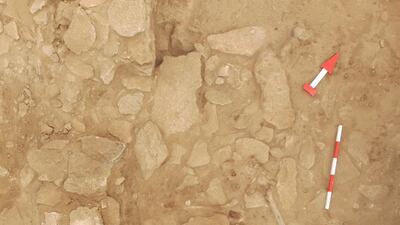
Archeologists digging into the Arab world's rich history believe donkeys may have been used to complete arduous desert journys during the Bronze Age. Pawan Singh / The National

Were donkeys the original ships of the desert?


Daniel Bardsley
  • English
  • Arabic

Fascinating new evidence about life on the Arabian peninsula four millennia ago suggests that people may have undertaken lengthy journeys across the desert even without camels.

Archaeologists believe that donkeys may have supported the crossing of the Empty Quarter between the Dilmun civilisation on the Arabian Gulf coast and Wadi Al Faw, 1,000km to the south-west.

If members of the Dilmun civilisation did undertake these arduous trips during the Bronze Age, it may have been to trade incense with inland communities.

Dr Steffen Laursen, of Moesgaard Museum at Aarhus University in Denmark, the first author of a new study on the period, said it was not certain how the people travelled without camels, but they were likely to have used donkeys.

Doing the donkey work

Dr Steffen Laursen inside an unexcavated Royal Dilmun Tomb in Bahrain. Photo: Moesgaard Museum

“In the paper we argued that they must have had trains of donkey caravans in the cold season, but it would still be very challenging,” he said.

“You would have to be able to rely on getting water and grass at much narrower intervals. They must have had a very particular route you could take in the cold season, in the wet season.”

Dr Laursen and Dr Faleh Al Otaibi, a Saudi researcher from King Saud University, have outlined their findings in the journal Arabian Archaeology and Epigraphy.

The identification in Wadi Al Faw of seals and other Dilmun objects, including a fragile and special type of “burial jar” used exclusively by the ancient Dilmunites, suggests that Dilmun traders travelled far inland about 1,000 years before the camel was domesticated.

“In one of the tombs Dr Al Otaibi discovered a distinctive Dilmun burial jar, which is a type only used for a very short period of time in Bahrain and Kuwait and it’s only produced in Dilmun,” Dr Laursen said.

“It’s extremely brittle, so bringing it to Al Faw would have been something people would have done because it was very important. It wouldn’t have been a random container you would stuff trade goods in because it would break very, very easily — it’s eggshell thin.”

Typically, trading activities from this period leave “very few traces”, Dr Laursen said, and the arid and windswept landscape tends to erase what little remains. Also, in this area trade was never as intense as in more populated regions, which is another reason why evidence is sparse.

The Dilmun civilisation existed during the Bronze Age, which lasted from around 3300BC to 1200BC, and was focused on Bahrain and the Arabian Gulf coast of what is now Saudi Arabia, stretching up towards present-day Kuwait.

What motivated epic journeys?

A Dilmun burial jar found at Wadi Al Faw in Saudi Arabia by Dr Faleh Al Otaibi. Photo: Dr Faleh Al Otaibi

“What we don’t know still and what this study can’t answer is what was the nature of the articles of trade that motivated people to go all the way overland to Wadi Al Faw,” said Dr Laursen.

“It could have been that it was incense, but the evidence points against that … It could also have been precious metals from the mountains of western Saudi Arabia or Yemen.

“Travelling through the extremely inhospitable terrain of inland Arabia was dangerous and probably not something one would venture to do unless the stakes were very high.”

In Wadi Al Faw, society was probably less developed than it was in the state-like Dilmun civilisation, but the area had good water supplies.

“It was probably a green island in an otherwise very, very dry environment,” Dr Laursen said.

“This would have drawn pastoral and nomadic groups in from a lot of places, but there would probably have been someone who tried to claim this area because of its resources, but we’re only just beginning to understand what was going on here in the Bronze Age.”

Dr Laursen has completed two doctorates on the Bronze Age in Dilmun (Bahrain) where, around 2000BC, society underwent many changes, with a single dynastic ruling elite taking control and developing a fortified capital in the north of the island.

Society became much wealthier, building stone-built temples, palaces, a city wall and royal tombs, along with many burial mounds, around 76,000 of which were created over a 500-year period, mostly for the middle and upper classes.

As well as farming, including date plantations, fishing went on and cereals were imported from Mesopotamia in modern-day Iraq. There was also a lucrative trade in other goods from around 2000BC.

The value of trade

The Dilmuns traded extensively with ancient Mesopotamia, and with another of the world’s great early civilisations in the Indus Valley in today’s Pakistan and India.

Other trading partners included the Magan civilisation, which covered coastal and inland areas of the UAE and Oman.

“The wealth of the [Dilmun] economy relied entirely on being a middle market for trading goods from the Oman peninsula, copper ingots coming from the beaches of Abu Dhabi and other goods, such as ivory … coming from the Indus region or Gujarat in western India. Other goods we don’t know that well came into this market from Iran,” Dr Laursen said.

A French-Saudi team under the auspices of the Saudi Heritage Commission is carrying out extensive mapping of the archaeological sites around Wadi Al Faw, and Dr Laursen is confident that more will be unearthed about Bronze Age life there.

Other civilisations, such as the Nabataeans, who existed from the third century BC to 106AD, have left more physical traces in Saudi Arabia and tend to be the primary focus of much archaeological work.

However, Dr Laursen said research on these other periods often also uncovered important material about the Bronze Age.

There are around 4,000 burial tombs around Wadi Al Faw, most unexcavated, and these could, Dr Laursen said, reveal details of the exchange of pottery, metal, beads and minerals over time. They could also, he said, be important for analysing human bones and looking for evidence of where they came from.

“Saudi Arabia is in this very, very intense phase of archaeological exploration with many, many field projects ongoing and I think we can expect a lot of news and our picture of Arabian archaeology will change profoundly because of this,” he said.

“In many cases the Bronze Age archaeology will be a by-catch to bigger projects focusing on more tangible heritage.”

Archaeological finds in the UAE — in pictures

  • Project director Dr Mark Beech, right, makes notes as a colleague cleans and preserves finds at village MR II. Dr Beech said the dig shines light into life in the Western Region at the time of the Late Stone Age.
    Project director Dr Mark Beech, right, makes notes as a colleague cleans and preserves finds at village MR II. Dr Beech said the dig shines light into life in the Western Region at the time of the Late Stone Age.
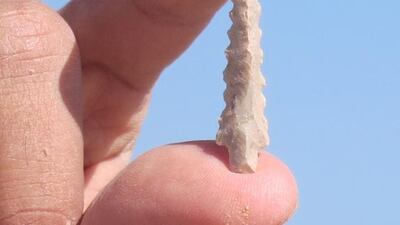
  • Flint arrowhead found at site MR11, Marawah Island. This type of arrowhead is known as a trihedral point, because of its triangular cross section. It dates to between the 6th to early 5th millennium BC.
    Flint arrowhead found at site MR11, Marawah Island. This type of arrowhead is known as a trihedral point, because of its triangular cross section. It dates to between the 6th to early 5th millennium BC.
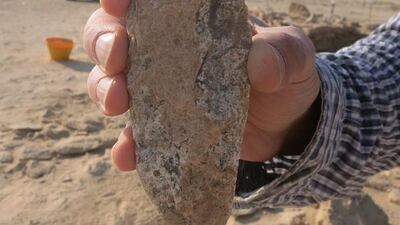
  • Flint spear found in Room 2 at site MR11, Marawah Island.
    Flint spear found in Room 2 at site MR11, Marawah Island.
  • Aerial view of the human skeleton found in Room 2 at site MR11, Marawah Island.
    Aerial view of the human skeleton found in Room 2 at site MR11, Marawah Island.
Specs%3A%202024%20McLaren%20Artura%20Spider
%3Cp%3E%3Cstrong%3EEngine%3A%3C%2Fstrong%3E%203.0-litre%20twin-turbo%20V6%20and%20electric%20motor%3Cbr%3E%3Cstrong%3EMax%20power%3A%3C%2Fstrong%3E%20700hp%20at%207%2C500rpm%3Cbr%3E%3Cstrong%3EMax%20torque%3A%3C%2Fstrong%3E%20720Nm%20at%202%2C250rpm%3Cbr%3E%3Cstrong%3ETransmission%3A%3C%2Fstrong%3E%20Eight-speed%20dual-clutch%20auto%3Cbr%3E%3Cstrong%3E0-100km%2Fh%3A%3C%2Fstrong%3E%203.0sec%3Cbr%3E%3Cstrong%3ETop%20speed%3A%20%3C%2Fstrong%3E330kph%3Cbr%3E%3Cstrong%3EPrice%3A%3C%2Fstrong%3E%20From%20Dh1.14%20million%20(%24311%2C000)%3Cbr%3E%3Cstrong%3EOn%20sale%3A%3C%2Fstrong%3E%20Now%3C%2Fp%3E%0A
Company%20profile
%3Cp%3EName%3A%20Tabby%3Cbr%3EFounded%3A%20August%202019%3B%20platform%20went%20live%20in%20February%202020%3Cbr%3EFounder%2FCEO%3A%20Hosam%20Arab%2C%20co-founder%3A%20Daniil%20Barkalov%3Cbr%3EBased%3A%20Dubai%2C%20UAE%3Cbr%3ESector%3A%20Payments%3Cbr%3ESize%3A%2040-50%20employees%3Cbr%3EStage%3A%20Series%20A%3Cbr%3EInvestors%3A%20Arbor%20Ventures%2C%20Mubadala%20Capital%2C%20Wamda%20Capital%2C%20STV%2C%20Raed%20Ventures%2C%20Global%20Founders%20Capital%2C%20JIMCO%2C%20Global%20Ventures%2C%20Venture%20Souq%2C%20Outliers%20VC%2C%20MSA%20Capital%2C%20HOF%20and%20AB%20Accelerator.%3Cbr%3E%3C%2Fp%3E%0A
The bio

Favourite book: Peter Rabbit. I used to read it to my three children and still read it myself. If I am feeling down it brings back good memories.

Best thing about your job: Getting to help people. My mum always told me never to pass up an opportunity to do a good deed.

Best part of life in the UAE: The weather. The constant sunshine is amazing and there is always something to do, you have so many options when it comes to how to spend your day.

Favourite holiday destination: Malaysia. I went there for my honeymoon and ended up volunteering to teach local children for a few hours each day. It is such a special place and I plan to retire there one day.

Sour%20Grapes
%3Cp%3E%3Cstrong%3EAuthor%3A%20%3C%2Fstrong%3EZakaria%20Tamer%3Cbr%3E%3Cstrong%3EPublisher%3A%20%3C%2Fstrong%3ESyracuse%20University%20Press%3Cbr%3E%3Cstrong%3EPages%3A%20%3C%2Fstrong%3E176%3C%2Fp%3E%0A
You may remember …

Robbie Keane (Atletico de Kolkata) The Irish striker is, along with his former Spurs teammate Dimitar Berbatov, the headline figure in this season’s ISL, having joined defending champions ATK. His grand entrance after arrival from Major League Soccer in the US will be delayed by three games, though, due to a knee injury.

Dimitar Berbatov (Kerala Blasters) Word has it that Rene Meulensteen, the Kerala manager, plans to deploy his Bulgarian star in central midfield. The idea of Berbatov as an all-action, box-to-box midfielder, might jar with Spurs and Manchester United supporters, who more likely recall an always-languid, often-lazy striker.

Wes Brown (Kerala Blasters) Revived his playing career last season to help out at Blackburn Rovers, where he was also a coach. Since then, the 23-cap England centre back, who is now 38, has been reunited with the former Manchester United assistant coach Meulensteen, after signing for Kerala.

Andre Bikey (Jamshedpur) The Cameroonian defender is onto the 17th club of a career has taken him to Spain, Portugal, Russia, the UK, Greece, and now India. He is still only 32, so there is plenty of time to add to that tally, too. Scored goals against Liverpool and Chelsea during his time with Reading in England.

Emiliano Alfaro (Pune City) The Uruguayan striker has played for Liverpool – the Montevideo one, rather than the better-known side in England – and Lazio in Italy. He was prolific for a season at Al Wasl in the Arabian Gulf League in 2012/13. He returned for one season with Fujairah, whom he left to join Pune.

COMPANY PROFILE

Name: Xpanceo

Started: 2018

Founders: Roman Axelrod, Valentyn Volkov

Based: Dubai, UAE

Industry: Smart contact lenses, augmented/virtual reality

Funding: $40 million

Investor: Opportunity Venture (Asia)

The burning issue

The internal combustion engine is facing a watershed moment – major manufacturer Volvo is to stop producing petroleum-powered vehicles by 2021 and countries in Europe, including the UK, have vowed to ban their sale before 2040. The National takes a look at the story of one of the most successful technologies of the last 100 years and how it has impacted life in the UAE. 

Read part four: an affection for classic cars lives on

Read part three: the age of the electric vehicle begins

Read part one: how cars came to the UAE


UFC%20FIGHT%20NIGHT%3A%20SAUDI%20ARABIA%20RESULTS
%3Cp%3E%0D%3C%2Fp%3E%0A%3Cp%3E%3Cstrong%3EMain%20card%3Cbr%3EMiddleweight%3A%3C%2Fstrong%3E%0D%3Cbr%3ERobert%20Whittaker%20defeated%20Ikram%20Aliskerov%20via%20knockout%20(Round%201)%0D%3Cbr%3E%3Cstrong%3EHeavyweight%3A%3C%2Fstrong%3E%0D%3Cbr%3EAlexander%20Volkov%20def%20Sergei%20Pavlovich%20via%20unanimous%20decision%0D%3Cbr%3E%3Cstrong%3EMiddleweight%3A%3C%2Fstrong%3E%0D%3Cbr%3EKelvin%20Gastelum%20def%20Daniel%20Rodriguez%20via%20unanimous%20decision%0D%3Cbr%3E%3Cstrong%3EMiddleweight%3A%3C%2Fstrong%3E%0D%3Cbr%3EShara%20Magomedov%20def%20Antonio%20Trocoli%20via%20knockout%20(Round%203)%0D%3Cbr%3E%3Cstrong%3ELight%20heavyweight%3A%3C%2Fstrong%3E%0D%3Cbr%3EVolkan%20Oezdemir%20def%20Johnny%20Walker%20via%20knockout%20(Round%201)%0D%3Cbr%3E%3Cstrong%3EPreliminary%20Card%0D%3Cbr%3ELightweight%3A%3C%2Fstrong%3E%0D%3Cbr%3ENasrat%20Haqparast%20def%20Jared%20Gordon%20via%20split%20decision%0D%3Cbr%3E%3Cstrong%3EFeatherweight%3A%3C%2Fstrong%3E%0D%3Cbr%3EFelipe%20Lima%20def%20Muhammad%20Naimov%20via%20submission%20(Round%203)%0D%3Cbr%3E%3Cstrong%3EWelterweight%3A%3C%2Fstrong%3E%0D%3Cbr%3ERinat%20Fakhretdinov%20defeats%20Nicolas%20Dalby%20via%20split%20decision%0D%3Cbr%3E%3Cstrong%3EBantamweight%3A%3C%2Fstrong%3E%0D%3Cbr%3EMuin%20Gafurov%20def%20Kang%20Kyung-ho%20via%20unanimous%20decision%0D%3Cbr%3E%3Cstrong%3ELight%20heavyweight%3A%3C%2Fstrong%3E%0D%3Cbr%3EMagomed%20Gadzhiyasulov%20def%20Brendson%20Ribeiro%20via%20majority%20decision%0D%3Cbr%3E%3Cstrong%3EBantamweight%3A%3C%2Fstrong%3E%0D%3Cbr%3EChang%20Ho%20Lee%20def%20Xiao%20Long%20via%20split%20decision%3C%2Fp%3E%0A
PULITZER PRIZE 2020 WINNERS

JOURNALISM 

Public Service
Anchorage Daily News in collaboration with ProPublica

Breaking News Reporting
Staff of The Courier-Journal, Louisville, Ky.

Investigative Reporting
Brian M. Rosenthal of The New York Times

Explanatory Reporting
Staff of The Washington Post

Local Reporting  
Staff of The Baltimore Sun

National Reporting
T. Christian Miller, Megan Rose and Robert Faturechi of ProPublica

and    

Dominic Gates, Steve Miletich, Mike Baker and Lewis Kamb of The Seattle Times

International Reporting
Staff of The New York Times

Feature Writing
Ben Taub of The New Yorker

Commentary
Nikole Hannah-Jones of The New York Times

Criticism
Christopher Knight of the Los Angeles Times

Editorial Writing
Jeffery Gerritt of the Palestine (Tx.) Herald-Press

Editorial Cartooning
Barry Blitt, contributor, The New Yorker

Breaking News Photography
Photography Staff of Reuters

Feature Photography
Channi Anand, Mukhtar Khan and Dar Yasin of the Associated Press

Audio Reporting
Staff of This American Life with Molly O’Toole of the Los Angeles Times and Emily Green, freelancer, Vice News for “The Out Crowd”

LETTERS AND DRAMA

Fiction
"The Nickel Boys" by Colson Whitehead (Doubleday)

Drama
"A Strange Loop" by Michael R. Jackson

History
"Sweet Taste of Liberty: A True Story of Slavery and Restitution in America" by W. Caleb McDaniel (Oxford University Press)

Biography
"Sontag: Her Life and Work" by Benjamin Moser (Ecco/HarperCollins)

Poetry
"The Tradition" by Jericho Brown (Copper Canyon Press)

General Nonfiction
"The Undying: Pain, Vulnerability, Mortality, Medicine, Art, Time, Dreams, Data, Exhaustion, Cancer, and Care" by Anne Boyer (Farrar, Straus and Giroux)

and

"The End of the Myth: From the Frontier to the Border Wall in the Mind of America" by Greg Grandin (Metropolitan Books)

Music
"The Central Park Five" by Anthony Davis, premiered by Long Beach Opera on June 15, 2019

Special Citation
Ida B. Wells


Ten tax points to be aware of in 2026

1. Domestic VAT refund amendments: request your refund within five years

If a business does not apply for the refund on time, they lose their credit.

2. E-invoicing in the UAE

Businesses should continue preparing for the implementation of e-invoicing in the UAE, with 2026 a preparation and transition period ahead of phased mandatory adoption. 

3. More tax audits

Tax authorities are increasingly using data already available across multiple filings to identify audit risks. 

4. More beneficial VAT and excise tax penalty regime

Tax disputes are expected to become more frequent and more structured, with clearer administrative objection and appeal processes. The UAE has adopted a new penalty regime for VAT and excise disputes, which now mirrors the penalty regime for corporate tax.

5. Greater emphasis on statutory audit

There is a greater need for the accuracy of financial statements. The International Financial Reporting Standards standards need to be strictly adhered to and, as a result, the quality of the audits will need to increase.

6. Further transfer pricing enforcement

Transfer pricing enforcement, which refers to the practice of establishing prices for internal transactions between related entities, is expected to broaden in scope. The UAE will shortly open the possibility to negotiate advance pricing agreements, or essentially rulings for transfer pricing purposes. 

7. Limited time periods for audits

Recent amendments also introduce a default five-year limitation period for tax audits and assessments, subject to specific statutory exceptions. While the standard audit and assessment period is five years, this may be extended to up to 15 years in cases involving fraud or tax evasion. 

8. Pillar 2 implementation 

Many multinational groups will begin to feel the practical effect of the Domestic Minimum Top-Up Tax (DMTT), the UAE's implementation of the OECD’s global minimum tax under Pillar 2. While the rules apply for financial years starting on or after January 1, 2025, it is 2026 that marks the transition to an operational phase.

9. Reduced compliance obligations for imported goods and services

Businesses that apply the reverse-charge mechanism for VAT purposes in the UAE may benefit from reduced compliance obligations. 

10. Substance and CbC reporting focus

Tax authorities are expected to continue strengthening the enforcement of economic substance and Country-by-Country (CbC) reporting frameworks. In the UAE, these regimes are increasingly being used as risk-assessment tools, providing tax authorities with a comprehensive view of multinational groups’ global footprints and enabling them to assess whether profits are aligned with real economic activity. 

Contributed by Thomas Vanhee and Hend Rashwan, Aurifer

Dunbar
Edward St Aubyn
Hogarth

Citadel: Honey Bunny first episode

Directors: Raj & DK

Stars: Varun Dhawan, Samantha Ruth Prabhu, Kashvi Majmundar, Kay Kay Menon

Rating: 4/5

The Outsider

Stephen King, Penguin

Manchester United v Club America

When: Thursday, 9pm Arizona time (Friday UAE, 8am)

KEY HIGHLIGHTS

Healthcare spending to double to $2.2 trillion rupees

Launched a 641billion-rupee federal health scheme

Allotted 200 billion rupees for the recapitalisation of state-run banks

Around 1.75 trillion rupees allotted for privatisation and stake sales in state-owned assets

Labour dispute

The insured employee may still file an ILOE claim even if a labour dispute is ongoing post termination, but the insurer may suspend or reject payment, until the courts resolve the dispute, especially if the reason for termination is contested. The outcome of the labour court proceedings can directly affect eligibility.


- Abdullah Ishnaneh, Partner, BSA Law 

Ruwais timeline

1971 Abu Dhabi National Oil Company established

1980 Ruwais Housing Complex built, located 10 kilometres away from industrial plants

1982 120,000 bpd capacity Ruwais refinery complex officially inaugurated by the founder of the UAE Sheikh Zayed

1984 Second phase of Ruwais Housing Complex built. Today the 7,000-unit complex houses some 24,000 people.  

1985 The refinery is expanded with the commissioning of a 27,000 b/d hydro cracker complex

2009 Plans announced to build $1.2 billion fertilizer plant in Ruwais, producing urea

2010 Adnoc awards $10bn contracts for expansion of Ruwais refinery, to double capacity from 415,000 bpd

2014 Ruwais 261-outlet shopping mall opens

2014 Production starts at newly expanded Ruwais refinery, providing jet fuel and diesel and allowing the UAE to be self-sufficient for petrol supplies

2014 Etihad Rail begins transportation of sulphur from Shah and Habshan to Ruwais for export

2017 Aldar Academies to operate Adnoc’s schools including in Ruwais from September. Eight schools operate in total within the housing complex.

2018 Adnoc announces plans to invest $3.1 billion on upgrading its Ruwais refinery 

2018 NMC Healthcare selected to manage operations of Ruwais Hospital

2018 Adnoc announces new downstream strategy at event in Abu Dhabi on May 13

Source: The National

Avatar: Fire and Ash

Director: James Cameron

Starring: Sam Worthington, Sigourney Weaver, Zoe Saldana

Rating: 4.5/5

In-demand jobs and monthly salaries
  • Technology expert in robotics and automation: Dh20,000 to Dh40,000 
  • Energy engineer: Dh25,000 to Dh30,000 
  • Production engineer: Dh30,000 to Dh40,000 
  • Data-driven supply chain management professional: Dh30,000 to Dh50,000 
  • HR leader: Dh40,000 to Dh60,000 
  • Engineering leader: Dh30,000 to Dh55,000 
  • Project manager: Dh55,000 to Dh65,000 
  • Senior reservoir engineer: Dh40,000 to Dh55,000 
  • Senior drilling engineer: Dh38,000 to Dh46,000 
  • Senior process engineer: Dh28,000 to Dh38,000 
  • Senior maintenance engineer: Dh22,000 to Dh34,000 
  • Field engineer: Dh6,500 to Dh7,500
  • Field supervisor: Dh9,000 to Dh12,000
  • Field operator: Dh5,000 to Dh7,000
2025 Fifa Club World Cup groups

Group A: Palmeiras, Porto, Al Ahly, Inter Miami.

Group B: Paris Saint-Germain, Atletico Madrid, Botafogo, Seattle.

Group C: Bayern Munich, Auckland City, Boca Juniors, Benfica.

Group D: Flamengo, ES Tunis, Chelsea, (Leon banned).

Group E: River Plate, Urawa, Monterrey, Inter Milan.

Group F: Fluminense, Borussia Dortmund, Ulsan, Mamelodi Sundowns.

Group G: Manchester City, Wydad, Al Ain, Juventus.

Group H: Real Madrid, Al Hilal, Pachuca, Salzburg.

Children who witnessed blood bath want to help others

Aged just 11, Khulood Al Najjar’s daughter, Nora, bravely attempted to fight off Philip Spence. Her finger was injured when she put her hand in between the claw hammer and her mother’s head.

As a vital witness, she was forced to relive the ordeal by police who needed to identify the attacker and ensure he was found guilty.

Now aged 16, Nora has decided she wants to dedicate her career to helping other victims of crime.

“It was very horrible for her. She saw her mum, dying, just next to her eyes. But now she just wants to go forward,” said Khulood, speaking about how her eldest daughter was dealing with the trauma of the incident five years ago. “She is saying, 'mama, I want to be a lawyer, I want to help people achieve justice'.”

Khulood’s youngest daughter, Fatima, was seven at the time of the attack and attempted to help paramedics responding to the incident.

“Now she wants to be a maxillofacial doctor,” Khulood said. “She said to me ‘it is because a maxillofacial doctor returned your face, mama’. Now she wants to help people see themselves in the mirror again.”

Khulood’s son, Saeed, was nine in 2014 and slept through the attack. While he did not witness the trauma, this made it more difficult for him to understand what had happened. He has ambitions to become an engineer.

Updated: February 10, 2023, 6:00 PM