


I first met 26-year old Bahati Ernestine in Nairobi in late 2019, when in-person events were still the norm. Her story offered a rare light in what was yet another jargon-studded conference – to seek solutions for hundreds of thousands of refugees stuck in remote camps in Kenya.
Among the world’s mere three per cent of refugees to have completed university education, Bahati had surmounted immeasurable odds to earn a nursing degree. Escaping genocide in Rwanda in 1994, Bahati’s family had first fled to the Democratic Republic of Congo from where they eventually made their way to Kenya. Upon arriving in Kenya, Bahati’s parents decided against settling in a refugee camp, opting instead to make a living on the outskirts of Nairobi.
That decision changed the course of Bahati's life. It created education opportunities she may not have had in a camp. She had the courage and determination to persevere, snapping up a scholarship programme and an internship at the renowned Kenyatta National Hospital.
Along the way, she faced the sort of challenges that those without a country to call home often do: convincing the bureaucracy of her existence, fighting to be seen as more than just a refugee. The lack of a birth certificate and limited rights meant that this remained a constant struggle.
I have spent the last two years closely following the waning hopes of Dadaab refugees. Their three-decade ordeal for human dignity remains elusive, locked up as they are in remote camps. So, stumbling upon Bahati provided hope. Her struggle and resilience – formidable, given the odds she was up against – was made possible by choices, however limited.
But for the more than 200,000 refugees in Dadaab, consigned to a barren prison, there has never been much choice except to go back to the country they had fled. For the majority that is Somalia, where the skills needed to evade threat to life are as elemental as the ones required to not go hungry.
It all stems from a catastrophic choice in policy: to keep refugees in camps, where they remain dependent on measly and ever-dwindling humanitarian assistance, with little no access to jobs, higher education or specialised health care.
-
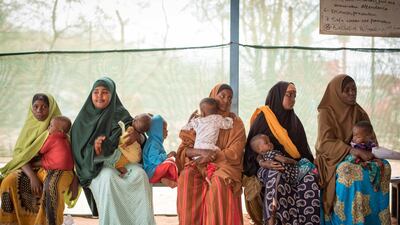
Mothers wait at an MSF health post in Dagahaley to get a nutrition check-up for their children. -
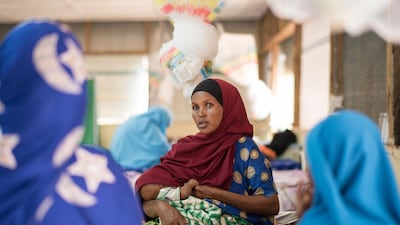
Howam with her four months old baby Fatam Usman Ali. -
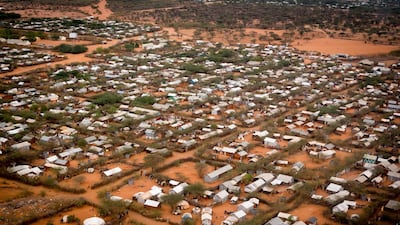
The Dadaab refugee complex—Hagadera, Dagahaley and Ifo—is among the oldest refugee camps in the world today. Since it was first established in 1991, Dadaab has, over the years, hosted several waves of Somali refugees, fleeing a combination of violence, generalised insecurity and drought. -
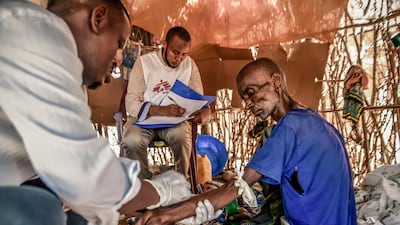
55-year-old Muse Bare suffers from cancer of the oesophagus -
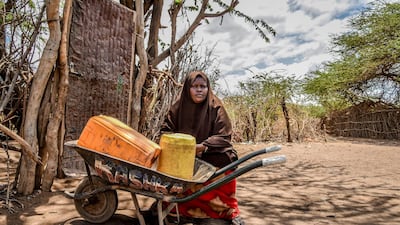
Thirty-eight-year-old Janai owns a wheelbarrow, which she uses to fetch water from the tap stands and sell to some households. Janai came to the camp in 1991 from Kismayu, Somalia, with six members of her family including both her parents. Her parents have both died. She has 10 children, all who were born inside the camp. Her eldest child is 19, and the youngest, 18 months. -
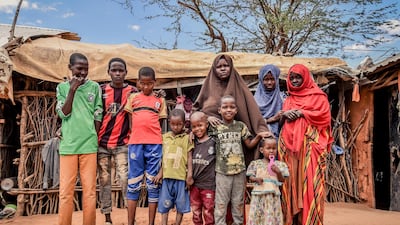
Janai has 10 children, all who were born inside the camp. Her eldest child is 19, and the youngest, 18 months. “A lot has changed in my life over the years,” she says, “all my children were born here, and they all go to school here. I don’t know why they keep asking us if we want to go back to Somalia, yet our answer is always the same as last time: no." -
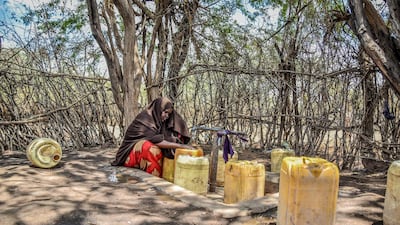
“I have a bigger family now, and look at the house I live in,” Janai says, pointing at a house made of stick-walls and iron-sheets for roofs. -

Young refugee girls in Dagahaley


Camps are lifesaving to start with, but when time spent in them drags into decades, they can test human resilience, grind hopes and crush the talent of people who, in normal circumstances, could contribute so much to society.
It was this realisation two years ago that prompted the UN General Assembly to ratify the Global Compact on Refugees (GCR). The Compact made assisting refugees a global public responsibility, requiring increased support for host countries to ensure that they could provide refugees access to public services, as well as assimilate them into the social fabric of their nations. Many rich countries also recognised the need for additional efforts to provide resettlement options for refugees.
The Compact’s promise reverberated in Kenya and the wider region. Local counties such as Garissa – which hosts Dadaab – started working on including refugees in their development plans, likely seeing an opportunity to attract more funding to develop the region.
And at the first-ever Global Refugee Forum in December 2019, the countries in the region, under the auspices of the Inter-Governmental Authority on Development, pledged to establish a “Support Platform”, which could mobilise funding to help host countries such as Kenya implement the commitments they took when subscribing to the GRC.
Covid-19 slashed that progress. All of last year, Dadaab refugees saw few efforts to develop durable solutions which respect their dignity and legitimate aspiration to have a life, rather than just survive. And resettlement options have all but dried up, with UNHCR announcing 2020 to be a record low for resettlement.
So the “city of thorns” remains, where lives continue to be on hold and dreams die a slow death. The withering hopes of successive generations is taking a severe psychological toll on many. As we warned, a mental health crisis is growing in Dadaab. In 2020, at least 13 people have attempted suicide in Dagahaley camp, two of those attempts were fatal.
Dadaab also presents a critical challenge for organisations like mine. For how long do we continue to support a camp that saves lives but robs people of dignity? We have been providing medical services for most of the camp’s three-decades’ existence. By doing so, are we perpetuating a soul-crushing system?
As a humanitarian organisation with limited means, we are doing our bit by providing a small number of scholarships for refugee adults to study nursing and other paramedical professions. Once they graduate, they become part of a vital health force, sorely needed to address public health challenges in countries like Kenya.
But as Bahati knows too well, education is only one among a series of hurdles that refugees must overcome. Even just securing a work permit requires navigating a labyrinthine bureaucracy.
Bahati is determined to persevere. She told me she will push the system to get to practice nursing. In Swahili, “Bahati” means luck. So, with some luck on her side, she may well succeed.
But refugees in Dadaab will need much more than luck to turn their fortunes around. They need access to opportunities – mostly educational and to earn livelihoods – and the chance to choose how they want to live. Humanitarian aid has been vital in sustaining Dadaab refugees; it can still support them to transition to a life of dignity.
Emmanuelle Privat is deputy country director of Médecins Sans Frontières in Kenya

