

It was the night of July 15, 1969 and, at the age of 13, I found sleep hard to come by. The next day was the last day of school before the summer break, but this was not the reason for my restless excitement. It was also my birthday, but this was secondary to the event that was keeping me awake. July 16 marked the beginning of mankind's greatest adventure. It was the day Apollo 11 lifted off, taking human beings to the Moon for the first time.
In my bedroom was a wall chart and a cardboard model of the Saturn V rocket that could be reconfigured for the various stages of the mission, such as the unlocking of the lunar module in Earth's orbit and the descent to the Moon's surface. By the time the astronauts returned home on July 24, all that was left of my model of the 111-metre rocket was a tiny grey triangle of card.
I watched the launch on our living room TV via a flickering black-and-white satellite transmission from Florida. Even without colour, the lift-off of Saturn V was an astonishing thing, from the thunder of fire and noise from the engines to the slow rise of the huge steel column amid a shower of ice caused by condensation frozen by the rocket's liquid oxygen and hydrogen fuel.
I also remember the giant letters sliding past the launch pad camera: U, S, A.
There was no thought of failure, at least in my mind, as I manipulated my cardboard Apollo 11 over the next few days, only excitement, as the lunar module detached from the command ship Columbia to descend to the Moon's surface. Then there was the crackling message from 384,000 kilometres away, saying: "Houston. Tranquility Base here. The Eagle has landed."
By that point it was nearly 10pm in London, where I lived at the time. My two younger brothers and I were sent to bed before Neil Armstrong stepped on to the lunar surface.
I've never quite understood, even if it happened at 3am, why we were not allowed to watch live. Perhaps my parents felt they were being responsible, or they feared something might go wrong, that Armstrong and Aldrin could die on their mission and that was something children should not see.
Instead, I watched those first steps, almost indiscernible through the static, replayed over and over later that day. Across the world, millions watched it live, massive crowds were glued to screens in London and other cities, awestruck as science fiction became fact.
The first men on the Moon spent less than a day there. Memory can play tricks and I have a recollection of dramatic footage of the upper stage of Eagle leaving the Moon from a camera left behind on the surface. But I now think that was actually a memory of a later lunar mission, probably Apollo 15. Instead, the departure of Eagle and its astronauts from the Moon's surface was filmed from inside the ship, the lunar surface receding as the tiny capsule rose back into space to rendezvous with the main ship.
We then awaited news that Apollo 11 had left lunar orbit, exhaling with relief when its crew returned home. There were more than three minutes of tense radio silence during their re-entry into Earth's atmosphere, culminating in the wonderful sight of the scorched Apollo 11 capsule – my little cardboard triangle – dangling safely beneath its three parachutes. The three astronauts on board, including Michael Collins, the command module pilot, were quarantined for 21 days as a precaution against Moon bugs that turned out not to exist.
A photo gallery of the moon landings in 1969:
-
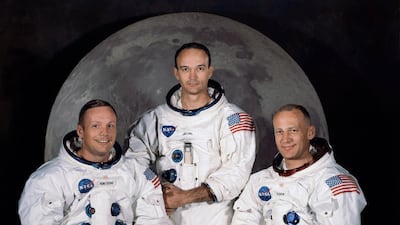
The Apollo 11 lunar landing mission crew with, from left, mission commander Neil A. Armstrong, command module pilot Michael Collins and lunar module pilot Edwin E. Aldrin Jr. pose in their space suits. NASA / EPA -
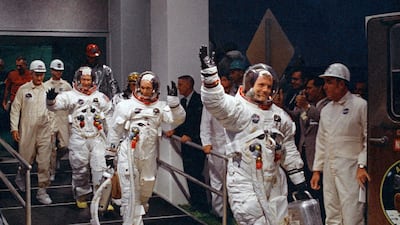
From right, Armstrong, Collins and Aldrin walk to the van that will take the crew to the launchpad at Kennedy Space Center on Merritt Island, Florida. AP Photo -
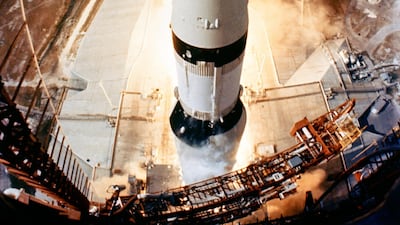
The 363-feet tall Saturn V rocket carrying the Apollo 11 launches from its pad in Cape Canaveral, USA. NASA / EPA -
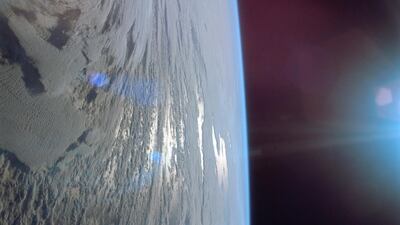
Earth as the Apollo 11 mission heads to the moon. NASA / AP -
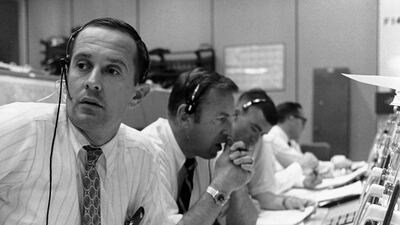
Flight controllers at the Space Center in Houston, Texas, USA, as the Apollo 11 mission's lunar landing module descends to the surface of the moon on July 20, 1969. NASA / EPA -
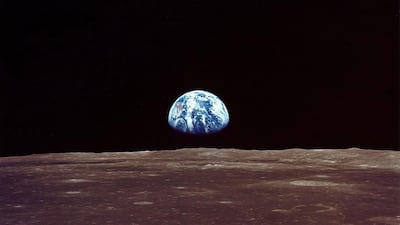
Earthrise viewed from the Apollo 11 mission's lunar landing module Eagle prior to its landing. NASA / EPA -
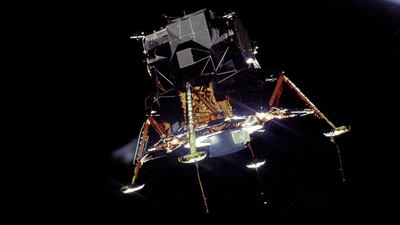
The 'Eagle' lunar landing module in landing configuration in lunar orbit taken by service module 'Columbia' commander Collins. NASA / EPA -
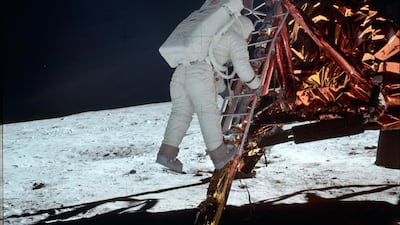
Aldrin descends a ladder from the Lunar Module during the Apollo 11 mission. NASA / AP -
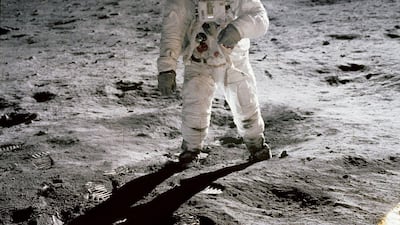
Astronaut Aldrin walks on the moon in an iconic image taken by Armstrong. NASA / EPA -
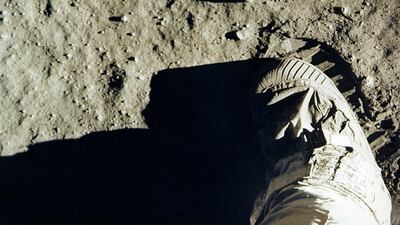
Aldrin's boot and footprint in lunar soil. NASA / EPA -
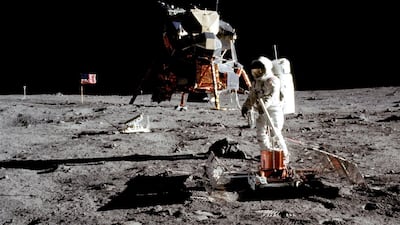
Aldrin deploys the Passive Seismic Experiment Package. NASA / EPA -
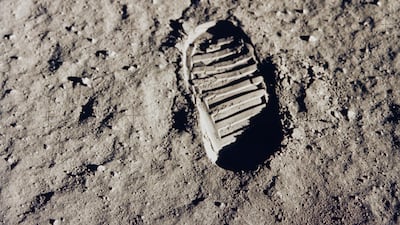
One of the first steps taken on the Moon. NASA / EPA -
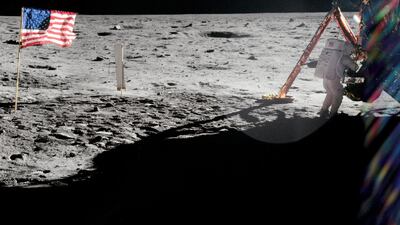
Armstrong works near the lunar landing module. NASA / EPA -
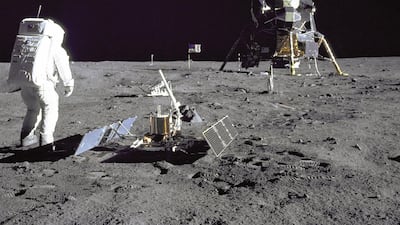
Aldrin stands besides a lunar seismometer. NASA / EPA -
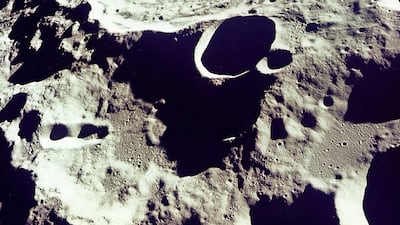
Crater 308 on the moon viewed from orbit. NASA / EPA -
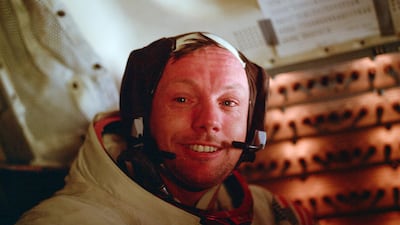
Armstrong sits inside the Lunar Module after he and Buzz Aldrin completed their extravehicular activity on the surface of the moon. NASA / AP -
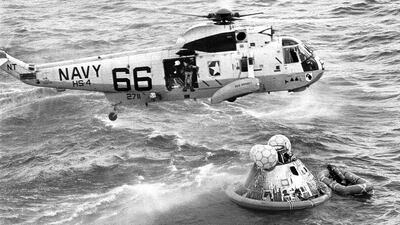
Navy UDT swimmer Clancy Hatleberg prepares to jump from a helicopter to assist the astronauts into the raft at right. US Navy / AP -
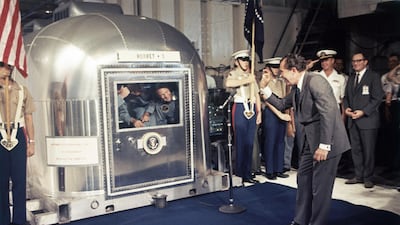
President Richard Nixon gives an "OK" sign as he greets Apollo 11 astronauts in a quarantine van aboard the USS Hornet. AP Photo -
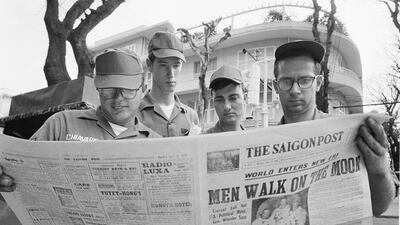
US soldiers read a newspaper headlining the Apollo 11 moon landing, in downtown Saigon, Vietnam. AP Photo -
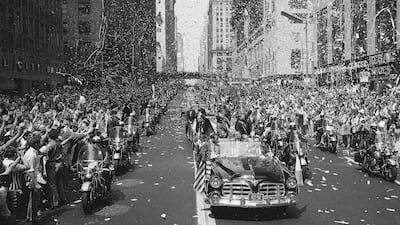
People line 42nd Street in New York to cheer Apollo 11 astronauts traveling towards the United Nations. AP Photo


Half a century later, it still seems extraordinary that they succeeded in their mission. We know now how close they came to disaster, when the guidance computer on Eagle, a cutting-edge design at the time that used silicon chips instead of vacuum tubes, crashed several times during the descent to the Moon's surface, with the computer being restarted only 40 seconds before landing.
It was unclear at the time if the lunar surface could even support the weight of the ladder. The engine used to take Eagle off the surface was also untested in that environment. Any one of a dozen potential scenarios could have left Neil Armstrong and Buzz Aldrin stranded.
Nasa was rightly concerned. It prepared a speech in advance for US president at the time, Richard Nixon, should the astronauts have died. It read: "Fate has ordained that the men who went to the Moon to explore in peace, will stay on the Moon to rest in peace."
I have read that Armstrong placed the odds of coming home alive at 90 per cent, but thought the chance of a successful Moon landing was only 50 per cent.
Aldrin thought the likelihood they would die was one in three and believed they would likely fail.
They went on the mission anyway, and returned as heroes. It was the most astonishing achievement by the bravest men I can think of in all my lifetime.

