• Mohamed Zakaria. He came to Dubai in the 1960s and is now an Emirati citizen. Reem Mohammed / The National
    Mohamed Zakaria. He came to Dubai in the 1960s and is now an Emirati citizen. Reem Mohammed / The National
  • Farouk Mohamed, who moved here in 1963. Antonie Robertson / The National
    Farouk Mohamed, who moved here in 1963. Antonie Robertson / The National
  • Mr Zakaria was first the accountant and later the chief executive of Dubai Refreshment Company, which made Pepsi Cola and had Dubai’s first ice factory. Reem Mohammed / The National
    Mr Zakaria was first the accountant and later the chief executive of Dubai Refreshment Company, which made Pepsi Cola and had Dubai’s first ice factory. Reem Mohammed / The National
  • When Mr Zakaria first flew over Dubai in the 1960s, he saw nothing only sabkha salt flats and a winding creek. On the wall is a photograph of Mr Zakaria (white suit) taken in the 1960s with Sheikh Rashid, Ruler of Dubai, and Ali Al Owais, who was chairman of Dubai Refreshment company.
    When Mr Zakaria first flew over Dubai in the 1960s, he saw nothing only sabkha salt flats and a winding creek. On the wall is a photograph of Mr Zakaria (white suit) taken in the 1960s with Sheikh Rashid, Ruler of Dubai, and Ali Al Owais, who was chairman of Dubai Refreshment company.
  • Dubai Airport in the 1960s. “The pilot said, ‘we are now over Dubai’ and I looked down and said, ‘there is nothing," said Mr Zakaria. Courtesy Dubai Airports
    Dubai Airport in the 1960s. “The pilot said, ‘we are now over Dubai’ and I looked down and said, ‘there is nothing," said Mr Zakaria. Courtesy Dubai Airports
  • Mr Mohamed recalls the time before and after unification as one when you walked in the street and you knew everyone by face and by name. Antonie Robertson / The National
    Mr Mohamed recalls the time before and after unification as one when you walked in the street and you knew everyone by face and by name. Antonie Robertson / The National
  • Sheikh Rashid, Ruler of Dubai, whose business acumen was attracting people to the emirate from across the region. Keystone Features / Hulton Archive / Getty
    Sheikh Rashid, Ruler of Dubai, whose business acumen was attracting people to the emirate from across the region. Keystone Features / Hulton Archive / Getty
  • Dubai Creek in the 1960s, when traditional dhows still plied routes to Africa and India. Chris Ware / Keystone Features / Hulton Archive / Getty Images
    Dubai Creek in the 1960s, when traditional dhows still plied routes to Africa and India. Chris Ware / Keystone Features / Hulton Archive / Getty Images
  • Mr Zakaria meets Sheikh Rashid. Reem Mohammed / The National
    Mr Zakaria meets Sheikh Rashid. Reem Mohammed / The National
  • Mr Zakaria with his nephews Laith and Rayan. He recalls unification as bringing jobs and prosperity. Reem Mohammed / The National
    Mr Zakaria with his nephews Laith and Rayan. He recalls unification as bringing jobs and prosperity. Reem Mohammed / The National

Memories of '71: How three Egyptian friends came to know 'everyone in Dubai by name'


  • English
  • Arabic

In the days of the new UAE, unification meant different things to different people. Some arrived in the years before 1971 to lend their expertise. Others came in search of a better life. And for some, the union meant something as simple yet vital as electricity. In the second of a three-part series to celebrate the UAE's 49th National Day, we speak to two friends from Cairo who came to Dubai in the 1960s.

Mahmoud's sad letters brought Farouq Mohamed and Mohamed Zakaria to Dubai in 1962.

The trio had studied accounting at university in Cairo during the peak of Gamal Abdel Nasser’s pan-Arabism, graduating in 1959. Within a few years, they reunited in Dubai and witnessed the decade before the formation of the UAE.

Mahmoud came to Dubai because of his uncle, a general in Nasser’s revolutionary government. The general had travelled to the Gulf with a delegation representing Egypt’s new pan-Arab government.

At the majlis of Dubai’s then Ruler, Sheikh Rashid, the envoys were asked to send young, trustworthy men from Egypt.

The airport was sabkha. No roads, no people

Mahmoud was volunteered by his uncle. But Dubai was a world removed from cosmopolitan Cairo. Homesick, he pleaded with his friends to join him.

“When he came here, he was alone, lonely,” said Mr Zakaria. “So he sent for his friend, me. He said: ‘Come join me in this desert’.” Mr Mohamed  got similar letters.

“We wanted to have the same group that we had in university because it would make life better for Mahmoud,” said Mr Mohamed.

"I liked a challenge. But when I came, I came with the idea that the return ticket was in my pocket. So I said: ‘Let’s see. If I'm happy I shall stay and if I'm not happy I shall return to Cairo’.”

Mr Zakaria was offered a job and a one-way ticket to Dubai by the merchant Ali Al Owais, chairman of Dubai Refreshment Company, which made Pepsi Cola and had Dubai’s first ice factory.

When he collected his ticket from Cairo’s BOAC office, he asked where Dubai was.

The clerk unrolled a map, squinted hard and said: “There is nothing called Dubai. There are two towns only: Muscat and Sharjah.”

Days later, Mr Zakaria was aboard a 12-seater plane, peering out a window in confusion as the pilot announced they were about to land in Dubai. Mr Zakaria saw nothing but sea, sabkha salt flats and a winding creek.

“The pilot said: ‘We are now over Dubai’ and I looked down and said: ‘There is nothing I can see, absolutely nothing. Where is the airport? There is no airport there.’ I was very surprised, because the airport was sabkha. No roads, no people, no water, no electricity – nothing really.”

'Have you ever seen chicken in a can?'

Mr Zakaria and Mahmoud shared a flat in Deira and Mr Mohamed lived across the creek in Bur Dubai at the vegetable bazaar.

There was no air conditioning, so Mr Mohamed carried his mattress on to the roof each night to catch the breeze, only to be woken at dawn each morning when the vegetable auction began.

There was no water connection, so Mr Mohamed took buckets of water from a steel tank on the roof to fill his bathtub so he could have a cool bath at night. In the tub, he’d catch up on the news by reading newspapers printed days earlier in Kuwait or Egypt.

Mr Zakaria worked as an accountant at Dubai Refreshment Company, becoming chief executive in 1968. This was a hit with the fishermen and grocers who previously relied on canned goods, most of which came from Bahrain.

“By the way, have you ever seen a chicken in a can?” said Mr Zakaria. “This is how we ate chicken in 1963. Canned chicken. You opened the can and took the chicken out from inside, one full chicken.”

The factory was on the Dubai Creek, where dhows set off for India, Iraq, Kuwait and Zanzibar. It had a platform on the crowded waterway and everything arrived by dhow, including sugar, concentrate and Pepsi signs. Even the water to make cola was distilled from the creek.

Most dhows were used in the Indian gold trade, which was at its peak. As head accountant to prominent merchants and captains, Mr Mohamed oversaw accounts for the captains who commanded ships laden with gold.

“At that time, Dubai was closer to India [than Egypt],” said Mr Mohamed. “The currency was the rupee; the only foreigners here were Indian. There were also a few Pakistanis and lots of Iranians who were born here.”

Most Arabs were Egyptian teachers, supported by their government, or doctors from Egypt, Palestine and Iraq, who were supported by Kuwait in a show of pan-Arab solidarity.

“At that time, when you walked in the street you knew everyone by face and by name,” said Mr Mohamed. “When you were on the airplane, you knew everyone on the airplane. Those were the days when you had a small community and our only ambition was to meet every night for dinner.”

Dubai Creek in the 1960s, when traditional dhows still plied routes to Africa and India. Chris Ware / Keystone Features / Hulton Archive / Getty Images

The British withdrawal

In 1968, the British announced plans to withdraw from the Gulf. Rulers worked to unify the emirates into a single state but Dubai’s business community was preoccupied with trade.

“The concentration was only on business,” said Mr Mohamed. “You had weekly shipments to India and when you are shipping goods to India you are waiting to get news that they have arrived. You get this news after seven days and during these seven days you are not thinking about anything except your money.

"You don't have time for concentrating on anything other than that."

“At that time, the Arab world was boiling about independence,” he said. “Nasser had nationalised the Suez Canal so the whole Arab world was pro Nasser and everyone was waiting to hear Nasser’s speeches.

“Here, they were very careful. Sheikh Rashid didn’t really want to involve himself. He said: ‘I like you but I don’t want to destroy my country.' They managed to compromise.”

'You'd look out and find black carpets'

Oil was discovered at Al Falah field in 1966 and Dubai soon had its first export. Government spending on infrastructure spurred private investment in retail, construction and property.

“The government moved towards infrastructure with Jebel Ali, the Dubai Port, the World Trade Centre,” said Mr Mohamed. “Many things started to be made by the Dubai government, which encouraged the people to spend money.”

Car dealerships were especially popular, even before paved roads. Landscapes transformed overnight.

British companies laid roads as Dubai slept.

“In the morning, you’d look out and find black carpets,” said Mr Mohamed. "Sand became black.”

The impact of unification

Unification, known as ittihad in Arabic, opened Abu Dhabi to other emirates.

“The people in Dubai, Sharjah, Ras Al Khaimah and Ajman, they were much closer together than Abu Dhabi,” said Mr Zakaria. “From the beginning, it was almost like one country, people went here and there. Except for Abu Dhabi, of course. If you didn’t have an Abu Dhabi [permit] you would never enter Abu Dhabi.”

Prior to unification, it had been difficult for people to cross into Abu Dhabi without a permit and setting up business in the capital required a sponsor or partner from Abu Dhabi. In contrast, free movement and business between Dubai and the Northern Emirates was common. With unification, Abu Dhabi became more integrated with the other emirates and it experienced a flush of investment from the future capital.

“After ittihad, people were very happy because so many jobs came,” said Mr Zakaria. “The education in the Northern Emirates was much more advanced than anywhere else. This is a fact. So people who had good education found opportunities in Abu Dhabi. Maybe more than 40 per cent of its workers were from Sharjah, Ajman, Ras Al Khaimah.” Mahmoud left Dubai in 1963, after his employer passed away.

But his Cairo friends, now Emiratis themselves, have never looked back.

______________

Sheikh Zayed and the story of a nation

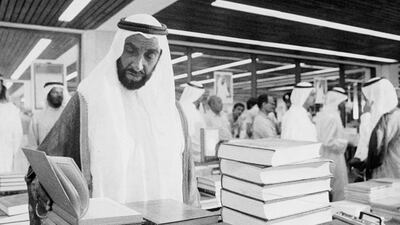
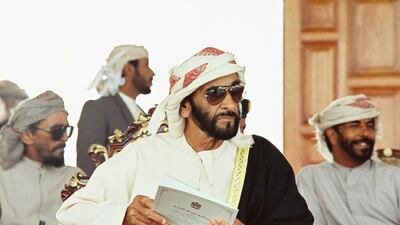
  • Sheikh Zayed, seen here attending an early book fair in Abu Dhabi. Courtesy: Al Ittihad
    Sheikh Zayed, seen here attending an early book fair in Abu Dhabi. Courtesy: Al Ittihad
  • The true genius of a culture and a society lay, Sheikh Zayed believed, in their capacity to adopt and thrive in a changing world. Courtesy: Al Ittihad
    The true genius of a culture and a society lay, Sheikh Zayed believed, in their capacity to adopt and thrive in a changing world. Courtesy: Al Ittihad
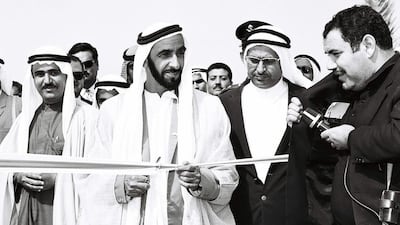
  • Sheikh Zayed raising the flag at Union House in Dubai. December 2, 1971. Courtesy: Al Ittihad
    Sheikh Zayed raising the flag at Union House in Dubai. December 2, 1971. Courtesy: Al Ittihad
  • Sheikh Zayed attending the first UAE National Day celebrations on December 2, 1972. Courtesy: Al Ittihad
    Sheikh Zayed attending the first UAE National Day celebrations on December 2, 1972. Courtesy: Al Ittihad
  • Sheikh Zayed attending the first session of the National Consultative Council in Abu Dhabi in October 1971. Courtesy: Al Ittihad
    Sheikh Zayed attending the first session of the National Consultative Council in Abu Dhabi in October 1971. Courtesy: Al Ittihad
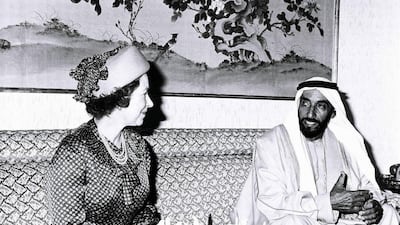
  • Sheikh Zayed meets Queen Elizabeth II during a state visit 40 years ago. Courtesy: Al Ittihad
    Sheikh Zayed meets Queen Elizabeth II during a state visit 40 years ago. Courtesy: Al Ittihad
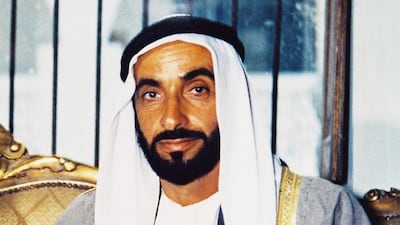
  • Sheikh Zayed, the founding father of the UAE. Courtesy: Al Ittihad
    Sheikh Zayed, the founding father of the UAE. Courtesy: Al Ittihad
  • Sheikh Zayed was a man of the people. Courtesy: Al Ittihad
    Sheikh Zayed was a man of the people. Courtesy: Al Ittihad
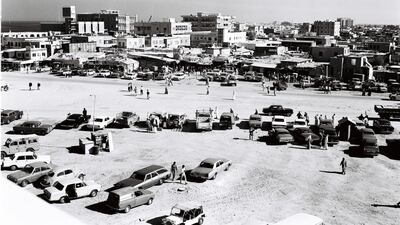
  • The old souq in Abu Dhabi shot at some point in the 1970s. Courtesy Al Ittihad
    The old souq in Abu Dhabi shot at some point in the 1970s. Courtesy Al Ittihad
  • Sheikh Zayed's leadership is not just remembered for all that he built, but for all he did for others. Courtesy: Al Ittihad
    Sheikh Zayed's leadership is not just remembered for all that he built, but for all he did for others. Courtesy: Al Ittihad
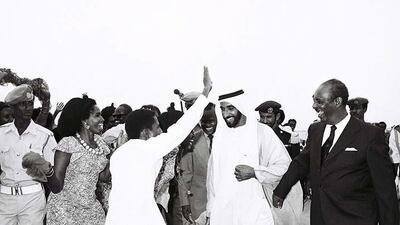
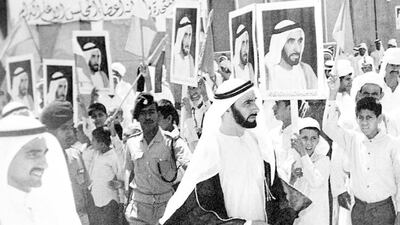
  • Sheikh Zayed walking past supporters Fujairah during his in January 1972. Wam
    Sheikh Zayed walking past supporters Fujairah during his in January 1972. Wam
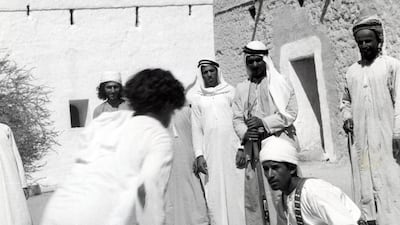
  • Men dance while holding khanjars in Al Ain, 1959. Getty Images
    Men dance while holding khanjars in Al Ain, 1959. Getty Images
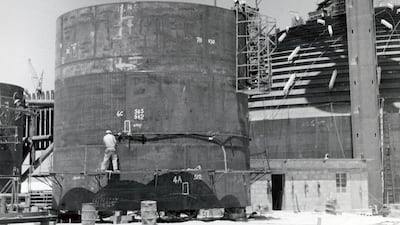
  • Oil sustained the development of the UAE. And this, a petroleum tank being built in Dubai Creek in 1970, was a familiar sight. Getty Images
    Oil sustained the development of the UAE. And this, a petroleum tank being built in Dubai Creek in 1970, was a familiar sight. Getty Images
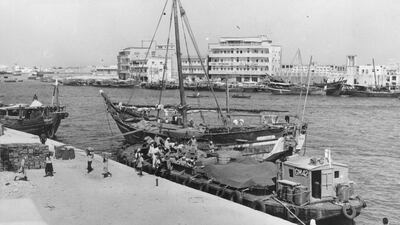
  • Ships unloading their goods on the creek for the Customs Department in Dubai in 1967. Getty Images
    Ships unloading their goods on the creek for the Customs Department in Dubai in 1967. Getty Images
Desert Warrior

Starring: Anthony Mackie, Aiysha Hart, Ben Kingsley

Director: Rupert Wyatt

Rating: 3/5

COMPANY%20PROFILE
%3Cp%3E%3Cstrong%3EName%3A%3C%2Fstrong%3E%20SupplyVan%3Cbr%3E%3Cstrong%3EBased%3A%3C%2Fstrong%3E%20Dubai%2C%20UAE%3Cbr%3E%3Cstrong%3ELaunch%20year%3A%3C%2Fstrong%3E%202017%3Cbr%3E%3Cstrong%3ENumber%20of%20employees%3A%3C%2Fstrong%3E%2029%3Cbr%3E%3Cstrong%3ESector%3A%3C%2Fstrong%3E%20MRO%20and%20e-commerce%3Cbr%3E%3Cstrong%3EFunding%3A%3C%2Fstrong%3E%20Seed%3C%2Fp%3E%0A
From Zero

Artist: Linkin Park

Label: Warner Records

Number of tracks: 11

Rating: 4/5

What is graphene?

Graphene is extracted from graphite and is made up of pure carbon.

It is 200 times more resistant than steel and five times lighter than aluminum.

It conducts electricity better than any other material at room temperature.

It is thought that graphene could boost the useful life of batteries by 10 per cent.

Graphene can also detect cancer cells in the early stages of the disease.

The material was first discovered when Andre Geim and Konstantin Novoselov were 'playing' with graphite at the University of Manchester in 2004.

Top%2010%20most%20competitive%20economies
%3Cp%3E1.%20Singapore%0D%3Cbr%3E2.%20Switzerland%0D%3Cbr%3E3.%20Denmark%0D%3Cbr%3E4.%20Ireland%0D%3Cbr%3E5.%20Hong%20Kong%0D%3Cbr%3E6.%20Sweden%0D%3Cbr%3E7.%20UAE%0D%3Cbr%3E8.%20Taiwan%0D%3Cbr%3E9.%20Netherlands%0D%3Cbr%3E10.%20Norway%0D%3Cbr%3E%3C%2Fp%3E%0A

Baby Driver

Director: Edgar Wright

Starring: Ansel Elgort, Kevin Spacey, Jamie Foxx, Lily James

Three and a half stars

Dubai Bling season three

Cast: Loujain Adada, Zeina Khoury, Farhana Bodi, Ebraheem Al Samadi, Mona Kattan, and couples Safa & Fahad Siddiqui and DJ Bliss & Danya Mohammed 

Rating: 1/5

In numbers: PKK’s money network in Europe

Germany: PKK collectors typically bring in $18 million in cash a year – amount has trebled since 2010

Revolutionary tax: Investigators say about $2 million a year raised from ‘tax collection’ around Marseille

Extortion: Gunman convicted in 2023 of demanding $10,000 from Kurdish businessman in Stockholm

Drug trade: PKK income claimed by Turkish anti-drugs force in 2024 to be as high as $500 million a year

Denmark: PKK one of two terrorist groups along with Iranian separatists ASMLA to raise “two-digit million amounts”

Contributions: Hundreds of euros expected from typical Kurdish families and thousands from business owners

TV channel: Kurdish Roj TV accounts frozen and went bankrupt after Denmark fined it more than $1 million over PKK links in 2013 

Our family matters legal consultant

Name: Dr Hassan Mohsen Elhais

Position: legal consultant with Al Rowaad Advocates and Legal Consultants.

SPECS
%3Cp%3E%3Cstrong%3EEngine%3A%3C%2Fstrong%3E%201.5-litre%204-cylinder%3Cbr%3E%3Cstrong%3EPower%3A%3C%2Fstrong%3E%20101hp%3Cbr%3E%3Cstrong%3ETorque%3A%3C%2Fstrong%3E%20135Nm%3Cbr%3E%3Cstrong%3ETransmission%3C%2Fstrong%3E%3A%20Six-speed%20auto%3Cbr%3E%3Cstrong%3EPrice%3A%3C%2Fstrong%3E%20From%20Dh79%2C900%3Cbr%3E%3Cstrong%3EOn%20sale%3A%3C%2Fstrong%3E%20Now%3C%2Fp%3E%0A
Results

1. Mathieu van der Poel (NED) Alpecin-Fenix - 3:45:47

2. David Dekker (NED) Jumbo-Visma - same time

3. Michael Morkov (DEN) Deceuninck-QuickStep   

4. Emils Liepins (LAT) Trek-Segafredo

5. Elia Viviani (ITA) Cofidis

6. Tadej Pogacar (SLO UAE Team Emirates

7. Anthony Roux (FRA) Groupama-FDJ

8. Chris Harper (AUS) Jumbo-Visma - 0:00:03

9. Joao Almeida (POR) Deceuninck-QuickStep         

10. Fausto Masnada (ITA) Deceuninck-QuickStep

You Were Never Really Here

Director: Lynne Ramsay

Starring: Joaquim Phoenix, Ekaterina Samsonov

Four stars

Key facilities
  • Olympic-size swimming pool with a split bulkhead for multi-use configurations, including water polo and 50m/25m training lanes
  • Premier League-standard football pitch
  • 400m Olympic running track
  • NBA-spec basketball court with auditorium
  • 600-seat auditorium
  • Spaces for historical and cultural exploration
  • An elevated football field that doubles as a helipad
  • Specialist robotics and science laboratories
  • AR and VR-enabled learning centres
  • Disruption Lab and Research Centre for developing entrepreneurial skills
One in nine do not have enough to eat

Created in 1961, the World Food Programme is pledged to fight hunger worldwide as well as providing emergency food assistance in a crisis.

One of the organisation’s goals is the Zero Hunger Pledge, adopted by the international community in 2015 as one of the 17 Sustainable Goals for Sustainable Development, to end world hunger by 2030.

The WFP, a branch of the United Nations, is funded by voluntary donations from governments, businesses and private donations.

Almost two thirds of its operations currently take place in conflict zones, where it is calculated that people are more than three times likely to suffer from malnutrition than in peaceful countries.

It is currently estimated that one in nine people globally do not have enough to eat.

On any one day, the WFP estimates that it has 5,000 lorries, 20 ships and 70 aircraft on the move.

Outside emergencies, the WFP provides school meals to up to 25 million children in 63 countries, while working with communities to improve nutrition. Where possible, it buys supplies from developing countries to cut down transport cost and boost local economies.


Mercer, the investment consulting arm of US services company Marsh & McLennan, expects its wealth division to at least double its assets under management (AUM) in the Middle East as wealth in the region continues to grow despite economic headwinds, a company official said.

Mercer Wealth, which globally has $160 billion in AUM, plans to boost its AUM in the region to $2-$3bn in the next 2-3 years from the present $1bn, said Yasir AbuShaban, a Dubai-based principal with Mercer Wealth.

Within the next two to three years, we are looking at reaching $2 to $3 billion as a conservative estimate and we do see an opportunity to do so,” said Mr AbuShaban.

Mercer does not directly make investments, but allocates clients’ money they have discretion to, to professional asset managers. They also provide advice to clients.

“We have buying power. We can negotiate on their (client’s) behalf with asset managers to provide them lower fees than they otherwise would have to get on their own,” he added.

Mercer Wealth’s clients include sovereign wealth funds, family offices, and insurance companies among others.

From its office in Dubai, Mercer also looks after Africa, India and Turkey, where they also see opportunity for growth.

Wealth creation in Middle East and Africa (MEA) grew 8.5 per cent to $8.1 trillion last year from $7.5tn in 2015, higher than last year’s global average of 6 per cent and the second-highest growth in a region after Asia-Pacific which grew 9.9 per cent, according to consultancy Boston Consulting Group (BCG). In the region, where wealth grew just 1.9 per cent in 2015 compared with 2014, a pickup in oil prices has helped in wealth generation.

BCG is forecasting MEA wealth will rise to $12tn by 2021, growing at an annual average of 8 per cent.

Drivers of wealth generation in the region will be split evenly between new wealth creation and growth of performance of existing assets, according to BCG.

Another general trend in the region is clients’ looking for a comprehensive approach to investing, according to Mr AbuShaban.

“Institutional investors or some of the families are seeing a slowdown in the available capital they have to invest and in that sense they are looking at optimizing the way they manage their portfolios and making sure they are not investing haphazardly and different parts of their investment are working together,” said Mr AbuShaban.

Some clients also have a higher appetite for risk, given the low interest-rate environment that does not provide enough yield for some institutional investors. These clients are keen to invest in illiquid assets, such as private equity and infrastructure.

“What we have seen is a desire for higher returns in what has been a low-return environment specifically in various fixed income or bonds,” he said.

“In this environment, we have seen a de facto increase in the risk that clients are taking in things like illiquid investments, private equity investments, infrastructure and private debt, those kind of investments were higher illiquidity results in incrementally higher returns.”

The Abu Dhabi Investment Authority, one of the largest sovereign wealth funds, said in its 2016 report that has gradually increased its exposure in direct private equity and private credit transactions, mainly in Asian markets and especially in China and India. The authority’s private equity department focused on structured equities owing to “their defensive characteristics.”

THE SPECS

Engine: 1.5-litre turbocharged four-cylinder

Transmission: Constant Variable (CVT)

Power: 141bhp 

Torque: 250Nm 

Price: Dh64,500

On sale: Now

How does ToTok work?

The calling app is available to download on Google Play and Apple App Store

To successfully install ToTok, users are asked to enter their phone number and then create a nickname.

The app then gives users the option add their existing phone contacts, allowing them to immediately contact people also using the application by video or voice call or via message.

Users can also invite other contacts to download ToTok to allow them to make contact through the app.


When Umm Kulthum performed in Abu Dhabi


Known as The Lady of Arabic Song, Umm Kulthum performed in Abu Dhabi on November 28, 1971, as part of celebrations for the fifth anniversary of the accession of Sheikh Zayed bin Sultan Al Nahyan as Ruler of Abu Dhabi. A concert hall was constructed for the event on land that is now Al Nahyan Stadium, behind Al Wahda Mall. The audience were treated to many of Kulthum's most well-known songs as part of the sold-out show, including Aghadan Alqak and Enta Omri.

 
Company%20profile
%3Cp%3E%3Cstrong%3ECompany%20name%3A%3C%2Fstrong%3E%20Fasset%0D%3Cbr%3E%3Cstrong%3EStarted%3A%20%3C%2Fstrong%3E2019%0D%3Cbr%3E%3Cstrong%3EFounders%3A%3C%2Fstrong%3E%20Mohammad%20Raafi%20Hossain%2C%20Daniel%20Ahmed%0D%3Cbr%3E%3Cstrong%3EBased%3A%3C%2Fstrong%3E%20Dubai%0D%3Cbr%3E%3Cstrong%3ESector%3A%20%3C%2Fstrong%3EFinTech%0D%3Cbr%3E%3Cstrong%3EInitial%20investment%3A%3C%2Fstrong%3E%20%242.45%20million%0D%3Cbr%3E%3Cstrong%3ECurrent%20number%20of%20staff%3A%3C%2Fstrong%3E%2086%0D%3Cbr%3E%3Cstrong%3EInvestment%20stage%3A%3C%2Fstrong%3E%20Pre-series%20B%0D%3Cbr%3E%3Cstrong%3EInvestors%3A%3C%2Fstrong%3E%20Investcorp%2C%20Liberty%20City%20Ventures%2C%20Fatima%20Gobi%20Ventures%2C%20Primal%20Capital%2C%20Wealthwell%20Ventures%2C%20FHS%20Capital%2C%20VN2%20Capital%2C%20local%20family%20offices%3C%2Fp%3E%0A
Quick facts on cancer
  • Cancer is the second-leading cause of death worldwide, after cardiovascular diseases 
  •  About one in five men and one in six women will develop cancer in their lifetime 
  • By 2040, global cancer cases are on track to reach 30 million 
  • 70 per cent of cancer deaths occur in low and middle-income countries 
  • This rate is expected to increase to 75 per cent by 2030 
  • At least one third of common cancers are preventable 
  • Genetic mutations play a role in 5 per cent to 10 per cent of cancers 
  • Up to 3.7 million lives could be saved annually by implementing the right health
    strategies 
  • The total annual economic cost of cancer is $1.16 trillion


Day 3 stumps

New Zealand 153 & 249
Pakistan 227 & 37-0 (target 176)

Pakistan require another 139 runs with 10 wickets remaining

The rules on fostering in the UAE

A foster couple or family must:

  • be Muslim, Emirati and be residing in the UAE
  • not be younger than 25 years old
  • not have been convicted of offences or crimes involving moral turpitude
  • be free of infectious diseases or psychological and mental disorders
  • have the ability to support its members and the foster child financially
  • undertake to treat and raise the child in a proper manner and take care of his or her health and well-being
  • A single, divorced or widowed Muslim Emirati female, residing in the UAE may apply to foster a child if she is at least 30 years old and able to support the child financially
The specs

Engine: 2.0-litre 4cyl turbo

Power: 261hp at 5,500rpm

Torque: 405Nm at 1,750-3,500rpm

Transmission: 9-speed auto

Fuel consumption: 6.9L/100km

On sale: Now

Price: From Dh117,059

Some of Darwish's last words

"They see their tomorrows slipping out of their reach. And though it seems to them that everything outside this reality is heaven, yet they do not want to go to that heaven. They stay, because they are afflicted with hope." - Mahmoud Darwish, to attendees of the Palestine Festival of Literature, 2008

His life in brief: Born in a village near Galilee, he lived in exile for most of his life and started writing poetry after high school. He was arrested several times by Israel for what were deemed to be inciteful poems. Most of his work focused on the love and yearning for his homeland, and he was regarded the Palestinian poet of resistance. Over the course of his life, he published more than 30 poetry collections and books of prose, with his work translated into more than 20 languages. Many of his poems were set to music by Arab composers, most significantly Marcel Khalife. Darwish died on August 9, 2008 after undergoing heart surgery in the United States. He was later buried in Ramallah where a shrine was erected in his honour.

LA LIGA FIXTURES

Thursday (All UAE kick-off times)

Sevilla v Real Betis (midnight)

Friday

Granada v Real Betis (9.30pm)

Valencia v Levante (midnight)

Saturday

Espanyol v Alaves (4pm)

Celta Vigo v Villarreal (7pm)

Leganes v Real Valladolid (9.30pm)

Mallorca v Barcelona (midnight)

Sunday

Atletic Bilbao v Atletico Madrid (4pm)

Real Madrid v Eibar (9.30pm)

Real Sociedad v Osasuna (midnight)