

Between 2015 and 2016, Germany welcomed about 1.2 million asylum seekers, many fleeing Syria's civil war. Ordinary people who suffered the most extraordinary traumas suddenly found a refuge in the heart of Europe.
In the fog of the migrant crisis, it was also inevitable that a small number of the Syrian war’s most serious criminals would take advantage, seeing Germany and other European states as havens in which to flee responsibility for their actions.
In Syria’s messy conflict, crimes have been committed on every side. ISIS, the terrorist group that once occupied large swathes of Syrian territory, has committed just about every imaginable offence – from theft to systematic rape and torture to attempted genocide. The Syrian security forces’ own charge sheet would be strikingly similar.
In 2019, Germany arrested on its soil an ISIS member accused of enslaving and killing a Yazidi girl in Syria four years earlier. The same year, it also arrested Eyad Al Gharib, a former Syrian secret police officer accused of overseeing the torture of 4,000 people in Damascus.
Syria lacks any infrastructure capable of sifting through the myriad atrocities of its war. It is unlikely that the country will deliver meaningful justice to the millions of victims of those atrocities any time soon.
In Al Hol camp, north-eastern Syria, one can find both victims and suspects crammed together in miserable conditions. The site is at once a refugee camp and a prison, housing 68,000 people, including 10,000 foreign fighters suspected of being ISIS members, along with their wives and children – the latter, of course, having committed no crimes. There are also Syrians and Iraqis suspected of links to ISIS.
Al Hol’s residents, guarded by a meagre troop of Syrian Kurdish soldiers, languish there indefinitely because of a complete unwillingness by their home countries to accept them for repatriation or trial. Among its most famous residents is Shamima Begum, a British-born woman who has been rendered stateless by the UK government after she was groomed to join ISIS at age 15.
The camp’s conditions worsen by the day. Over the weekend, two children were killed in a fire.
Wars such as these and the instability that lingers after them motivated the 20th-century desire to create an international legal system in which certain crimes, regardless of where they are committed, are acknowledged to be universal in their gravity and magnitude. The International Criminal Court and various international tribunals held over the years are designed to give force to that system and, ultimately, a rules-based international order.
-

Kurdish fighter stand guard as Syrian child, suspected of being related to Islamic State (IS) group fighters, waits at the Kurdish-run al-Hol camp, before being released along with women and children to return to their homes, in the al-Hasakeh governorate in northeastern Syria. AFP -
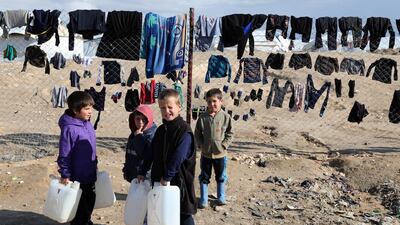
Children hold onto water containers in al-Hol camp, Syria. Reuters -
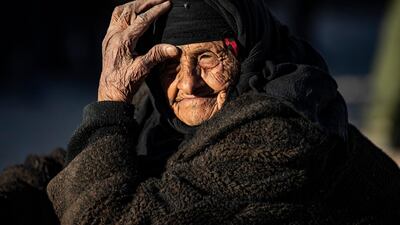
An elderly Syrian woman waits to leave the Kurdish-run al-Hol camp holding relatives of alleged Islamic State (IS) group fighters, in the al-Hasakeh governorate in northeastern Syria. AFP -
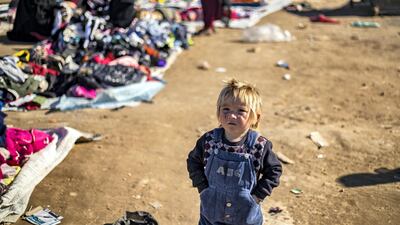
A child looks on at the Kurdish-run al-Hol camp for the displaced in the al-Hasakeh governorate in northeastern Syria. AFP -

Syrian youths get food portions as they prepare to leave the Kurdish-run al-Hol camp holding relatives of alleged Islamic State (IS) group fighters, in the al-Hasakeh governorate in northeastern Syria. AFP -

A Kurdish fighter looks on as Syrian women and children, suspected of being related to Islamic State (IS) group fighters, gather at the Kurdish-run al-Hol camp, before being released to return to their homes, in the al-Hasakeh governorate in northeastern Syria. AFP -

Children look through holes in a tent at al-Hol displacement camp in Hasaka governorate, Syria. Reuters -
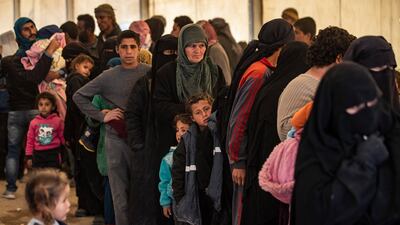
Syrians wait to leave the Kurdish-run al-Hol camp holding relatives of alleged Islamic State (IS) group fighters, in the al-Hasakeh governorate in northeastern Syria. AFP -
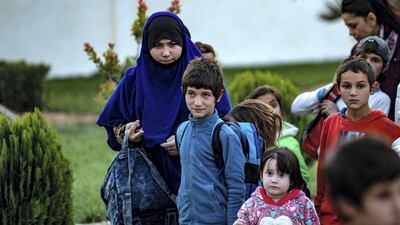
Russian children and an adolescent woman from the Kurdish-run al-Hol camp, which holds displaced families accused of being related to the Islamic State (IS) group, are handed over to a delegation from their country, in the northeastern Syrian city of Qamishli. AFP -
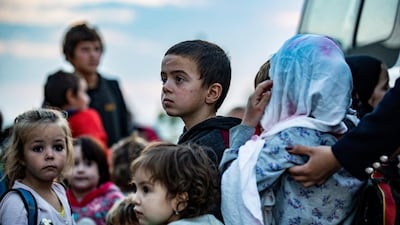
Russian children from the Kurdish-run al-Hol camp, which holds displaced families accused of being related to the Islamic State (IS) group, are handed over to a delegation from their country, in the northeastern Syrian city of Qamishli. AFP


In Syria, however, the ICC has proven entirely ineffectual. The Syrian government has not signed onto the Court's founding treaty, effectively barring ICC prosecutors from investigating it. A referral to the ICC by the UN Security Council would circumvent that obstacle, but the involvement of powerful council members in the war makes that possibility remote. Like the unresolved status of Al Hol camp, the ICC's paralysis with respect to Syria is a stark exposure of gaping holes in our treaty-based view of universality in justice.
In light of these flaws, German courts have turned to the still-nascent legal principle of “universal jurisdiction” to pursue justice for Syrian victims unilaterally, independent of any international process. Al Gharib was convicted and sentenced in Germany last week.
Universal jurisdiction is not an ideal tool for justice. It relies on domestic courts, mainly in Europe, acquiring evidence and context for crimes in foreign countries. It is, largely, a stand-in for accountability in places like Syria. But it is, for the moment, the best that victims in these situations can hope for. If only European nations could apply a similar initiative and a hunger for justice to their people stranded in Al Hol.

