
Saudi Arabia’s King Salman has ordered authorities to extend visit, exit and return visas free until June 2 for residents of the kingdom.
The extension applies to kingdom's residents from countries placed on the red list that currently faces a travel ban because of Covid-19 pandemic. The visas will be extended automatically and with immediate effect, authorities said.
For Saudi Arabia's residents stranded in countries worst hit by the pandemic, including India, this comes as a huge relief.
“My wife and kids travelled to see my parents in March and haven’t been able to return as things took a turn for the worse,” said Mohsin Khan, an Indian expatriate living in Jeddah.
"I have lost friends and family members due to Covid-19 and the only thing I want is my family to return and be safe here. King Salman's generosity and understanding of our financial situation helps us a lot because we have no control over flights and cannot bring back our families until the country resumes flights again."
Coronavirus around the world – in pictures
-
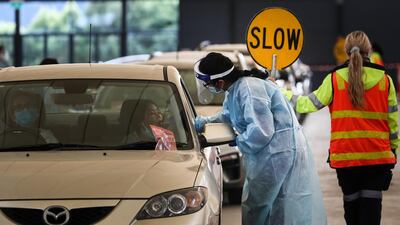
A medical worker conducts a Covid-19 test at a drive-through testing facility at the Melbourne Showgrounds, in Melbourne, Australia. Getty Images -

A security guard walks past the Olympic rings in Tokyo, Japan. The city is due to host the Olympic Games this summer, after they were postponed last year due to Covid-19. AP Photo -
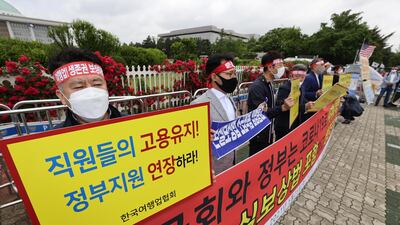
Travel industry workers protest in front of the National Assembly in Seoul, South Korea, calling for a law to enable compensation for losses faced by the industry due to coronavirus. EPA -
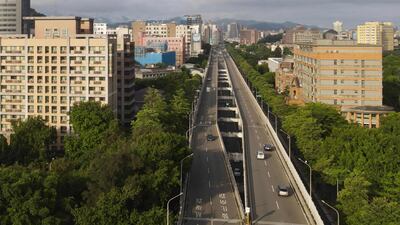
Near-deserted roads in Taipei, after Taiwan raised its coronavirus alert level following a surge in Covid-19 infections. AFP -

Factory workers are reflected in a rearview mirror as they receive the Pfizer-BioNTech vaccine in a bus in Ciudad Juarez, Mexico. Reuters -

A trumpeter takes part in a protest by musicians who are asking to be allowed to play outdoors again and for coronavirus subsidies, in downtown Montevideo, Uruguay. AP Photo -
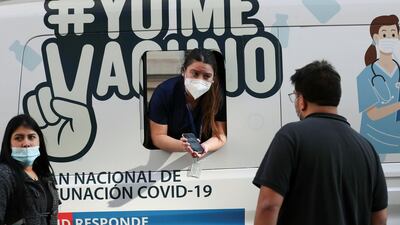
A healthcare worker delivers information as people wait to receive Sinovac's CoronaVac Covid-19 vaccine at a mobile vaccination centre in Chile's capital, Santiago. Reuters -
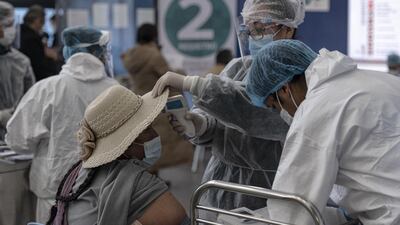
Healthcare workers take a resident's temperature before administering a dose of the Sputnik V Covid-19 vaccine at South Hospital in El Alto, Bolivia. Bloomberg -
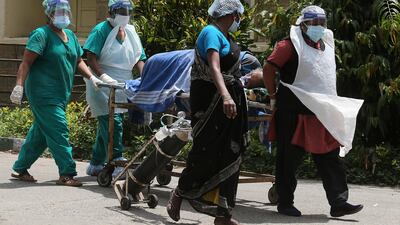
Health workers bring a suspected Covid-19 patient at KC General Hospital in Bangalore, India. EPA -
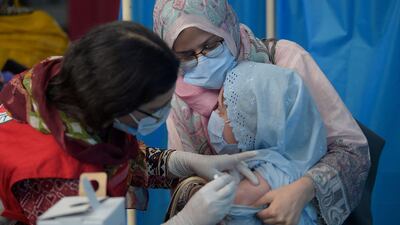
A woman is inoculated with the Sinovac Covid-19 vaccine at the Red Crescent vaccination centre in Rawalpindi, Pakistan. AFP -
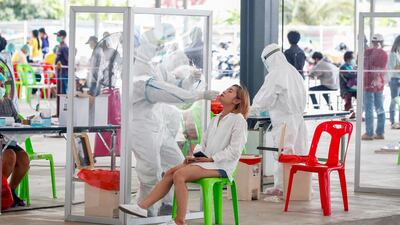
Thai health officials collect samples during a community Covid-19 nasal swab testing drive at a car park in Bangkok, Thailand. EPA -

Commuters wearing face masks to help curb the spread of the coronavirus ride on a subway train in Beijing. AP Photo


Expats in Saudi Arabia currently have to pay at least 200 Saudi riyal ($53.33) for an exit and re-entry visa that last up to one month when they travel abroad. Once issued, dates cannot be changed and travellers would need to buy a new entry visa if they extend the time on the one that was originally issued. According to the General Directorate of Passports, the extension applies to iqamas and visitors visas.
The fine for overstaying an exit visa is 1,000 Saudi riyal and the fine for overstaying on visit visa is 100 Saudi riyal per day.
Mr Khan also pays 4,500 Saudi riyal per dependent every year.
"I end up paying more than 13,000 Saudi riyal in total for the family's iqama [residency] renewal every year."
Companies that hire expatriate workers provide and pay for their iqamas or resident permits. But the monthly fee of 400 riyals is usually covered by residents themselves for each of their dependents.
The Saudi government started charging fee for dependents from July 2017, when the Finance Ministry announced the move in a bid to diversify sources of non-oil revenue.
In an effort to further lessen the financial burden of Covid-19, the General Authority of Civil Aviation (GACA) on Monday revealed that the state will cover all medical expenses for Saudi citizens and residents as well as GCC citizens who need hospital treatment after testing positive for the coronavirus during their institutional quarantine upon arrival to the kingdom. The announcement comes in line with the kingdom's efforts at finding solutions for those affected by the virus and for those travelling to and from the kingdom.
The aviation authority guidelines state that all passengers who test positive for Covid-19 will undergo isolation in the institutional quarantine for a period of 10 to 14 days. It says they advise all air carriers to issue a notice on their websites that the Saudi government requires institutional quarantine for all those travelling to the kingdom and that arrivals must have medical insurance that covers the cost of their treatment related to Covid-19.
Saudi authorities, meanwhile, have intensified efforts to inoculate the population.
More than 12.9 million doses of the Covid-19 vaccine have been administered so far, the Health Ministry said on Monday.
The country has increasedstepped up efforts to ensure implementation of health and safety protocols.
Authorities continue to inspect facilities and arrest those breaching social distancing and gathering limits.
"You can tell that the Saudi government is concerned about both its citizens and residents equally as they continue to provide free vaccines and are now ready to cover hospital treatment during the institutional quarantine," said Lujain Ahmed, a Saudi citizen living in Jeddah.
"We are grateful to live in place that provides safety and care for all those living here. Many of my expat friends from Lebanon, US, South Africa and Pakistan feel safer here than in their home countries," she said.
"The country has undoubtedly laid out strong rules and honestly strict measures are needed at time when our Covid-19 cases are surpassing the daily 1,000-mark. I think the fear of penalties might help public understand how crucial and sensitive the situation is."

