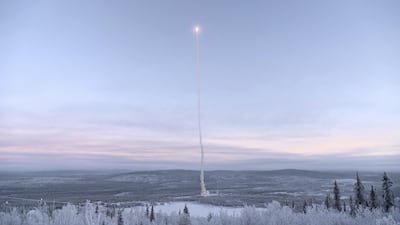
Norway has expressed displeasure at Nordic neighbour Sweden after a research rocket crashed on its territory.
The rocket, which was launched on Monday from the Esrange Space Centre in Kiruna, northern Sweden, plunged into a mountainside in the Malselv municipality in Norway's far north, about 10km from the closest inhabited area.
The fallout is a rare public diplomatic spat between two usually close allies, and there seems to be some disagreement about recovering the wreckage.
Retrieval work was not supposed to begin without Norwegian authorisation, which had not been granted, Norway's foreign ministry said on Tuesday.
But bosses at the Swedish Space Corporation (SSC) said on Monday they were already working on recovering the crashed rocket.
"The crash of a rocket like this is a very serious incident that can cause serious damage," the Norwegian foreign ministry said.
"When such a border violation occurs, it is crucial that those responsible immediately inform the relevant Norwegian authorities through the proper channels.”
No one was injured and no material damage was reported. The rocket was carrying out experiments in zero gravity at an altitude of 250km.
Norway's Civil Aviation Authority said it had learnt of the crash only when the Swedish Space Corporation issued a press release on Monday.
"Norwegian authorities take any unauthorised activity on the Norwegian side of the border very seriously," the Ministry of Foreign Affairs said. The ministry had not received a formal notification of the incident from the Swedish authorities.
Bosses at the SSC are working on retrieving the crashed rocket.
"It landed in the mountains at 1,000m altitude, and 10km from the closest settlement," said SSC head of communications Philip Ohlsson.
There are routines in place when things go wrong and we inform both Swedish and Norwegian governments, and other actors, he said.|
"The rocket took a slightly longer and more westerly trajectory than calculated and landed after a completed flight 15 kilometres into Norway," the SSC said. "Work on retrieving the payload is underway," it added.

10 tips for entry-level job seekers
- Have an up-to-date, professional LinkedIn profile. If you don’t have a LinkedIn account, set one up today. Avoid poor-quality profile pictures with distracting backgrounds. Include a professional summary and begin to grow your network.
- Keep track of the job trends in your sector through the news. Apply for job alerts at your dream organisations and the types of jobs you want – LinkedIn uses AI to share similar relevant jobs based on your selections.
- Double check that you’ve highlighted relevant skills on your resume and LinkedIn profile.
- For most entry-level jobs, your resume will first be filtered by an applicant tracking system for keywords. Look closely at the description of the job you are applying for and mirror the language as much as possible (while being honest and accurate about your skills and experience).
- Keep your CV professional and in a simple format – make sure you tailor your cover letter and application to the company and role.
- Go online and look for details on job specifications for your target position. Make a list of skills required and set yourself some learning goals to tick off all the necessary skills one by one.
- Don’t be afraid to reach outside your immediate friends and family to other acquaintances and let them know you are looking for new opportunities.
- Make sure you’ve set your LinkedIn profile to signal that you are “open to opportunities”. Also be sure to use LinkedIn to search for people who are still actively hiring by searching for those that have the headline “I’m hiring” or “We’re hiring” in their profile.
- Prepare for online interviews using mock interview tools. Even before landing interviews, it can be useful to start practising.
- Be professional and patient. Always be professional with whoever you are interacting with throughout your search process, this will be remembered. You need to be patient, dedicated and not give up on your search. Candidates need to make sure they are following up appropriately for roles they have applied.
Arda Atalay, head of Mena private sector at LinkedIn Talent Solutions, Rudy Bier, managing partner of Kinetic Business Solutions and Ben Kinerman Daltrey, co-founder of KinFitz
WHAT IS A BLACK HOLE?
1. Black holes are objects whose gravity is so strong not even light can escape their pull
2. They can be created when massive stars collapse under their own weight
3. Large black holes can also be formed when smaller ones collide and merge
4. The biggest black holes lurk at the centre of many galaxies, including our own
5. Astronomers believe that when the universe was very young, black holes affected how galaxies formed