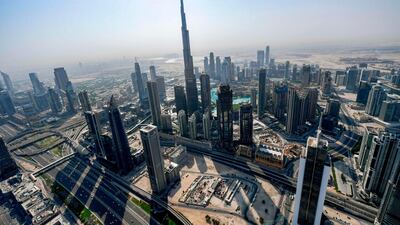
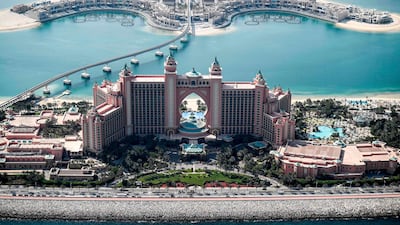
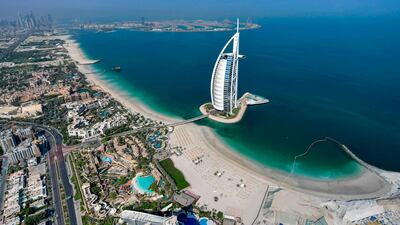
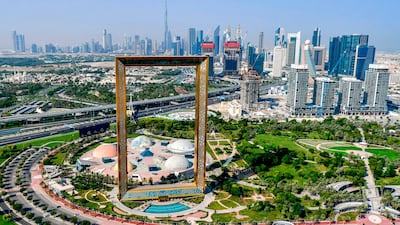
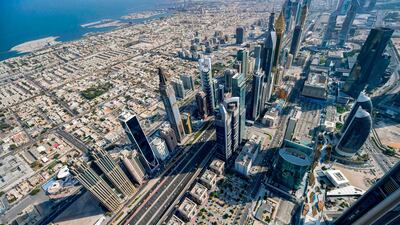
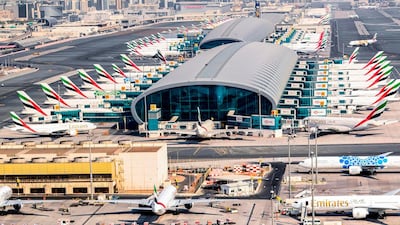
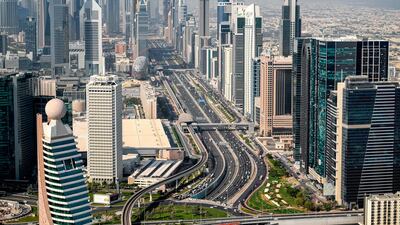
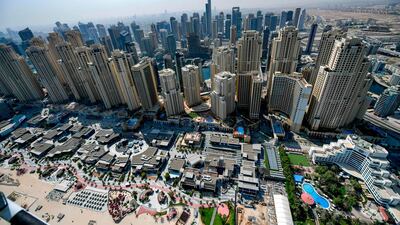
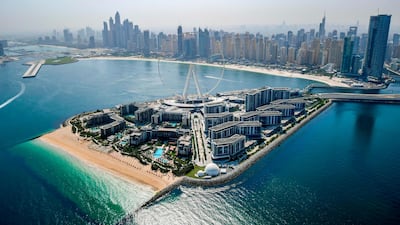
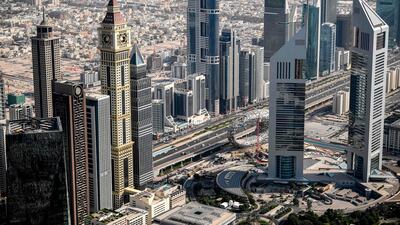
Kite surfers fill the sky as people go to the beach in Jumeirah, Dubai. Chris Whiteoak / The National

Dubai given safe tourism stamp of approval amid global pandemic


  • English
  • Arabic

Dubai has been awarded a global safety and hygiene stamp by the World Travel & Tourism Council to show the UAE's commitment to reopening its tourism sector as it recovers from the coronavirus outbreak.
The WTTC, a council that represents private-sector travel and tourism, created the Safe Travels stamp to allow tourists to identify destinations and businesses around the world that have adopted the global standardised health and hygiene protocols.

The stamp provides guidance to travel providers and travellers about the new approach to health, hygiene, deep cleansing and physical distancing, in the "new normal" of a post-Covid-19 world.
The protocols were devised following the experience of WTTC members dealing with Covid-19 and based on guidelines from the World Health Organisation and the European Centre for Disease Prevention and control.
The United Nations World Tourism Organisation has welcomed the WTTC Safe Travels stamp, which makes the safety and hygiene of travellers a top priority.

“As we reopen Dubai’s doors to tourism and welcome our international visitors back to the city, our foremost priority is their well-being, achieved through stringent hygiene and safety protocols that have been deployed across all tourist touch points,” Helal Saeed Almarri, director general, Dubai’s Department of Tourism and Commerce Marketing (Dubai Tourism) said.

"The WTTC's Safe Travels stamp endorses Dubai's strong global co-operation in combating the pandemic with comprehensive and effective measures to ensure guest health and safety.
"We trust that our efforts not only provide an optimised experience for our visitors, but also secure their health and that of their families, further cementing the confidence that our guests have had thus far in Dubai, and encouraging people from every corner of the world to visit one of the safest cities in the world this summer."

The UAE has been praised for its coronavirus response. A survey by the Deep Knowledge Group, a consortium of technology companies and non-profit organisations, last month ranked the Emirates as 11th on the list in its responses to the pandemic.

Costa Rica, Indonesia, Rwanda, Tobago and Tanzania are also among the latest recipients of the health and safety stamp.

The growing list of endorsements has come from many major holiday and city destinations around the world, such as Sharjah as well Malaga in Spain, which joins the growing list of Spanish destinations including Alicante and Benidorm.

Gloria Guevara, WTTC president and chief executive, said: “Our Safe Travels stamp is proving a great success and we are delighted to see even more popular countries and destinations adopt our global health and hygiene protocols.

“The success of the WTTC Safe Travels stamp shows its importance not only to countries and destinations, but also crucially to travellers and the 330 million people around the world who work in and depend on the travel and tourism sector.

“The stamp is a critical step in re-establishing consumer confidence in travel and tourism and ensuring travellers can rest easy knowing that enhanced standards of hygiene are in place and they can once again experience ‘safe travels’.”

______________

Travel information:

Where can you fly to in the Middle East?

Emirates offers free medical cover for Covid-19: what is included and how to claim it

All travellers must now be tested before their flight to UAE

Scoreline

Saudi Arabia 1-0 Japan

 Saudi Arabia Al Muwallad 63’

Earth under attack: Cosmic impacts throughout history

4.5 billion years ago: Mars-sized object smashes into the newly-formed Earth, creating debris that coalesces to form the Moon

- 66 million years ago: 10km-wide asteroid crashes into the Gulf of Mexico, wiping out over 70 per cent of living species – including the dinosaurs.

50,000 years ago: 50m-wide iron meteor crashes in Arizona with the violence of 10 megatonne hydrogen bomb, creating the famous 1.2km-wide Barringer Crater

1490: Meteor storm over Shansi Province, north-east China when large stones “fell like rain”, reportedly leading to thousands of deaths.  

1908: 100-metre meteor from the Taurid Complex explodes near the Tunguska river in Siberia with the force of 1,000 Hiroshima-type bombs, devastating 2,000 square kilometres of forest.

1998: Comet Shoemaker-Levy 9 breaks apart and crashes into Jupiter in series of impacts that would have annihilated life on Earth.

-2013: 10,000-tonne meteor burns up over the southern Urals region of Russia, releasing a pressure blast and flash that left over 1600 people injured.

UPI facts

More than 2.2 million Indian tourists arrived in UAE in 2023
More than 3.5 million Indians reside in UAE
Indian tourists can make purchases in UAE using rupee accounts in India through QR-code-based UPI real-time payment systems
Indian residents in UAE can use their non-resident NRO and NRE accounts held in Indian banks linked to a UAE mobile number for UPI transactions

Mercer, the investment consulting arm of US services company Marsh & McLennan, expects its wealth division to at least double its assets under management (AUM) in the Middle East as wealth in the region continues to grow despite economic headwinds, a company official said.

Mercer Wealth, which globally has $160 billion in AUM, plans to boost its AUM in the region to $2-$3bn in the next 2-3 years from the present $1bn, said Yasir AbuShaban, a Dubai-based principal with Mercer Wealth.

Within the next two to three years, we are looking at reaching $2 to $3 billion as a conservative estimate and we do see an opportunity to do so,” said Mr AbuShaban.

Mercer does not directly make investments, but allocates clients’ money they have discretion to, to professional asset managers. They also provide advice to clients.

“We have buying power. We can negotiate on their (client’s) behalf with asset managers to provide them lower fees than they otherwise would have to get on their own,” he added.

Mercer Wealth’s clients include sovereign wealth funds, family offices, and insurance companies among others.

From its office in Dubai, Mercer also looks after Africa, India and Turkey, where they also see opportunity for growth.

Wealth creation in Middle East and Africa (MEA) grew 8.5 per cent to $8.1 trillion last year from $7.5tn in 2015, higher than last year’s global average of 6 per cent and the second-highest growth in a region after Asia-Pacific which grew 9.9 per cent, according to consultancy Boston Consulting Group (BCG). In the region, where wealth grew just 1.9 per cent in 2015 compared with 2014, a pickup in oil prices has helped in wealth generation.

BCG is forecasting MEA wealth will rise to $12tn by 2021, growing at an annual average of 8 per cent.

Drivers of wealth generation in the region will be split evenly between new wealth creation and growth of performance of existing assets, according to BCG.

Another general trend in the region is clients’ looking for a comprehensive approach to investing, according to Mr AbuShaban.

“Institutional investors or some of the families are seeing a slowdown in the available capital they have to invest and in that sense they are looking at optimizing the way they manage their portfolios and making sure they are not investing haphazardly and different parts of their investment are working together,” said Mr AbuShaban.

Some clients also have a higher appetite for risk, given the low interest-rate environment that does not provide enough yield for some institutional investors. These clients are keen to invest in illiquid assets, such as private equity and infrastructure.

“What we have seen is a desire for higher returns in what has been a low-return environment specifically in various fixed income or bonds,” he said.

“In this environment, we have seen a de facto increase in the risk that clients are taking in things like illiquid investments, private equity investments, infrastructure and private debt, those kind of investments were higher illiquidity results in incrementally higher returns.”

The Abu Dhabi Investment Authority, one of the largest sovereign wealth funds, said in its 2016 report that has gradually increased its exposure in direct private equity and private credit transactions, mainly in Asian markets and especially in China and India. The authority’s private equity department focused on structured equities owing to “their defensive characteristics.”

Uefa Champions League last 16 draw

Juventus v Tottenham Hotspur

Basel v Manchester City

Sevilla v  Manchester United

Porto v Liverpool

Real Madrid v Paris Saint-Germain

Shakhtar Donetsk v Roma

Chelsea v Barcelona

Bayern Munich v Besiktas