Salmon farming on land, Fitbit-style devices for cattle and acres of greenhouses producing vegetables in a Mediterranean environment — the face of farming in the UAE is changing fast.
With a 70 per cent increase in global food demand expected by 2050, and climate change affecting agricultural production, innovation is proving the key to easing food insecurity.
A campaign by the Ministry of Climate Change and Environment aims to unite businesses with innovation and funding to tackle such issues.
Local farms are at the heart of the National Dialogue for Food Security, which will be supported to become major suppliers in the UAE to help reduce the reliance on imported goods.
Pure Harvest chief executive
The project will develop a platform for emerging innovation in food production to improve the use of hydroponic, aeroponic and aquaponic farming that uses minimal resources to produce a high yield of fresh fruit and vegetables while providing a gateway into the mass market.
The drive aims to increase domestic production and self-sufficiency of selected food items and improve the income of UAE farms without compromising food trade.
Under the plan, bodies will increase their purchases of fresh national food products to 50 per cent by the end of this year, 70 per cent by 2025 and 100 per cent by 2030.
Food products and plant varieties identified in the first phase include red meat, poultry, eggs and other dairy products, dates, leafy vegetables, tomatoes, cucumbers, peppers and aubergine. A study is currently being conducted to identify more products for the second phase.
-
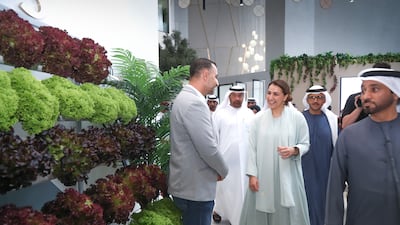
A special initiative by the Ministry of Climate Change and Environment aims to unite businesses with innovation and funding to tackle food security issues. All Photos: Ministry of Climate Change and Environment -
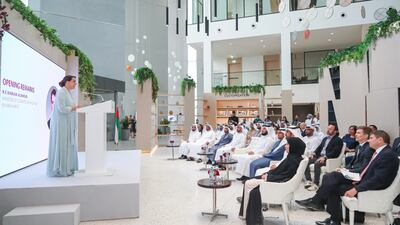
Mariam Al Mheiri, Minister of Climate Change and Environment and Minister of State for Food Security, said recent global crises have underlined the need for promoting food security in the UAE -
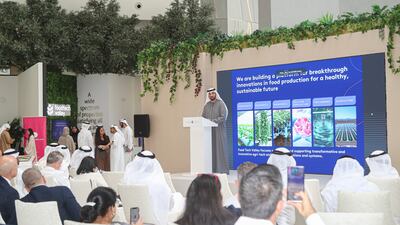
Local farms are at the heart of the National Dialogue for Food Security -
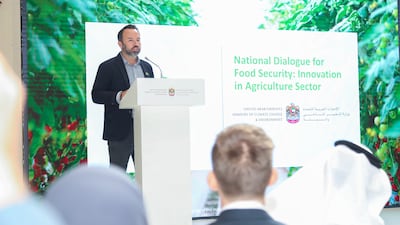
Sky Kurtz, chief executive of Pure Harvest, said there is the potential to localise sourcing for many of the UAE's food needs


Mariam Al Mheiri, Minister of Climate Change and Environment, Minister of State for Food Security, said recent global crises have underlined the need for promoting food security in the UAE.
"To promote food security, the UAE has taken strategic steps, such as deploying advanced technology to strengthen the local food production sector, enhancing its contribution to closing the food gap and tackling food loss and waste by launching several initiatives, like Ne'ma, to promote the sustainability of national farms," she said.
"These initiatives aim to enhance food security in the UAE by boosting production and marketing effectiveness for local farms, particularly those following a modern and sustainable approach."
Ne'ma — Arabic for blessing — is a campaign aimed at curbing food loss and waste by encouraging responsible consumption.
At a meeting on Monday to discuss the latest developments, it was revealed a farm in Maliha in Sharjah had produced more than 15,000 tonnes of protein-enriched wheat.
It is the latest example of how staple foods can be produced sustainably in the UAE.
The planet’s population is expected to swell to 9.5 billion by 2050, with climate change continuing to cause extreme weather events and drought which heavily impact food production.
With freshwater sources also depleting, scientists have turned to innovation to solve these global issues.
The Ministry of Climate Change and Environment's recent statistics show there are 38,000 farms operating in the UAE.
Total UAE vegetable production is about 156,000 tonnes annually, with more than 500 tonnes of field crops and feed, while fruit production is about 200,000 tonnes.
Domestic production of vegetables currently meets more than 20 per cent of the total demand in the country.
Precision farming, using data science and agricultural engineering, has increased yields, while high-tech greenhouses and vertical farms are reducing the need for water.
In livestock agriculture, gene editing, bio-engineering and smart tech to monitor cattle more closely are being used to increase meat production to keep up with consumer demand and close the food price gap.
Alternative proteins with more food derived from non-animal sources are also likely to become more common, using insects and plant-based meats.
Farming innovation
Health trackers worn by dairy cattle — known as rumination collars — keep track of their health and food consumption, monitoring production and allowing farm managers to oversee a large herd more effectively.
An innovation already in widespread use across the country is salmon farming on land, using huge tanks to replicate the fish’s life-cycle in the wild.
Fish were identified as one of the UAE’s strategic food items under the 2018 Food Security Strategy.
At about 30kg per capita, it has among the fish highest consumption in the GCC, according to the UN Food and Agriculture Organisation.
In 2019, domestic fish made up only 8 per cent of UAE consumption but that is beginning to change, with farmed salmon controlled in freshwater tanks (which are transferred to seawater as they grow) proving an efficient method of sustainable production.

Added to these innovative farming methods, the growing of fruit and vegetables in the arid desert has become one of the biggest success stories.
In huge temperature-controlled farming tunnels and domes, Pure Harvest Smart Farms has created the perfect Mediterranean climate to produce impressive yields of fruit and vegetables in Al Ain.
With temperatures regulated to between 14°C-32°C, tomatoes, green leafy vegetables and berries are produced using only a 30th of the amount of water usually required.
“This shows what can be done,” said Sky Kurtz, chief executive of Pure Harvest, a smart farm producing around 18 metric tonnes of food a week.
“Change [in the way we produce food] will require investment and re-education.
"There is potential to localise sourcing for many of the UAE's food needs and to do so in a way that is sustainable, economic and environmentally sound.”
By the end of this year, the UAE hopes local farms and producers will be able to supply half of some basic food requirements, such as greens, tomatoes, meat and poultry, with an ambition to double that target by 2030.
“This will require a co-ordinated effort between the government and the private sector,” said Mr Kurtz.
"Many of the technology-enabled food production solutions that are necessary to produce food year-round in the UAE require capital, scale and know-how to deliver.
“The more that the government can do to support the many elements that underpin the fundamental business cases of these solutions, the better.”