
The Salameh Papers: Full coverage here
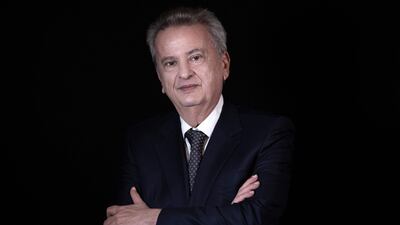
Lebanon's former central bank chief Riad Salameh was arrested on Tuesday after a judicial hearing in Beirut, a senior judicial source told The National.
Public Prosecutor Judge Jamal Hajjar ordered his arrest, after which we will be detained for four days, the source added.
Mr Salameh is under investigation in Lebanon in two separate cases involving alleged embezzlement from the Lebanon central bank, Banque Du Liban (BDL).
Tuesday's hearing in Beirut related to alleged embezzlement and manipulation of financial statements through an $8 billion scheme. It involves controversial Lebanese broker Optimum Invest SA, with which BDL engaged in “round-tripping” of transactions, generating $8 billion in fake gains for the central bank and suspected embezzlement of public funds.
The 45 contracts, all seen by The National, were signed by Mr Salameh in his capacity as central bank governor at the time, and Optimum’s chairman, Antoine Salame – a distant relative who has since then left the company – between 2015 and 2018.
The alleged accounting “trick” would let BDL record future interest payments as immediate revenue, creating no real economic value, in an effort to hide mounting losses from unsustainable monetary policy, according to experts who accessed the audit and spoke to The National.
A BDL source previously confirmed to The National that the bank is looking into allegations of falsified financial statements.
BDL's forensic audit, conducted by consulting firm Alvarez & Marsal (A & M), also suggests at least $111 million of these “paper” profits was siphoned off as shady disbursement to undisclosed third parties.
Commenting on the rationale behind the deals with Optimum, Mr Salameh told The National in July that operations with Optimum were in line with the institution's accounting framework.
“The income from these operations was not booked as profit but revenue against postponed losses in accordance with the financial chart of BDL,” he said by email.
BDL relies on its own accounting standards, which diverge from International Financial Reporting Standards.
A&M had previously criticised BDL's “non-traditional” accounting standards in its audit for lacking transparency.
Mr Salameh did not comment on the embezzlement allegations related to Optimum in his email.
Caretaker Minister of Justice Judge Henri Khoury said of Mr Salameh's detention that the “judiciary has had its say. We respect the judiciary's decision.”
The move comes amid speculation that Lebanon could be put on the “grey list” by the FATF, the international financial crime watchdog, during its plenary in October of this year.
“Let justice take its course and we will see if this is a political manoeuvre, FATF-related move to show a desperate last minute agonising attempt to avoid a grey listing or it is finally a serious move by the judiciary to address corruption and money laundering alleged charges,” financial expert Henri Chaoul told The National.
Stalled investigation
Optimum commissions are suspected to be a continuation of the Forry Associates Ltd scheme, another broker under investigation in Europe, allegedly used by Mr Salameh to embezzle $330 million from the BDL between 2002 and 2015.
The funds were reportedly used to acquire luxurious properties in Europe and the US, most of which are now frozen.
Mr Salameh has repeatedly denied any wrongdoing.
The investigation into Forry, which began in 2021 in Lebanon, has been stalled for years due to political interference in a country where impunity usually prevails.
However, it has gained momentum abroad with France, Luxembourg, Germany, Switzerland, Belgium and Liechtenstein opening investigation into Mr Salameh over suspected financial crimes.
In May 2023, France issued an arrest warrant for Mr Salameh after a hearing in Paris. The US, UK and Canada have also imposed sanctions on him in connection with the allegations.
French lawyer William Bourdon, who initially brought legal action against Mr Salameh in France and has extensive experience in recovering ill-gotten assets, warns that Mr Salameh's arrest could be a “tactic” by the Lebanese judiciary.
“My experience shows that these procedures could act as smokescreens to create the impression of a genuine investigation, when in reality the person is arrested with the intention of later releasing them and dropping the case.”
This could be a calculated move to make Mr Salameh a scapegoat, he added, shifting the focus away and reducing international pressure on those who have committed worse offences.
“This would not work,” Mr Bourdon said.
Once praised as the guardian of the flourishing banking sector, Mr Salameh is widely blamed for Lebanon's financial collapse, characterised by losses exceeding $70 billion, a crumbling local currency and largely insolvent banks.