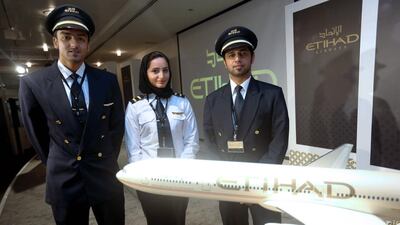
Faisal Obaid Al Naqbi had a job that others can only dream of. He played professional football for Al Wahda Football Club.
But he had other dreams too.
A human resources graduate of Abu Dhabi Men’s College, Mr Al Naqbi wanted to follow in his father’s footsteps.
His father, a pilot in the UAE Air Force, was elated.
They went to a flying school in Germany in 2009, a year after the young Emirati’s graduation. He test flew with an instructor for an hour over the fields of Bautzen, near Berlin.
“I wasn’t scared, I was dreaming about it,” he said. “I felt more confident about flying after that.”
Soon, he enrolled for Etihad’s pilot training programme.
Mr Al Naqbi is one of about 50 Emirati pilots who graduate yearly from the Etihad Airways Training Academy. While most are enrolled in the pilot training programme, a handful participate in the cabin crew category.
The programme is part of the Abu Dhabi carrier's effort to build a future line-up of pilots and leaders.
It “gives the airline options for future leadership for operations roles and different management positions”, said Ray Gammell, the chief people and performance officer at Etihad. “Given we are growing at the rate we are, creating capability is the key.”
The UAE carrier is one of the world’s fastest growing airlines. It is expanding into South East Asia as well as North America and investing in foreign airlines such as India’s Jet Airways, Air Serbia, Virgin Australia, Air Seychelles and Ireland’s Aer Lingus.
Several management and operational roles – such as in safety, training, flight and airport operations – are held by pilots who still fly. For them, 30 per cent of the time is dedicated to flying to keep their certification, while the rest is taken up by their responsibilities on the ground.
Emirati cabin crew can also apply for similar ground jobs. This year, the airlines received 160 such applications from its cabin crew.
So far, six women have graduated from the pilot training programme, and 13 others are in training.
While graduates of the Etihad programme are free to join other airlines, all are absorbed in-house.
“And we need more,” said Mr Gammell.
Etihad has partnered Abu Dhabi University to allow applicants without a graduate degree to pursue a bachelor’s degree in aviation science, which can be completed in about five years.
After graduation, an applicant for the pilot training programme is required to complete 750 hours of ground training and 205 hours on a small aircraft. This can take about 18 months. After passing an examination, the students receive an air pilot transport licence and graduate to second officers. They then move to the Etihad academy to complete their simulator training – which can take up to a year. That is followed by 43 flights under the supervision of a training pilot. Upon successful completion, they graduate as first officers.
While Etihad would not disclose how much it spends on training the Emirati pilots, the training programme costs Dh500,000 for an international student.
The total number of cadets – second officers and first officers – is 518, including 387 UAE nationals and 119 international students.
Every year, about 10 international student pilots graduate from the programme.
Mr Al Naqbi is one of 76 second officers currently at Etihad.
“I am flying A320s and I am excited to go to bigger jets,” he said. “The most exciting part is connecting people from Abu Dhabi to the world.”
The 25-year-old is still undergoing training and expects to complete it in January. He currently flies short-range flights to Cairo, Beirut, the Seychelles and the Gulf countries besides India and Pakistan.
“That feeling, being above the clouds, is amazing,” Mr Al Naqbi said. “You feel that you are owning the world.”
So, would he like his two-year-old child to follow in his flight path?
“She is a girl, but if she wants I won’t stop her,” he said. “Because doing something else that you don’t like can leave you unfulfilled.”
ssahoo@thenational.ae

Four motivational quotes from Alicia's Dubai talk
“The only thing we need is to know that we have faith. Faith and hope in our own dreams. The belief that, when we keep going we’re going to find our way. That’s all we got.”
“Sometimes we try so hard to keep things inside. We try so hard to pretend it’s not really bothering us. In some ways, that hurts us more. You don’t realise how dishonest you are with yourself sometimes, but I realised that if I spoke it, I could let it go.”
“One good thing is to know you’re not the only one going through it. You’re not the only one trying to find your way, trying to find yourself, trying to find amazing energy, trying to find a light. Show all of yourself. Show every nuance. All of your magic. All of your colours. Be true to that. You can be unafraid.”
“It’s time to stop holding back. It’s time to do it on your terms. It’s time to shine in the most unbelievable way. It’s time to let go of negativity and find your tribe, find those people that lift you up, because everybody else is just in your way.”
Mercer, the investment consulting arm of US services company Marsh & McLennan, expects its wealth division to at least double its assets under management (AUM) in the Middle East as wealth in the region continues to grow despite economic headwinds, a company official said.
Mercer Wealth, which globally has $160 billion in AUM, plans to boost its AUM in the region to $2-$3bn in the next 2-3 years from the present $1bn, said Yasir AbuShaban, a Dubai-based principal with Mercer Wealth.
“Within the next two to three years, we are looking at reaching $2 to $3 billion as a conservative estimate and we do see an opportunity to do so,” said Mr AbuShaban.
Mercer does not directly make investments, but allocates clients’ money they have discretion to, to professional asset managers. They also provide advice to clients.
“We have buying power. We can negotiate on their (client’s) behalf with asset managers to provide them lower fees than they otherwise would have to get on their own,” he added.
Mercer Wealth’s clients include sovereign wealth funds, family offices, and insurance companies among others.
From its office in Dubai, Mercer also looks after Africa, India and Turkey, where they also see opportunity for growth.
Wealth creation in Middle East and Africa (MEA) grew 8.5 per cent to $8.1 trillion last year from $7.5tn in 2015, higher than last year’s global average of 6 per cent and the second-highest growth in a region after Asia-Pacific which grew 9.9 per cent, according to consultancy Boston Consulting Group (BCG). In the region, where wealth grew just 1.9 per cent in 2015 compared with 2014, a pickup in oil prices has helped in wealth generation.
BCG is forecasting MEA wealth will rise to $12tn by 2021, growing at an annual average of 8 per cent.
Drivers of wealth generation in the region will be split evenly between new wealth creation and growth of performance of existing assets, according to BCG.
Another general trend in the region is clients’ looking for a comprehensive approach to investing, according to Mr AbuShaban.
“Institutional investors or some of the families are seeing a slowdown in the available capital they have to invest and in that sense they are looking at optimizing the way they manage their portfolios and making sure they are not investing haphazardly and different parts of their investment are working together,” said Mr AbuShaban.
Some clients also have a higher appetite for risk, given the low interest-rate environment that does not provide enough yield for some institutional investors. These clients are keen to invest in illiquid assets, such as private equity and infrastructure.
“What we have seen is a desire for higher returns in what has been a low-return environment specifically in various fixed income or bonds,” he said.
“In this environment, we have seen a de facto increase in the risk that clients are taking in things like illiquid investments, private equity investments, infrastructure and private debt, those kind of investments were higher illiquidity results in incrementally higher returns.”
The Abu Dhabi Investment Authority, one of the largest sovereign wealth funds, said in its 2016 report that has gradually increased its exposure in direct private equity and private credit transactions, mainly in Asian markets and especially in China and India. The authority’s private equity department focused on structured equities owing to “their defensive characteristics.”
Dr Amal Khalid Alias revealed a recent case of a woman with daughters, who specifically wanted a boy.
A semen analysis of the father showed abnormal sperm so the couple required IVF.
Out of 21 eggs collected, six were unused leaving 15 suitable for IVF.
A specific procedure was used, called intracytoplasmic sperm injection where a single sperm cell is inserted into the egg.
On day three of the process, 14 embryos were biopsied for gender selection.
The next day, a pre-implantation genetic report revealed four normal male embryos, three female and seven abnormal samples.
Day five of the treatment saw two male embryos transferred to the patient.
The woman recorded a positive pregnancy test two weeks later.
MATCH INFO
English Premiership semi-finals
Saracens 57
Wasps 33
Exeter Chiefs 36
Newcastle Falcons 5
In%20the%20Land%20of%20Saints%20and%20Sinners
%3Cp%3E%3Cstrong%3EDirector%3A%20%3C%2Fstrong%3ERobert%20Lorenz%3C%2Fp%3E%0A%3Cp%3E%3Cstrong%3EStarring%3A%3C%2Fstrong%3E%20Liam%20Neeson%2C%20Kerry%20Condon%2C%20Jack%20Gleeson%2C%20Ciaran%20Hinds%3C%2Fp%3E%0A%3Cp%3E%3Cstrong%3ERating%3A%20%3C%2Fstrong%3E2%2F5%3C%2Fp%3E%0A
The specs: 2018 Nissan 370Z Nismo
Price, base / as tested: Dh182,178
Engine: 3.7-litre V6
Power: 350hp @ 7,400rpm
Torque: 374Nm @ 5,200rpm
Transmission: Seven-speed automatic
Fuel consumption, combined: 10.5L / 100km
UAE currency: the story behind the money in your pockets
THE DETAILS
Solo: A Star Wars Story
Dir: Ron Howard
Starring: Alden Ehrenreich, Emilia Clarke, Woody Harrelson
3/5
The specs: 2018 Ford F-150
Price, base / as tested: Dh173,250 / Dh178,500
Engine: 5.0-litre V8
Power: 395hp @ 5,000rpm
Torque: 555Nm @ 2,750rpm
Transmission: 10-speed automatic
Fuel consumption, combined: 12.4L / 100km
Barcelona 3
Messi (27’, 32’, 87’)
Leganes 1
El Zhar (68’)
Racecard
6.35pm: American Business Council – Maiden (PA) Dh80,000 (Dirt) 1,600m
7.10pm: British Business Group – Maiden (TB) Dh82,500 (D) 1,200m
7.45pm: CCI France UAE – Handicap (TB) Dh87,500 (D) 1,400m
8.20pm: Czech Business Council – Rated Conditions (TB) Dh105,000 (D) 1,400m
8.55pm: Netherlands Business Council – Rated Conditions (TB) Dh95,000 (D) 1,600m
9.30pm: Indian Business and Professional Council – Handicap (TB) Dh95,000 (D) 1,200m