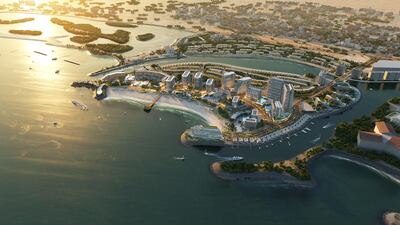
RAK Properties plans to launch four new residential projects and a hotel project in Ras Al Khaimah this year and aims to surpass last year’s profitability on the back of higher sales, its chief executive has said.
The value of the projects will be “in the billions of dirhams”, Sameh Al Muhtadi told The National in an interview.
The new projects consisting of branded apartments and villas will be built at the company’s Dh10 billion ($2.72 billion) Mina Al Arab master development off the coast of Ras Al Khaimah.
RAK Properties has unveiled three new residential projects with close to 900 units so far this year with the residences at one of its developments, Bayviews, selling out within a few hours of being launched earlier this year.
“There’s tremendous demand in Ras Al Khaimah,” said Mr Al Muhtadi.
“I think people realise the value to be had, they realise the potential of returns on their investments and we are seeing the appetite to invest in Ras Al Khaimah grow on a daily basis.”
The new projects will be financed through a mix of debt and equity and the company has a “very robust balance sheet and we have very healthy liquidity”.
“A lot of the financing comes from off-plan sales, but we have lines of credit with multiple banks if need be,” Mr Al Muhtadi said.
It also has plans to raise money through bonds as it continues to focus on developing new projects.
“That's one of the considerations but that's down the road as needed. That might be because we have a very strong development plan ahead of us. This is something that we may require in mid-25 [2025].”
The UAE’s property market rebounded strongly from the coronavirus pandemic with property transaction numbers increasing across the country.
Pent-up demand and improved investor sentiment as well as new initiatives, such as visas for retirees and the expansion of the 10-year golden visa programme, have helped to drive property sales up.
Both Dubai and Abu Dhabi recorded higher sales this year amid strong demand from buyers as the UAE economy expanded at its fastest pace in more than a decade, accelerating 7.9 per cent in 2022.
Dubai’s off-plan sales surged more than 100 per cent annually in May to Dh14 billion with the total number of off-plan units sold during the month rising more than 100 per cent to 5,476, EFG Hermes said in a report this month.
Abu Dhabi recorded 5,472 real estate transactions worth Dh27.9 billion in the first quarter of 2023, according to the latest data from the Department of Municipalities and Transport.
The value of the deals in the emirate more than doubled during the three-month period to the end of March while the volume of transactions, which include property sales and mortgages, rose by 66 per cent.
RAK Properties had set a target of Dh1 billion in sales for 2023 and achieved the target “two weeks back”, with sales of property to international investors including Russians, Chinese and Germans as well as UAE citizens, Mr Al Muhtadi said.
“The speed with which we are developing, rolling out and constructing … is helping us tremendously.”
“Investors when they see the route of progress that we are achieving on site, encouraged them to invest in the properties that we are offering.”
The company’s profit and revenue in 2023 will exceed that of last year amid the launch of new projects and growth in sales, he added.
In 2022, RAK Properties reported Dh408.2 million in revenue and the net profit during the period reached Dh30.7 million.
The company’s first-quarter net profit rose 46 per cent year-on-year to Dh44.5 million as revenue during the period more than doubled to Dh258.5 million.
“I am hoping that we are going to have a multiple of last year's profitability,” Mr Al Muhtadi said.
The company has a land bank both in Dubai and Abu Dhabi and will look “at potential partnerships, co-development in those Emirates as well” to start projects.
“This is something that we are studying very closely for next year but we have a very significant pipeline of projects in Ras Al Khaimah for this year and we are very focused on that,” he added.
It has already completed one project called Julphar Residence in Abu Dhabi and has started handing over homes to customers.
Mr Al Muhtadi expects interest rates to reduce next year and that will further encourage investors to boost investments in the property sector.
“Interest rates are close to having peaked and are going to get better and interest on mortgages might reduce. I see that as a positive indication.”

Who was Alfred Nobel?
The Nobel Prize was created by wealthy Swedish chemist and entrepreneur Alfred Nobel.
- In his will he dictated that the bulk of his estate should be used to fund "prizes to those who, during the preceding year, have conferred the greatest benefit to humankind".
- Nobel is best known as the inventor of dynamite, but also wrote poetry and drama and could speak Russian, French, English and German by the age of 17. The five original prize categories reflect the interests closest to his heart.
- Nobel died in 1896 but it took until 1901, following a legal battle over his will, before the first prizes were awarded.
Match info:
Burnley 0
Manchester United 2
Lukaku (22', 44')
Red card: Marcus Rashford (Man United)
Man of the match: Romelu Lukaku (Manchester United)
Super Bowl LIII schedule
What Super Bowl LIII
Who is playing New England Patriots v Los Angeles Rams
Where Mercedes-Benz Stadium in Atlanta, United States
When Sunday (start time is 3.30am on Monday UAE time)
Frankenstein in Baghdad
Ahmed Saadawi
Penguin Press
UAE currency: the story behind the money in your pockets
Results
6.30pm: Dubai Millennium Stakes Group Three US$200,000 (Turf) 2,000m; Winner: Ghaiyyath, William Buick (jockey), Charlie Appleby (trainer).
7.05pm: Handicap $135,000 (T) 1,600m; Winner: Cliffs Of Capri, Tadhg O’Shea, Jamie Osborne.
7.40pm: UAE Oaks Group Three $250,000 (Dirt) 1,900m; Winner: Down On Da Bayou, Mickael Barzalona, Salem bin Ghadayer.
8.15pm: Zabeel Mile Group Two $250,000 (T) 1,600m; Winner: Zakouski, James Doyle, Charlie Appleby.
8.50pm: Meydan Sprint Group Two $250,000 (T) 1,000m; Winner: Waady, Jim Crowley, Doug Watson.
Mercer, the investment consulting arm of US services company Marsh & McLennan, expects its wealth division to at least double its assets under management (AUM) in the Middle East as wealth in the region continues to grow despite economic headwinds, a company official said.
Mercer Wealth, which globally has $160 billion in AUM, plans to boost its AUM in the region to $2-$3bn in the next 2-3 years from the present $1bn, said Yasir AbuShaban, a Dubai-based principal with Mercer Wealth.
“Within the next two to three years, we are looking at reaching $2 to $3 billion as a conservative estimate and we do see an opportunity to do so,” said Mr AbuShaban.
Mercer does not directly make investments, but allocates clients’ money they have discretion to, to professional asset managers. They also provide advice to clients.
“We have buying power. We can negotiate on their (client’s) behalf with asset managers to provide them lower fees than they otherwise would have to get on their own,” he added.
Mercer Wealth’s clients include sovereign wealth funds, family offices, and insurance companies among others.
From its office in Dubai, Mercer also looks after Africa, India and Turkey, where they also see opportunity for growth.
Wealth creation in Middle East and Africa (MEA) grew 8.5 per cent to $8.1 trillion last year from $7.5tn in 2015, higher than last year’s global average of 6 per cent and the second-highest growth in a region after Asia-Pacific which grew 9.9 per cent, according to consultancy Boston Consulting Group (BCG). In the region, where wealth grew just 1.9 per cent in 2015 compared with 2014, a pickup in oil prices has helped in wealth generation.
BCG is forecasting MEA wealth will rise to $12tn by 2021, growing at an annual average of 8 per cent.
Drivers of wealth generation in the region will be split evenly between new wealth creation and growth of performance of existing assets, according to BCG.
Another general trend in the region is clients’ looking for a comprehensive approach to investing, according to Mr AbuShaban.
“Institutional investors or some of the families are seeing a slowdown in the available capital they have to invest and in that sense they are looking at optimizing the way they manage their portfolios and making sure they are not investing haphazardly and different parts of their investment are working together,” said Mr AbuShaban.
Some clients also have a higher appetite for risk, given the low interest-rate environment that does not provide enough yield for some institutional investors. These clients are keen to invest in illiquid assets, such as private equity and infrastructure.
“What we have seen is a desire for higher returns in what has been a low-return environment specifically in various fixed income or bonds,” he said.
“In this environment, we have seen a de facto increase in the risk that clients are taking in things like illiquid investments, private equity investments, infrastructure and private debt, those kind of investments were higher illiquidity results in incrementally higher returns.”
The Abu Dhabi Investment Authority, one of the largest sovereign wealth funds, said in its 2016 report that has gradually increased its exposure in direct private equity and private credit transactions, mainly in Asian markets and especially in China and India. The authority’s private equity department focused on structured equities owing to “their defensive characteristics.”
Who's who in Yemen conflict
Houthis: Iran-backed rebels who occupy Sanaa and run unrecognised government
Yemeni government: Exiled government in Aden led by eight-member Presidential Leadership Council
Southern Transitional Council: Faction in Yemeni government that seeks autonomy for the south
Habrish 'rebels': Tribal-backed forces feuding with STC over control of oil in government territory