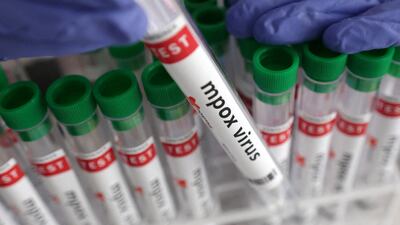
Mpox has been largely considered as an "African problem", and Big Pharma’s apparent lack of interest in developing vaccines puts people on the continent - as well as around the world - at increased risk of exposure to a deadlier strand, experts have warned.
The limited availability of vaccines approved by the World Health Organisation and the higher cost they are sold at means financially strained African nations could struggle to get hold of whatever quantities are available, making disease prevention an extremely difficult task, industry experts say.
Unlike their rush to develop and market billions of doses of vaccines to curb Covid-19, the big pharmaceutical companies have yet to commit resources to develop vaccines for large-scale inoculation of Africans against mpox.
The field is left wide open for smaller vaccine manufacturers, which have limited capabilities. However, Big Pharma, with its deep pockets, can muscle in anytime to buy out smaller companies if there is a commercial case to enter the mpox market.
“Mpox has been, frankly, overlooked," Seth Lederman, chief executive of US-based Tonix Pharamceuticals, which is in race to develop its own mpox vaccine told The National.
"Traditionally, mpox has been a market in Africa which is … not something that typically attracts a lot of attention. One of the things about these big [pharmaceutical] companies is that they can wait until the very end, and they can pay up, and they can buy whatever they want.”
Pfizer declined to comment. Johnson & Johnson said it currently does not have plans to develop an mpox vaccine. Moderna did not immediately return The National's request for comment.
-
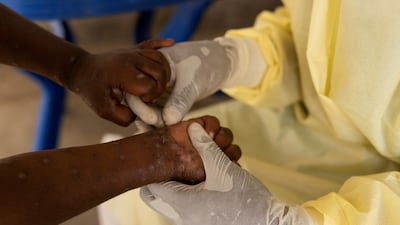
A laboratory nurse takes a sample from a child with a suspected case of mpox at a treatment centre near Goma, in the Democratic Republic of the Congo, in July. Reuters -
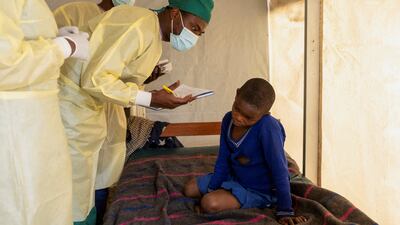
A doctor verifies the growth of skin lesions on the ear of a child suffering from mpox in July. Reuters -
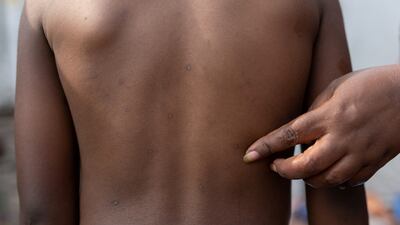
A mother points out the rash marks on her child who recovered from mpox, in July. Reuters -
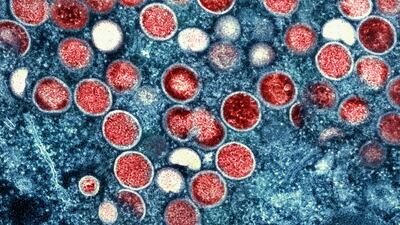
This image provided by the National Institute of Allergy and Infectious Diseases shows a colourised transmission electron micrograph of mpox particles (red) found in an infected cell (blue). Niaid / AP -
The World Health Organisation has declared its second public health emergency of international concern on the mpox virus in two years. AP -

Mpox, formerly known as monkeypox, can be treated with antiviral medication, and it can be prevented with a two-dose vaccine regimen. AP -
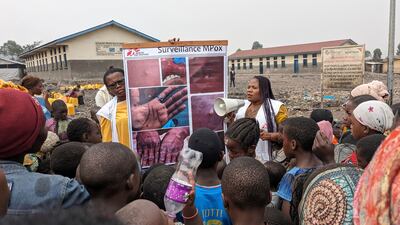
African health officials said mpox cases have risen by 160% in the past year. Doctors Without Borders / AP -
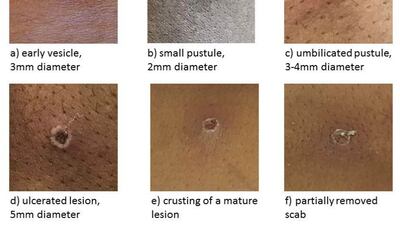
Images from the UK Health Security Agency show the stages of monkeypox. UK Health Security Agency -
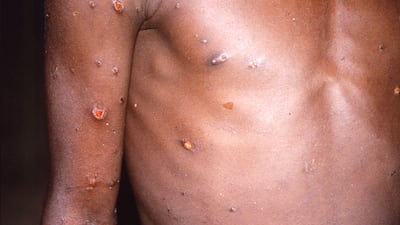
An image taken during an outbreak of mpox in the Democratic Republic of the Congo in 1996 and 1997 shows the arms and torso of a patient with skin lesions. Reuters -
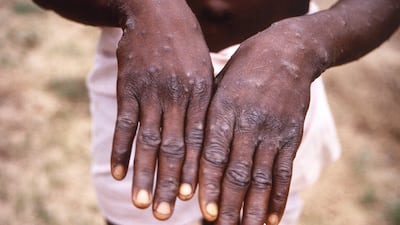
A man's hands are covered in a rash caused by the mpox virus that swept through the Democratic Republic of the Congo from 1996 to 1997. Reuters -
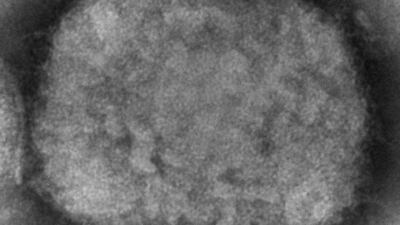
This 2003 electron microscope image from the Centres for Disease Control and Prevention shows an mpox virion, from a sample associated with the 2003 prairie dog outbreak. AP


Two mpox global emergencies
On August 14, the WHO declared mpox in the Democratic Republic of the Congo and neighbouring countries to be a public health emergency of international concern.
It is the second time in two years that the global health watchdog has elevated mpox's threat level and asked for a global response to control its spread.
The last mpox global health emergency was declared over in May 2023. However, the latest outbreak is more complex, more dangerous as it is being spread through human contact, rather than primarily through sexual transmission as was observed in previous outbreaks. It has also spread beyond the DRC, where it originated, to parts of Central and East Africa.
Since the beginning of this year, close to 19,000 cases of mpox have been reported, with the death toll in the DRC rising to more than 550 so far this year, according to the Africa Centres for Disease Control and Prevention.
New cases of the deadlier Clade 1b strand of the disease have also been detected in Europe and Asia among people with a travel history to Africa, the European Centre for Disease, Prevention and Control said in its latest mpox update.
On August 15, the first recorded case of the deadlier strain of the mpox outside of Africa was reported in Sweden, while Pakistan's Health Ministry also confirmed one patient had the virus.
Demand factor
Mpox, has been around for decades but the last two outbreaks have received a lot of attention, coming on the heels of the coronavirus pandemic.
Covid-19 brought the world economy to its knees, pushing it into the worst recession since the 1930s. The closure of borders around the globe brought the aviation and tourism industries to a grinding halt.
Millions of jobs were lost around the globe, as well as trillions of dollars in revenue across sectors as all but essential businesses were closed.
The human toll of the pandemic was even greater. More than 704 million cases of Covid-19 were reported around the globe, with death toll hitting 7.01 million globally, according to Worldometer, which collated data reported by governments across the world.
The world’s two biggest economies, the US and China, were among the worst affected, with the US suffering the highest number of reported Covid cases and China among the last countries to ease restrictions, which severely dented the growth of its manufacturing and exports sectors.
The impact of China’s slowdown is still reverberating through the global economy.
The sheer demand for Covid-19 vaccines by governments around the globe led to companies such as Pfizer, Moderna, AstraZeneca and China's Sinopharm racing to get their vaccines approved for emergency use by the WHO, the US Food and Drug Administration and other health regulators around the globe.
More than 5.65 billion people worldwide received at least one dose of a Covid-19 vaccine, equal to about 70.1 per cent of the world population, as of August 12 of this year, according to Our World in Data, an Oxford University data programme.
The sheer scale of demand for Covid-19 vaccines, which triggered the global pharma industry race to develop inoculations, is not even comparable to the rather small requirements for a vaccine to tackle the mpox problem.
Right now, there is no commercial case for these companies, hence the apparent lack of the interest, experts said.
Mpox is not Covid-19
The nature of disease is also different. It is less deadly than Covid-19 and it has been a known entity since 1970, when it was first discovered in the DRC.
With lessons learnt from the Covid-19 pandemic, health watchdogs around the globe are also better prepared to handle the latest mpox outbreak.
Dr Hans Kluge, regional director for Europe at the WHO, said that mpox, from a European perspective, was “not the new Covid [and] we know how to control it”.
“The risk in general to the population is low so there is no need for panic. People are asking ‘do we have to go to lockdown with this?’ Absolutely not, but we have to share all information between countries”, and stand in solidarity with Africa, he told BBC 4 radio last week.
Jimmy Whitworth, emeritus professor of epidemiology at the London School of Hygiene and Tropical Medicine, agreed. Mpox is a public health emergency and it has been declared so because it is spreading rapidly in central and eastern Africa and that is where it needs to be controlled, he said.
“Because with international travel it’s reasonable to assume that cases are going to pop up outside of Africa”, he said. However, if the world is “alert to the possibility of mpox [spreading], then this is entirely controllable outside of Africa", he added.

Africa’s inoculation drive
The Africa Centres for Disease Control estimates that 10 million doses are needed across the continent, with the DRC in need of the lion's share.
However, experts say the global shortage of mpox vaccines could slow progress in the fight against the disease.
“There’s a constraint, as there is with a number of vaccines around the world,” Prof Whitworth said. “This isn’t the only one in which we have shortfalls because of unanticipated sudden demand. You don’t want to be making vast amounts of vaccines that aren’t used and then expire.
“The companies that make the vaccines are acting responsibly here – manufacturers have agreed to provide doses on an immediate basis for the outbreak we have at the moment.”
Bavarian Nordic, which makes the only US Food and Drug Administration-approved mpox vaccine for use in US and Europe, said earlier this week that the company will ramp up the manufacturing of the vaccine.
It currently has the capacity to manufacture 10 million doses by the end of 2025, in addition to its current orders. The company could supply up to two million doses this year.
“Bavarian Nordic is working closely with all stakeholders to ensure the equitable access to our mpox vaccine,” said Paul Chaplin, president and chief executive of Bavarian Nordic, in a bourse filing.
“We are also working with the WHO on a regulatory path to ensure access to all countries while, in parallel, seeking approval for use in adolescents and also conducting clinical studies in Africa to further expand the use to children.”
While companies are boosting capacity to broaden the equitable supply of the mpox vaccine, the price at which it is being provided can be a deterrent to progress.
“They sell for between $100 and $200 a dose, and you need to give everybody two doses. So, that’s a very expensive vaccine,” Voice of America quoted Prof Salim Abdool Karim, a virologist at the Nelson Mandela School of Medicine in Durban, South Africa, as saying.
Bavarian Nordic has not publicly disclosed the price at which it is selling its mpox vaccine.
What's available in the market
The WHO currently recommends the use of Bavarian Nordic’s MVA-BN vaccine or the Japan-based KM Biologics’ LC16 vaccine, the only mpox vaccine currently licensed for children.
When the other two vaccines are not available, the WHO recommends the use of the US-based Emergent BioSolutions' ACAM2000 vaccine.
The US FDA on Friday expanded the approval of the ACAM2000 vaccine for use by people at high risk of contracting mpox, which boosted the drug maker's shares by 20 per cent in pre-trading before it closed the day down 6.73 per cent.
However, the WHO recommends that vaccines should only be used by people who are at risk and does not recommend mass vaccination at the moment, according to the mpox guidance on its website.
On August 9, the WHO extended an invitation to mpox vaccine manufacturers to submit an expression of interest for Emergency Use Listing, an authorisation process, developed to “expedite the availability of unlicensed medical products like vaccines that are needed in public health emergency situations”.
“Granting of an EUL will accelerate vaccine access, particularly for those lower-income countries which have not yet issued their own national regulatory approval,” the WHO said. “The EUL also enables partners including Gavi and Unicef to procure vaccines for distribution.”
Struggling African nations
However, African countries are struggling to mobilise the necessary funds to put in place medical countermeasures, including vaccines, Dr Javier Guzman, director of global health policy and senior policy fellow at the Centre for Global Development think tank in Washington, told The National earlier this month.
“Gavi, the Vaccine Alliance’s $500 million First Response Fund is available but remains non-operational because it requires WHO emergency use listing for mpox vaccines, despite these vaccines already being approved by well-resourced regulatory authorities,” he said. “This process needs to be updated.”
Africa has so far secured less than 10 per cent of the estimated $245 million it needs to fight the mpox outbreak on the continent, Reuter’s cited Africa Centres for Disease Control chief of staff Ngashi Ngongo as saying on Wednesday.
It is currently looking at a shortfall of $224 million, he said at a WHO meeting in the Republic of the Congo's capital, Brazzaville.
What smaller vaccine producers are doing?
With lack of interest from the bigger pharmaceutical companies, the smaller vaccine manufacturers are trying to fill the void.
Tonix Pharmaceuticals last week said it was collaborating with Bilthoven Biologicals, a part of the Cyrus Poonawalla Group, which includes the world’s biggest vaccine producer, the Serum Institute of India, to advance Tonix's mpox vaccine candidate TNX-801.
The potential vaccine would be a single-dose vaccine, which Mr Lederman said can be “rapidly scaled up” because of the Serum Institute in India’s involvement.
He would not disclose how much the company is investing in the project or when the vaccine could be ready for mass use, but said “we're not going to be the first … we're playing the long game”.
“We believe ours could be the most important, particularly if we have to vaccinate large segments of populations” such as the DRC in Africa or the US, he added.
While companies such as Tonix are developing their vaccine candidates, there are others such as Jynneos that have a US CDC-approved finished product and are awaiting a nod from the WHO.
The problem is “right in front of us”, which is that the WHO still has not approved the Jynneos vaccine or given it emergency use, Dr Chris Beyrer, director at the Duke Global Health Institute, told The National.
Countries such as the DRC, Burundi and the Republic of the Congo do not have capacity to approve drugs on their own and rely on the WHO, he said.
“[However,] we're stuck in bureaucratic approvals and regulatory approvals that are basically barriers between vaccine supply – which is not enough – and people who need to be protected.”