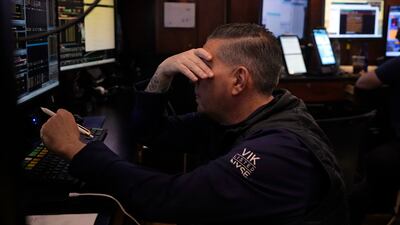
The world's 500 wealthiest people lost a combined $134 billion as fears of another recession in the US led to a stock market sell-off on worries over jobs data and weak manufacturing activity around the world.
Technology players suffered the worst, with Amazon founder Jeff Bezos leading the decline as he shed about $15 billion from his fortune for his third-worst loss, according to both the Bloomberg Billionaires Index and Forbes Real Time Billionaires list, after the world's biggest e-commerce platform retreated 8.8 per cent on Friday.
Oracle boss Larry Ellison lost about $5 billion as his company's shares settled 3 per cent lower, while Alphabet co-founders Sergey Brin and Larry Page's wealth each retreated more than $3 billion, as the Google parent company gave up 2.35 per cent.
Meta Platforms boss Mark Zuckerberg lost around $3 billion as the Facebook owner's stock slid nearly 2 per cent. Dell Technologies founder Michael Dell also lost around $3 billion as his company plunged 5.7 per cent.
Tesla co-founder and X owner Elon Musk, the world's wealthiest person, lost as much as $6.57 billion as shares in the electric vehicle maker declined more than 4.2 per cent.
LVMH chief executive Bernard Arnault, former Microsoft chief executives Bill Gates and Steve Ballmer, and Berkshire Hathaway chairman Warren Buffet, who make up the rest of the world's 10 wealthiest, collectively lost more than $7 billion.
The market selloff started after the US Labour Department reported a softening employment market, with the world's largest economy adding just 114,000 jobs last month, down from 179,000 in June.
That was well below economists' expectations of 185,000. Meanwhile, the unemployment rate unexpectedly rose 4.3 per cent, its highest level since October 2021.
"Global financial markets are in a state of heightened anxiety, with key indices experiencing significant declines and investor sentiment shifting rapidly," said Nigel Green, chief executive of financial advisory firm deVere Group.
The report dragged the tech-heavy Nasdaq Composite down 2.4 per cent, bringing its losses to about 10 per cent since its record close on July 10, confirming it was in correction territory. An index or stock is in a correction when it closes 10 per cent or more below its latest high.
The S&P 500, meanwhile, shed 1.8 per cent for its worst jobs day reaction in nearly two years, and has lost around 6 per cent since its last record close. The Dow Jones Industrial Average fell more than 1.5 per cent.
Adding to their woes are concerns over the health of manufacturing activity across Asia, Europe, the US and, in particular, China, the world's second-largest economy.
A US manufacturing report on Thursday showed activity dropped to an eight-month low, sparking fears the Federal Reserve may be late in cutting interest rates. The US central bank left rates unchanged on Wednesday and hinted that a widely-anticipated rate cut in September is "on the table".
For the week, both the S&P 500 and Dow retreated 2.1 per cent, and the Nasdaq lost 3.4 per cent. Still, they remain in the black year-to-date, having gained 12.1 per cent, 5.4 per cent and 11.8 per cent, respectively.
“The shifts in global markets have prompted investors to reevaluate their strategies in light of the US Federal Reserve’s September rate cut plan," Mr Green said.
“With manufacturing and jobs data signaling potential recessionary trends, there’s growing concern that the Fed may be lagging in its response, potentially cutting rates too late to avert a serious slowdown."
In Europe, London's FTSE 100 declined 1.3 per cent, hit by fears on the US economy. Paris' CAC 40 shed 1.6 per cent and Frankfurt's DAX dropped 2.3 per cent.
Earlier in Asia, Tokyo's Nikkei 225 bore the brunt of the stock market rout, diving 5.8 per cent as the yen strengthened after the Bank of Japan raised interest rates to its highest levels in 15 years on Wednesday.
Hong Kong's Hang Seng Index dropped 2.1 per cent, while the Shanghai Composite lost 0.9 per cent, despite concerns on the Chinese economy.
In commodities, oil prices settled lower and slid to its lowest levels in seven months on economic worries and as demand concerns offset fears of a supply disruption caused by geopolitical tension in the Middle East.
Brent plunged 3.41 per cent to at $76.81 a barrel, while West Texas Intermediate dove 3.66 per cent to $73.52 a barrel.
Gold, meanwhile, slid on profit-taking. The precious metal retreated nearly 0.5 per cent to $2,469.80 per ounce.

UAE currency: the story behind the money in your pockets
Company profile
Company: Eighty6
Date started: October 2021
Founders: Abdul Kader Saadi and Anwar Nusseibeh
Based: Dubai, UAE
Sector: Hospitality
Size: 25 employees
Funding stage: Pre-series A
Investment: $1 million
Investors: Seed funding, angel investors
About Housecall
Date started: July 2020
Founders: Omar and Humaid Alzaabi
Based: Abu Dhabi
Sector: HealthTech
# of staff: 10
Funding to date: Self-funded
COMPANY PROFILE
Name: Lamsa
Founder: Badr Ward
Launched: 2014
Employees: 60
Based: Abu Dhabi
Sector: EdTech
Funding to date: $15 million
UAE central contracts
Full time contracts
Rohan Mustafa, Ahmed Raza, Mohammed Usman, Chirag Suri, Mohammed Boota, Sultan Ahmed, Zahoor Khan, Junaid Siddique, Waheed Ahmed, Zawar Farid
Part time contracts
Aryan Lakra, Ansh Tandon, Karthik Meiyappan, Rahul Bhatia, Alishan Sharafu, CP Rizwaan, Basil Hameed, Matiullah, Fahad Nawaz, Sanchit Sharma
The specs
Engine: 2.0-litre 4-cylinder turbo
Power: 240hp at 5,500rpm
Torque: 390Nm at 3,000rpm
Transmission: eight-speed auto
Price: from Dh122,745
On sale: now
Company%20profile
%3Cp%3E%3Cstrong%3EName%3A%3C%2Fstrong%3E%20WonderTree%3Cbr%3E%3Cstrong%3EStarted%3A%3C%2Fstrong%3E%20April%202016%3Cbr%3E%3Cstrong%3ECo-founders%3A%3C%2Fstrong%3E%20Muhammad%20Waqas%20and%20Muhammad%20Usman%3Cbr%3E%3Cstrong%3EBased%3A%3C%2Fstrong%3E%20Karachi%2C%20Pakistan%2C%20Abu%20Dhabi%2C%20UAE%2C%20and%20Delaware%2C%20US%3Cbr%3E%3Cstrong%3ESector%3A%3C%2Fstrong%3E%20Special%20education%2C%20education%20technology%2C%20assistive%20technology%2C%20augmented%20reality%3Cbr%3EN%3Cstrong%3Eumber%20of%20staff%3A%20%3C%2Fstrong%3E16%3Cbr%3E%3Cstrong%3EInvestment%20stage%3A%20%3C%2Fstrong%3EGrowth%3Cbr%3E%3Cstrong%3EInvestors%3A%3C%2Fstrong%3E%20Grants%20from%20the%20Lego%20Foundation%2C%20UAE's%20Anjal%20Z%2C%20Unicef%2C%20Pakistan's%20Ignite%20National%20Technology%20Fund%3C%2Fp%3E%0A
Who are the Sacklers?
The Sackler family is a transatlantic dynasty that owns Purdue Pharma, which manufactures and markets OxyContin, one of the drugs at the centre of America's opioids crisis. The family is well known for their generous philanthropy towards the world's top cultural institutions, including Guggenheim Museum, the National Portrait Gallery, Tate in Britain, Yale University and the Serpentine Gallery, to name a few. Two branches of the family control Purdue Pharma.
Isaac Sackler and Sophie Greenberg were Jewish immigrants who arrived in New York before the First World War. They had three sons. The first, Arthur, died before OxyContin was invented. The second, Mortimer, who died aged 93 in 2010, was a former chief executive of Purdue Pharma. The third, Raymond, died aged 97 in 2017 and was also a former chief executive of Purdue Pharma.
It was Arthur, a psychiatrist and pharmaceutical marketeer, who started the family business dynasty. He and his brothers bought a small company called Purdue Frederick; among their first products were laxatives and prescription earwax remover.
Arthur's branch of the family has not been involved in Purdue for many years and his daughter, Elizabeth, has spoken out against it, saying the company's role in America's drugs crisis is "morally abhorrent".
The lawsuits that were brought by the attorneys general of New York and Massachussetts named eight Sacklers. This includes Kathe, Mortimer, Richard, Jonathan and Ilene Sackler Lefcourt, who are all the children of either Mortimer or Raymond. Then there's Theresa Sackler, who is Mortimer senior's widow; Beverly, Raymond's widow; and David Sackler, Raymond's grandson.
Members of the Sackler family are rarely seen in public.
The bio
Favourite vegetable: Broccoli
Favourite food: Seafood
Favourite thing to cook: Duck l'orange
Favourite book: Give and Take by Adam Grant, one of his professors at University of Pennsylvania
Favourite place to travel: Home in Kuwait.
Favourite place in the UAE: Al Qudra lakes
Mohammed bin Zayed Majlis
The Orwell Prize for Political Writing
Twelve books were longlisted for The Orwell Prize for Political Writing. The non-fiction works cover various themes from education, gender bias, and the environment to surveillance and political power. Some of the books that made it to the non-fiction longlist include:
- Appeasing Hitler: Chamberlain, Churchill and the Road to War by Tim Bouverie
- Some Kids I Taught and What They Taught Me by Kate Clanchy
- Invisible Women: Exposing Data Bias in a World Designed for Men by Caroline Criado Perez
- Follow Me, Akhi: The Online World of British Muslims by Hussein Kesvani
- Guest House for Young Widows: Among the Women of ISIS by Azadeh Moaveni