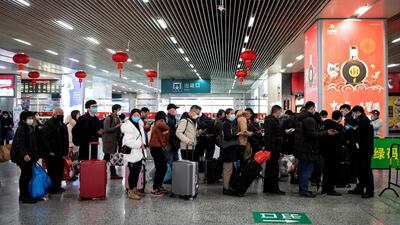
Like other carriers and transportation companies, Emirates is taking measures to offset a slide in demand due to the impact of coronavirus. Bloomberg

Emirates Group offers staff voluntary leave as coronavirus outbreak dents air travel demand


Deena Kamel
  • English
  • Arabic

Emirates Group, which includes the world's biggest airline by international traffic, has offered its staff the option of taking voluntary leave, joining global carriers in taking measures to address the slide in air traffic demand due to the coronavirus outbreak.

The company asked employees at its 100,000-strong group to consider taking paid and unpaid leave, according to an internal memo seen by The National.

"A particular challenge for us right now is dealing with the impact of Covid-19," the March 1 email said. "We've seen a measurable slow-down in business across our brands and a need for flexibility in the way we work."

The virus has spread to more than 60 countries, prompting the World Health Organisation to raise its risk assessment to its highest level.

Global airlines are forecast to lose an estimated $29.3 billion (Dh107.6bn) in revenue this year, 5 per cent lower than forecast in December, due to an estimated 4.7 per cent decline in travel demand, the International Air Transport Association said in an initial assessment of the coronavirus impact.

Emirates Group, which includes airport services unit Dnata, asked employees who have "accrued a significant balance of annual leave" to consider taking paid leave.

It also offered voluntary unpaid leave to employees in non-operational roles. This option may also become available to staff in operational roles.

"In all cases we strongly encourage you to take up this opportunity if you have the support and approval of your line manager," the email said.

Reuters first reported news of the memo earlier on Sunday.

The move comes after Emirates halted all fights to China, except Beijing, and Iran, based on directives from the UAE General Civil Aviation Authority because of the spread of coronavirus in those countries.

Other airlines have also taken measures in response to the drop in air travel demand. Hong Kong's Cathay Pacific said about 25,000 staff in the group agreed to take unpaid leave through a Special Leave Scheme as its "business challenges remain acute".

Hong Kong Airlines axed 400 jobs and asked staff to take two weeks of unpaid leave per month or switch to three-day weeks. China Southern Airlines asked its pilots to take mandatory indefinite no-pay leave. Singapore Airlines has also been forced to cut its flight schedule.

Many airlines and hotel groups have also warned of a hit to their earnings as the outbreak led to fewer bookings and more event cancellations.

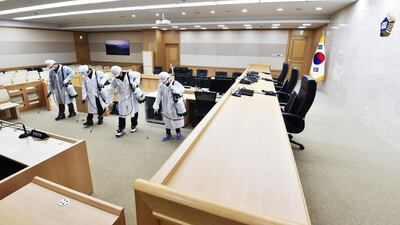
  • Workers wearing protective gear spray disinfectant as part of preventive measures against the spread of the COVID-19 coronavirus, in a courtroom at Suwon High Court in Suwon, South Korea. AFP
    Workers wearing protective gear spray disinfectant as part of preventive measures against the spread of the COVID-19 coronavirus, in a courtroom at Suwon High Court in Suwon, South Korea. AFP
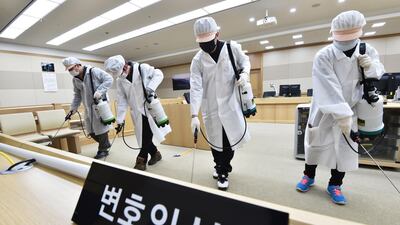
  • Workers wearing protective gear spray disinfectant as part of preventive measures against the spread of the COVID-19 coronavirus, in a courtroom at Suwon High Court in Suwon. AFP
    Workers wearing protective gear spray disinfectant as part of preventive measures against the spread of the COVID-19 coronavirus, in a courtroom at Suwon High Court in Suwon. AFP
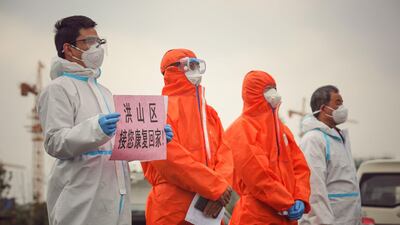
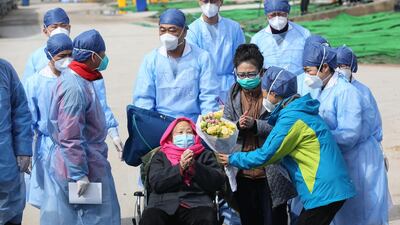
  • Staff members welcome recovered patients (unseen) as they are discharged from Leishenshan Hospital, the makeshift hospital for the COVID-19 coronavirus patients, in Wuhan in China's central Hubei province. AFP
    Staff members welcome recovered patients (unseen) as they are discharged from Leishenshan Hospital, the makeshift hospital for the COVID-19 coronavirus patients, in Wuhan in China's central Hubei province. AFP
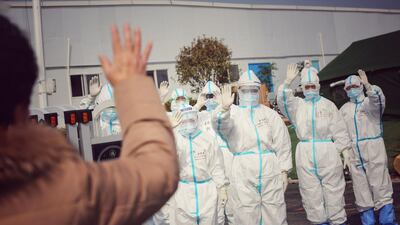
  • Medical staff members wave to a recovered patient (foreground L) at Leishenshan Hospital, the makeshift hospital for the COVID-19 coronavirus patients, in Wuhan in China's central Hubei province. AFP
    Medical staff members wave to a recovered patient (foreground L) at Leishenshan Hospital, the makeshift hospital for the COVID-19 coronavirus patients, in Wuhan in China's central Hubei province. AFP
  • A recovered patient (in wheelchair), 98, is discharged from Leishenshan Hospital, the makeshift hospital for the COVID-19 coronavirus patients, in Wuhan in China's central Hubei province. AFP
    A recovered patient (in wheelchair), 98, is discharged from Leishenshan Hospital, the makeshift hospital for the COVID-19 coronavirus patients, in Wuhan in China's central Hubei province. AFP
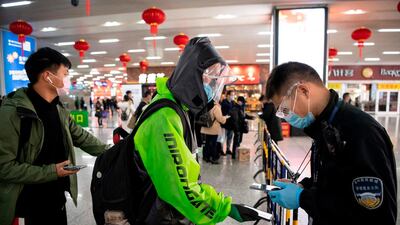
  • A passenger wearing a face mask as he shows a green QR code on his phone to show his health status to security upon arrival at Wenzhou railway station in Wenzhou. The National Health Commission on March 1 reported 573 new infections, bringing the total number of cases in mainland China to 79,824. AFP
    A passenger wearing a face mask as he shows a green QR code on his phone to show his health status to security upon arrival at Wenzhou railway station in Wenzhou. The National Health Commission on March 1 reported 573 new infections, bringing the total number of cases in mainland China to 79,824. AFP
  • A passenger wearing a face mask as he shows a green QR code on his phone to show his health status to security upon arrival at Wenzhou railway station in Wenzhou. The National Health Commission on March 1 reported 573 new infections, bringing the total number of cases in mainland China to 79,824. AFP
    A passenger wearing a face mask as he shows a green QR code on his phone to show his health status to security upon arrival at Wenzhou railway station in Wenzhou. The National Health Commission on March 1 reported 573 new infections, bringing the total number of cases in mainland China to 79,824. AFP
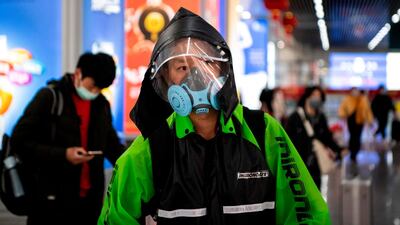
  • A passenger wearing a face mask upon arrival at Wenzhou railway station in Wenzhou. The National Health Commission on March 1 reported 573 new infections, bringing the total number of cases in mainland China to 79,824. AFP
    A passenger wearing a face mask upon arrival at Wenzhou railway station in Wenzhou. The National Health Commission on March 1 reported 573 new infections, bringing the total number of cases in mainland China to 79,824. AFP
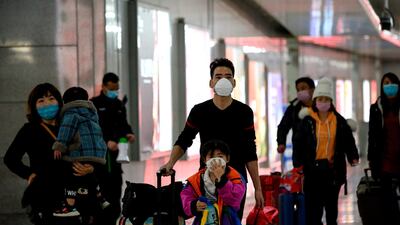
  • Passengers wearing face masks arriving at Wenzhou railway station in Wenzhou. The National Health Commission on March 1 reported 573 new infections, bringing the total number of cases in mainland China to 79,824. AFP
    Passengers wearing face masks arriving at Wenzhou railway station in Wenzhou. The National Health Commission on March 1 reported 573 new infections, bringing the total number of cases in mainland China to 79,824. AFP
  • Passengers wearing face masks queueing to show a green QR code on their phones to show their health status to security upon arrival at Wenzhou railway station in Wenzhou. The National Health Commission on March 1 reported 573 new infections, bringing the total number of cases in mainland China to 79,824. AFP
    Passengers wearing face masks queueing to show a green QR code on their phones to show their health status to security upon arrival at Wenzhou railway station in Wenzhou. The National Health Commission on March 1 reported 573 new infections, bringing the total number of cases in mainland China to 79,824. AFP

Heightened concern about the spread of the coronavirus has prompted companies and governments to cancel global events, such as Germany's ITB Tourism Fair in Berlin scheduled this month, to protect employees -- further denting corporate travel bookings. The world's biggest property fair, Mipim, yesterday postponed its annual gathering in Cannes, which was due to take place next week.

The deadly virus could wipe out $559.7bn annually from spending on corporate travel this year, which is 37 per cent of the industry's total global expenditure forecast, according to US-based Global Business Travel Association (GBTA).

A poll of GBTA's members showed that nearly two-thirds have cancelled at least a “few” meetings or events while 95 per cent suspended or cancelled “most” or “all” business trips to China. A quarter of respondents said their company cancelled or suspended at least some trips to European countries such as Italy, Germany, and France.

The virus is "fundamentally affecting" the way many companies are now doing business, Scott Solombrino, GBTA’s chief operating officer and executive director, said.

"If this turns into a global pandemic, the industry may well lose billions of dollars — an impact that will have negative ramifications for the entire global economy," he said.


The story of Edge

Sheikh Mohamed bin Zayed, Crown Prince of Abu Dhabi and Deputy Supreme Commander of the Armed Forces, established Edge in 2019.

It brought together 25 state-owned and independent companies specialising in weapons systems, cyber protection and electronic warfare.

Edge has an annual revenue of $5 billion and employs more than 12,000 people.

Some of the companies include Nimr, a maker of armoured vehicles, Caracal, which manufactures guns and ammunitions company, Lahab


How Apple's credit card works

The Apple Card looks different from a traditional credit card — there's no number on the front and the users' name is etched in metal. The card expands the company's digital Apple Pay services, marrying the physical card to a virtual one and integrating both with the iPhone. Its attributes include quick sign-up, elimination of most fees, strong security protections and cash back.

What does it cost?

Apple says there are no fees associated with the card. That means no late fee, no annual fee, no international fee and no over-the-limit fees. It also said it aims to have among the lowest interest rates in the industry. Users must have an iPhone to use the card, which comes at a cost. But they will earn cash back on their purchases — 3 per cent on Apple purchases, 2 per cent on those with the virtual card and 1 per cent with the physical card. Apple says it is the only card to provide those rewards in real time, so that cash earned can be used immediately.

What will the interest rate be?

The card doesn't come out until summer but Apple has said that as of March, the variable annual percentage rate on the card could be anywhere from 13.24 per cent to 24.24 per cent based on creditworthiness. That's in line with the rest of the market, according to analysts

What about security? 

The physical card has no numbers so purchases are made with the embedded chip and the digital version lives in your Apple Wallet on your phone, where it's protected by fingerprints or facial recognition. That means that even if someone steals your phone, they won't be able to use the card to buy things.

Is it easy to use?

Apple says users will be able to sign up for the card in the Wallet app on their iPhone and begin using it almost immediately. It also tracks spending on the phone in a more user-friendly format, eliminating some of the gibberish that fills a traditional credit card statement. Plus it includes some budgeting tools, such as tracking spending and providing estimates of how much interest could be charged on a purchase to help people make an informed decision. 

* Associated Press 

Small Victories: The True Story of Faith No More by Adrian Harte
Jawbone Press

French business

France has organised a delegation of leading businesses to travel to Syria. The group was led by French shipping giant CMA CGM, which struck a 30-year contract in May with the Syrian government to develop and run Latakia port. Also present were water and waste management company Suez, defence multinational Thales, and Ellipse Group, which is currently looking into rehabilitating Syrian hospitals.