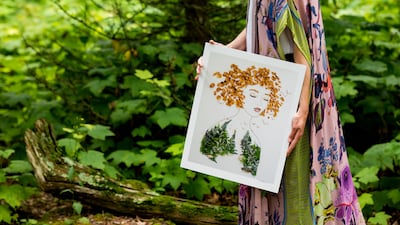
A leaf that doubles as a dog’s ear, stems that make for insect legs and a twig that becomes a baby. Garden artists are using nature’s bounty to unleash their creativity.
Foraging for materials including petals, seeds and acorns, nature lovers – many of whom are gardening enthusiasts – from all over the globe create both portraits and abstract art. These are then photographed for posterity, while the original work is recycled or left for the wind to carry away. The overarching aim of so-called Earth art is to create something of ephemeral beauty, even if it’s transient.
“Nature is an infinite well of inspiration, so naturally I gravitate towards it,” says Canadian artist and photographer Raku Inoue, who makes colourful portraits using flowers, twigs, leaves, seeds and stems placed on white paper, which he then photographs.
His creations also include orangutans, llamas, colourful birds, fish and butterflies, and even dinosaurs. He uses freshly cut flowers to create portraits of insects, from delicate beetles to vibrant ladybirds, using stems to artfully form legs.
Given the nature of his work, Inoue’s palette shifts with the seasons as leaves and petals change colour. He also digitally manipulates the arrangements using different angles to make a montage.
Fellow garden artist Subhashini Chandramani, who lives in Bengaluru, India, uses discarded petals, leaves and seeds to make portraits of anything from the Hindu deity Krishna, complete with a flute, to Audrey Hepburn, flamenco dancers and birds, using poinsettia leaves. For Earth Day in April, Chandramani created a stunning world map using the petals of different flowers on a black backdrop.
“The materials I use originate primarily from my own garden. Even when I am out in parks, I am always on the lookout for unique leaves, flowers, seeds and even vegetables that can inspire my next piece of art,” says Chandramani. “The process of creating each piece is a dance with time and nature, and a little like assembling a puzzle. For example, I've transformed the leaf of Leea rubra into a Native American’s eyes, and a crepe jasmine leaf into a sky filled with birds.”
In Chicago, artist Vicki Rawlins and her daughter Brooke spend much of their time outdoors foraging for materials that Rawlins then uses in her whimsical art.

“I work with foliage that I forage from walks in my yard and neighbourhood and build detailed scenes and portraits with no glue or tape, just 100 per cent Mother Nature,” says Rawlins. “Sometimes I’ll buy flowers from a local shop if I can't find what I need in my own backyard.
"My pieces aren’t permanent. After I take photos of what I create, I put the foliage back outside in the compost pile for a new life,” adds Rawlins, whose Instagram feed is filled with landscapes and portraits, including one of Frida Kahlo with a head full of flowers.
“If I like what I’ve done I’ll turn the photos into fine art prints and greeting cards,” she says.
British painter and photographer Hannah Bullen-Ryner is garden artist who assembles works not on paper, but rather on woodland floors. She describes herself as “a land artist and woodland pixie in love with the natural world”, and makes portraits of hummingbirds and owls using wildflowers, berries, leaves, seeds, twigs and petals.
She arranges various elements, such as leaves to form the feathers of a bird, such that they resemble artistic brush strokes before she leaves them to be reclaimed by nature.
Ryner also creates images of white tigers and chimpanzees drawn using chalk and water, then filled with foraged materials. She sells prints of her creations on Etsy.
Bridget Beth Collins, from Seattle, has been creating floral art for 15 years. “It started when I was walking through my garden one day and saw a ‘goldfish’ in my orange poppies. I brought the poppy inside and painted a body on a piece of paper, then used the petals as fins. Since that day I have made different animals, landscapes and books with flowers,” says Collins.

Her love of nature has been fostered by backpacking trips and time spent in mountain meadows in the state of Washington. Her Instagram feed is filled with eclectic images of everything from gnomes and turtles to bicycles and even the Eiffel Tower made out of petals, leaves and seeds.
“I forage for wildflowers from meadows and parks, and also grow my own flowers or buy bouquets at the market to create my botanical art. Many of my friends give me flowers from their gardens knowing I will create with them,” says Collins, who sells prints of her work at Floraforager.com.
In Singapore, fashion illustrator Grace Ciao uses petals and leaves to create “bloom belles”.
These are illustrations of women in stylish dresses, with full skirts and glamorous gowns made with the petals of daisies, gerberas and roses. Sometimes Ciao will use a whole flower to form a garment.
Unlike many other garden artists, Ciao draws and paints an entire picture before adding petals or leaves as embellishments.
Also differing from the norm is London artist Chris Kenny, whose nature portraits use just one material: twigs.

Kenny makes everything from detailed dancing figures and babies to abstract portraits by joining together the twigs he forages.
“Twigs provide naturally rhythmic, characterful and unpredictable lines,” says Kenny. “They reveal connections between plant limbs and human limbs with an exuberance inherent to life.”